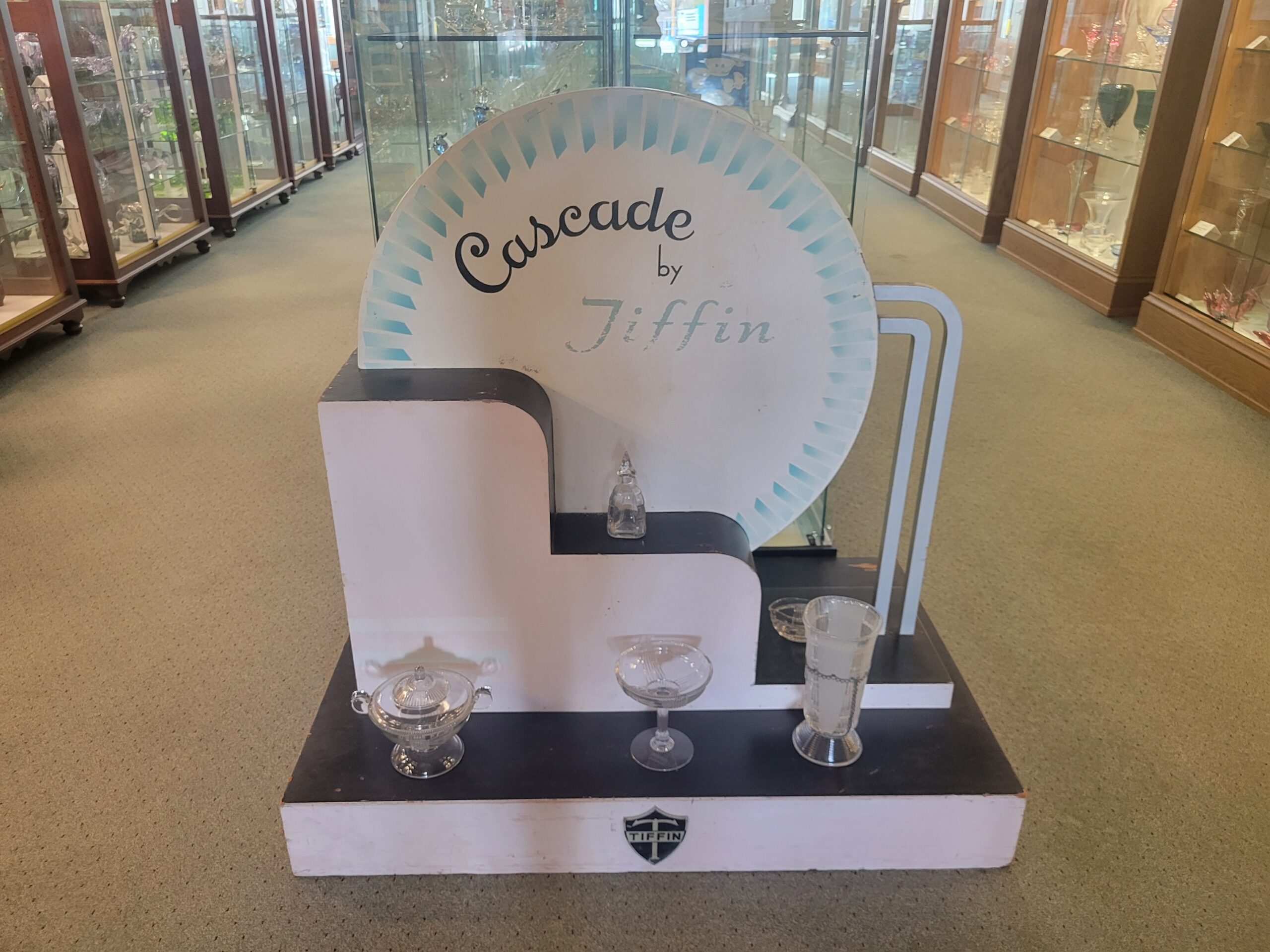
[Image above] A display of Tiffin Glass Cascade pieces, which featured a distinctive ribbed “rib and swag” design. Photo taken by Laurel Sheppard at the Tiffin Glass Museum.
This month’s stops on the Ohio Creativity Trail take us to Tiffin(opens in new tab), a city about 90 miles northwest of Columbus and 55 miles southeast of Toledo. Located in Seneca County, Tiffin is named after Edward Tiffin(opens in new tab), Ohio’s first governor, and is home to two private universities, Heidelberg University(opens in new tab) and Tiffin University(opens in new tab).

Historical marker describing the founding of Tiffin. Credit: Laurel Sheppard
The discovery of natural gas in 1888(opens in new tab) attracted a variety of industries to Tiffin in the late 19th and early 20th centuries to take advantage of the fuel. For example, Indiana-based Great Western Pottery(opens in new tab) decided to expand operations into Tiffin by purchasing the local Brewer Pottery Company in 1899.
Great Western Pottery was later acquired by the Standard Sanitary Manufacturing Company of Pittsburgh in the 1910s. In 1929, Standard Sanitary merged with(opens in new tab) the American Radiator Company to create the American Radiator and Standard Sanitary Corporation—later shortened to the well-known American Standard(opens in new tab) in 1967. (Learn more about the company’s history in this video(opens in new tab).)
American Standard was for decades one of the largest employers in the city, peaking at more than 650 hourly workers(opens in new tab) in the early 2000s. Unfortunately, high manufacturing costs led American Standard to close its Tiffin plant(opens in new tab) in 2007, and now the city only hosts small, independent local potteries, such as this one(opens in new tab). (This perspective piece(opens in new tab) by interdisciplinary artist Kaitlyn Jo Smith offers a look into the lives affected by the decline of large-scale manufacturing in the U.S.)
Like the pottery industry, large-scale glass manufacturing in Tiffin also declined because of changing economic conditions and shifting consumer preferences. However, the legacy of Tiffin’s glass operations lives on through two organizations on the Ohio Creativity Trail, which I visited in April 2026.
Tiffin Glass: Many changes in ownership
Large-scale glass operations in Tiffin kicked off when(opens in new tab) A. J. Beatty & Sons agreed to relocate from Steubenville, Ohio, in 1888 after the city of Tiffin offered several incentives. However, the newly constructed glass plant did not use Tiffin in its name until 1963, when four former employees bought it, renaming it the Tiffin Art Glass Company. This transaction ended the United States Glass Company’s involvement, which had merged with A. J. Beatty & Sons back in 1892 and had moved its headquarters from Pittsburgh to Tiffin in 1938.
The Tiffin plant, designated as Factory R by the United States Glass Company but known colloquially as the Glass House, ran into some bad luck over the years. It was destroyed by fire in 1895 and rebuilt. Despite the factory surviving the Great Depression of the 1930s (unlike other United States Glass Company plants that had to close), financial difficulties arose in 1958, resulting in the sale of the assets to an investment firm and shortly thereafter to a plastics company, both based in New York.
The company finally took on its famous name, Tiffin Glass Company, after being sold to the Continental Can Company in 1966. This name remained even after another major corporation, Interpace, bought it two years later.
Interpace remained Tiffin Glass’s parent company until 1979. That year, the factory was sold to Towle Silversmiths, who operated the company under the name Tiffin Crystal. However, the furnaces were shut down about a year later. Towle later donated the factory and land to the city, which demolished part of the factory in 1986 after not being able to find a tenant.
As ownership and markets changed, so did Tiffin Glass products(opens in new tab). In the late 1880s, early production capacity was 500,000 pressed tumblers per week. During the early 1900s, production shifted from pressed to blown tableware in response to customer demand.
Roughly four decades later, the consumer preferences changed once again: crystal stemware returned to popularity in place of colored stemware, and fine china replaced glass for table settings. During this time, a new stemware line based on modern, free-form design was introduced: the Swedish Modern, which was later renamed Tiffin Modern. This line remained popular throughout the 1960s. Stemware remained the major focus, with blown and pressed ware also manufactured.
Over the years, Tiffin Glass provided stemware and tableware to several major retailers, including Sears and Roebuck, Montgomery-Ward, Tiffany’s, and Macy’s. During Interpace’s reign, several new colors were introduced to coordinate with the company’s Shenango China.
Although the Tiffin Glass Company no longer exists, the Tiffin Glass Collectors Club(opens in new tab) established the Tiffin Glass Museum(opens in new tab) in 1998 to honor the heritage of the Glass House and its products. Located in a historic downtown Tiffin building, the museum is divided into two rooms: a large gallery space showcasing more than 3,000 pieces of Tiffin’s glassware throughout its history, and a smaller room where you can purchase your own Tiffin Glass piece to take home. (I couldn’t resist and found the perfect pair of candleholders, much to the chagrin of my husband who was tagging along.)
The Tiffin Glass Collectors Club also hosts an annual two-day show(opens in new tab) where glass dealers from across the United States offer a variety of vintage glassware made by Tiffin Glass and other companies for collectors. At the time of this writing, dates for the 2027 show were not available, although it typically takes place in mid-June.
See some of the museum’s collection in the following video. Additional glassware can be seen on the museum’s online gallery(opens in new tab), and the museum also keeps a list of catalogs(opens in new tab) available for research at the museum.

Credit: The American Ceramic Society(opens in new tab), YouTube
Hawkes Crystal: A ‘brilliant’ legacy
A few blocks down the street from the Tiffin Glass Museum is Hawkes Crystal(opens in new tab), which is continuing the tradition of the T.G. Hawkes & Co.(opens in new tab) but with a modern twist.
Based in Corning, N.Y., T.G. Hawkes & Co. was established in 1880 by Irish immigrant Thomas Gibbons Hawkes(opens in new tab), who had previously worked for the Hoare and Dailey Cut Glass Firm(opens in new tab), also in Corning. The year Hawkes officially incorporated the company in his name (1889), he was recognized for his glass designs at the Exposition Universelle(opens in new tab) in Paris, winning the Grand Prize.
T.G. Hawkes & Co. specialized in cutting fine brilliant cut glass and tableware, which was used in the White House from 1885 until 1938(opens in new tab). The company also had a close connection to Tiffin Glass: in the 1930s, the Tiffin Glass Factory (known for its exceptional quality lead crystal) was chosen to produce all blanks for Hawkes stemware and other designs.
The T.G. Hawkes trademark is now owned by Hawkes Crystal, which is led by master brilliant cutter and designer Aidan J. Scully(opens in new tab), also originally from Ireland. Scully is one of only a handful of master brilliant cutters currently creating in the United States, and he was apprenticed under Edward Flavin, one of the first five apprentices of famed Waterford Crystal.
Scully’s work has been featured in the collections of the Smithsonian Institution and Toledo Museum of Art. Commissions have included pieces for Presidents Bill Clinton and Ronald Reagan, First Lady Barbara Bush, Senator John Glenn, and Pope John Paul.
When my husband and I visited Hawkes Crystal, we first perused the wonderful pieces displayed in the shop (this time I restrained myself from making a purchase). We then had the opportunity to talk to Scully himself, and I learned that a cut piece could take anywhere from a few hours to weeks to create, depending on the size and complexity of the piece. You must have extreme patience for the type of work he does, which I’ll never have. As Scully said in a previous interview(opens in new tab), “You have to love it, or there’s no point in it.”
See some of Hawkes Crystal’s pieces in the following video.

Credit: The American Ceramic Society(opens in new tab), YouTube
Further information
Watch videos of Hawkes Crystal’s cutting process at this link(opens in new tab).
Learn more about the T.G. Hawkes company at this link(opens in new tab).
View the Rakow Library’s digitized collection of trade catalogs from T.G. Hawkes & Co. at this link(opens in new tab).
Learn more about American cut glass at this link(opens in new tab).
Check out a book about the American cut glass industry and T.G. Hawkes at this link(opens in new tab).