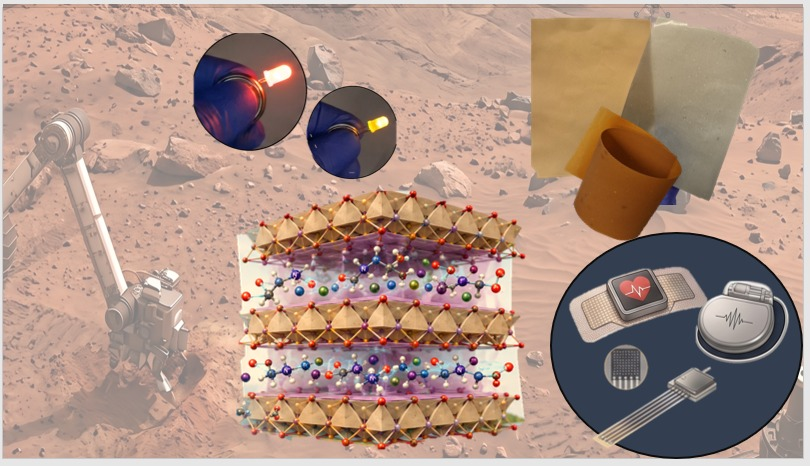
[Image above] By introducing a pillared architecture (center diagram), abundant phyllosilicate clays can be turned into biocompatible supercapacitors, which could help power the next generation of medical devices (bottom right inset images). Flexible membranes created from the clays (upper right) were used to power commercial red and yellow LEDs (center top inset images). Credit: Created by Md Roxy Islam; courtesy of Kausik Mukhopadhyay
For millions of people around the world, the steady beat of their heart is measured not by natural rhythms but by a small electronic device called a pacemaker.
Pacemakers, along with deep brain and spinal cord stimulators, are implanted electronic devices that deliver mild electrical pulses to targeted tissues or nerves within the body to regulate their activity. Functions can include managing cardiac rhythms, as with pacemakers, or blocking pain signals, as in the case of spinal cord stimulators.
Currently, nearly all commercial implanted stimulator devices rely on batteries and capacitors to generate the mild electrical shocks. The battery provides the device with a steady and predictable source of electrical energy, while the capacitors collect energy from the battery and release it in fast, sharp bursts.
Although these devices are reliable, using batteries to power the system comes with some drawbacks. One, batteries do not last forever, and replacing them requires minor surgery (non-rechargeable batteries last less than 10 years on average while rechargeable batteries can potentially last up to 15 years). Two, the batteries used in these devices are not biocompatible, and so they could cause adverse chemical reactions if the battery casing is breached.
Supercapacitors are another possibility for powering implanted stimulator devices that are being heavily investigated. This technology essentially combines the structure of both capacitors and batteries.
- Capacitors: Store low amounts of energy physically by trapping charges in an electric field between two conductive plates. The space between the plates is filled with a solid insulating material (dielectric), which supports the electric field.
- Batteries: Store large amounts of energy chemically by trapping charges in a liquid or solid ion-conducting material (electrolyte) between two conductive plates.
Like standard capacitors, supercapacitors store energy physically rather than chemically. However, the space between the conductive plates is filled with an electrolyte (like a battery) rather than a dielectric material. The electrolyte allows an electric double layer to form at each plate’s surface, greatly increasing the amount of energy that can be stored in the electric field.
Supercapacitors still require an external source of electrical energy to function. But this energy can be sourced from biomedical energy harvesters,* which convert ambient energy sources (such as mechanical energy from muscle movements or thermal energy from body heat) into electrical energy. When paired, supercapacitors and energy harvesters could potentially power implanted stimulator devices indefinitely without needing to be replaced, in contrast to current battery-based systems.
*Energy harvesters typically cannot be paired with standard capacitors because of the latter’s low storage capacity and internal current leakage(opens in new tab). These factors together mean the power harvested from bodily functions will drain away before it can accumulate to a usable level.
Although pairing supercapacitors with energy harvesters sounds ideal, current supercapacitors cannot realize this potential due to several outstanding design challenges. For example, many current supercapacitors are not biocompatible, so they face the same toxicity challenges as standard batteries. Additionally, current supercapacitors tend to lose stored energy rapidly, making them unreliable for steady device operation.
In a recent paper(opens in new tab), researchers at the University of Central Florida developed a novel supercapacitor based on phyllosilicates that could help address these outstanding design challenges.
As explained in the paper, phyllosilicates are layered, biocompatible clays known for possessing high surface charge density, ion-exchange capability, and tunable interlayer spacing. These characteristics have enabled their use in catalysis(opens in new tab) and adsorption(opens in new tab) applications, but their intrinsic brittleness and electrical insulation “have largely confined their role in electrochemical systems to that of passive additives rather than active functional materials,” the researchers write.
Brittleness is not an insurmountable characteristic(opens in new tab) of ceramics, however. There are ways to engineer ceramics with greater flexibility, and the UCF researchers drew inspiration from previous studies on pillared layered transition-metal oxides (here(opens in new tab) and here(opens in new tab)) to create a pillared layered version of the phyllosilicate clay bentonite.
Pillared layered materials are porous solids made from stacked 2D sheets propped apart by rigid chemical “pillars.” The researchers chose this design architecture to improve the mechanical properties of bentonite because it is known to enhance ion-transport pathways, thereby improving capacitor cycling stability.
The researchers used a two-step molecular functionalization strategy to create the pillared bentonite. First, they replaced the interlayer sodium ions in bentonite clay with redox-active transition-metal ions (Fe3+ or Mn2+) to introduce pseudocapacitive behavior. Second, they introduced a small, neutral molecule called zwitterionic betaine into the interlayer space of bentonite to “stitch” the clay particulates together.
The researchers ran reactive force field molecular dynamics simulations to better understand how the zwitterionic betaine molecules affected the bentonite’s structure. They used this information to optimize the amount of betaine introduced into the structure, and then they created pillared bentonite membranes for electrochemical testing.
Testing revealed that, compared with pure (unaltered) bentonite membranes, the modified membranes retained stored charge longer due to significantly reduced current leakage and unwanted chemical reactions. Furthermore, a coin-cell supercapacitor that used the same clay precursors for its architecture delivered an energy density of 158 mWh/cm3 and a power density of 5,688 mW/cm3. These properties allowed the supercapacitor to power commercial red and yellow LEDs with about 75% capacitance retention after 30,000 cycles.
The researchers also investigated the modified bentonite’s biocompatibility by observing its effect on a cell culture consisting of mouse embryonic fibroblasts. The results were favorable, with fibroblast viability remaining above 75% across all samples (this value exceeds the ISO 10993–5:2009(opens in new tab) viability threshold).
“The results highlight the practical viability of an entirely clay-based system for energy applications,” the researchers write. They also note that the clay membranes can be easily recycled and reprocessed in aqueous media without hazardous or toxic solvents, “highlighting their practical relevance and long-term sustainability.”
In an email, corresponding author and UCF Assistant Professor Kausik Mukhopadhyay(opens in new tab) says that the team is now working to determine exactly how lithium ions move through the pillared bentonite structure. Specifically, they are investigating whether lithium ions coordinate preferentially with the carboxylate group in betaine, the clay silanol and structural OH sites, or framework oxygens in the interlayer space.
“One pertinent question we would like to address is whether the measured ionic conductivity is truly Li⁺-dominated or arises from a mixed Li⁺/Na⁺ signal due to the mixed-alkali effect,” Mukhopadhyay says.
If this ion-transport picture can be resolved, it will allow the bentonite membrane to be optimized for the sodium/potassium-rich ionic environment within the body, thus “paving the way toward fully clay-based, biocompatible supercapacitors,” Mukhopadhyay says.
The paper, published in Angewandte Chemie International Edition, is “Flexible, biocompatible supercapacitors weaved from layered phyllosilicates and zwitterions via ionicity(opens in new tab)” (DOI: 10.1002/anie.3295676).