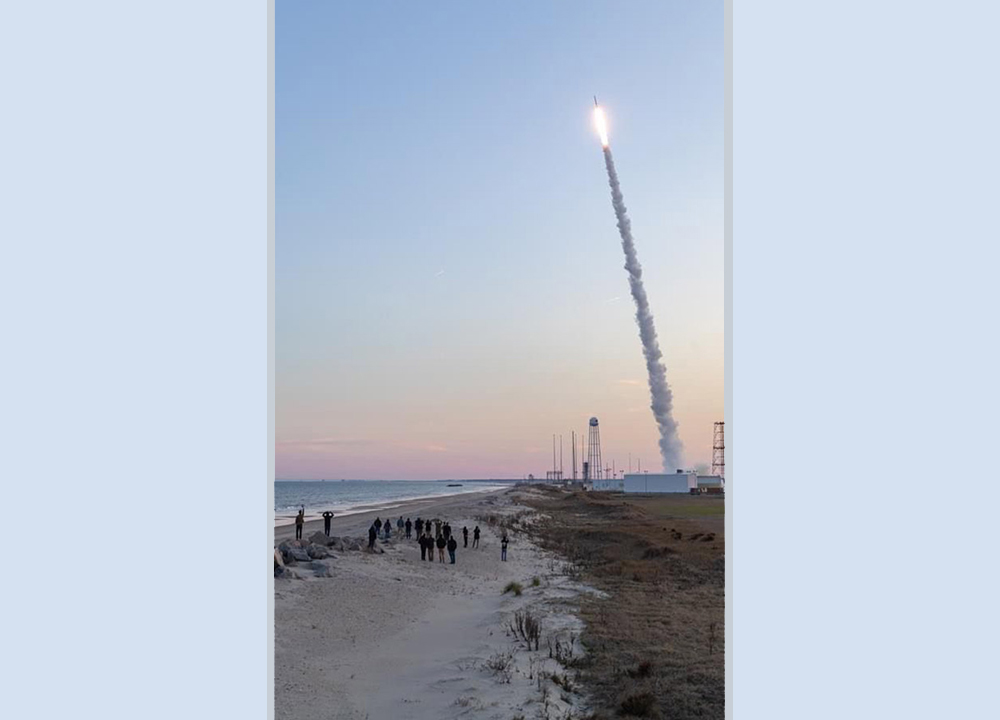
[Image above] Outfitted with more than 400 sensors, the BOLT-2 flight experiment launched from the NASA Wallops Flight Facility on March 22, 2022. Credit: Bryan Morreale, Texas A&M University
Speed is the name of the game when it comes to modern aerospace priorities. Governments around the world are investing billions of dollars to develop systems capable of traveling at hypersonic speeds, or more than five times the speed of sound. While such ambitions have been a nebulous dream for decades, recent advancements in new and evolving material classes, such as ultrahigh-temperature ceramics, bring that dream closer to reality.
When discussing hypersonic developments, the materials used to create these systems are often the focus. A quick look at the technical program for the 12th International Conference on High Temperature Ceramic Matrix Composites, which is taking place this week in San Diego, Calif., shows a symposia lineup centered on fiber-reinforced composites, advanced barrier coatings, and other materials for extreme environments.
However, to design materials that can withstand hypersonic flight, researchers must have an accurate understanding of the forces that the aerospace structure will need to withstand. Yet for decades, “There was a real gap between the data produced in controlled settings and what actually happens during flights and in the sky,” says Ivett Leyva in a press release.
Leyva is the Texas A&M Fort-Worth associate dean for research and Arthur McFarland professor of aerospace engineering at Texas A&M University. During her tenure as a program officer at the Air Force Office of Scientific Research, she helped shape and oversee the nearly decade-long Boundary Layer Transition and Turbulence (BOLT) Program, which involved launching rockets into the atmosphere to investigate these two physics phenomena.
Three flight experiments took place under the BOLT Program, with the first (2021) and third (2024) flight experiments led by Johns Hopkins University Applied Physics Laboratory and the second (2022) by Texas A&M University. Partners from numerous other institutions helped support these experiments, including NASA Langley, Johnson and Wallops, the University of Minnesota, Purdue University, CUBRC, VirtusAero, German Aerospace Center, Australian Defense Science and Technology Group, the University of Queensland, the Air Force Research Laboratory’s Propulsion Directorate, and the University of Arizona.
In January 2026, Leyva and her colleagues presented a paper at the American Institute of Aeronautics and Astronautics SciTech Forum 2026 highlighting the lessons learned from the three BOLT flight experiments. Below are some key details from the paper.
New vessel geometry for the flight experiments
The vessels used for the flight experiments featured a new geometry with low-curvature concave surfaces and highly swept leading edges. This design was meant to be significantly more complex than standard conical designs “as the flow induced by the geometry was intended to stress existing computational tools as well as the research community’s knowledge of transition physics,” the authors write. Additionally, “Symmetry in the geometry was also intentional with two identical concave surfaces that would enable separate studies of boundary layer transition on smooth and roughened/stepped surfaces.”
Aims of each flight experiment
The main objectives of the BOLT Program were to investigate flow features, boundary layer transition mechanisms, and turbulence on the new vessel geometry. To accomplish these objectives, the first flight experiment focused primarily on boundary layer transition physics. The second flight experiment used a lengthened variant of the first vessel’s geometry to enable measurements of turbulent flow. The third flight experiment obtained even more boundary layer transition and turbulent flow measurements using additional instrumentation installed on the vessel.
Discovery of streamwise vortex structures that dominate the flow field
The authors state that one of the most surprising initial outcomes of the experiments was the discovery of a flow field dominated by streamwise vortex structures. These structures were primarily seen in two regions:
- A center rollup region, where flow structures roll up into vortices due to the spanwise pressure gradient driving the flow together in that region.
- Within an outboard region where smaller and more numerous streamwise vortex structures are seen in test and simulations.
“Knowledge of these streak structures informed significant decisions on flight instrumentation for the BOLT flights,” the authors write.
Advancement of several new numerical techniques
Researchers at the University of Minnesota used the BOLT vessel’s unique geometry to test and advance several new numerical techniques for simulating hypersonic flight. Among these advancements were new methods for controlling numerical dissipation to reduce solution noise and increase accuracy.
The authors write, “The numerical simulations identified the domination of the BOLT flow field by streamwise vortex structures, predicted by high-fidelity CFD [computational fluid dynamics] with quiet DNS [direct numerical simulation], measured under quiet flow conditions on subscale wind-tunnel models, and confirmed by data from both the BOLT-2 [second] and BOLT-1B [third] flight.”
Progress on manufacturing and inspecting joint steps
Joint steps are minor surface height discontinuities in the aircraft found between panels, heat shields, and other components. These discontinuities can significantly alter the boundary layer and thereby introduce critical aerodynamic and structural challenges.
The BOLT Program made considerable progress on developing methods to manufacture and inspect joint steps in aerospace structures. In particular, “The program advanced the regular use and analysis of Struers Repliset-T3 mold material to quantify joint steps on subscale wind tunnel models as well as the flight articles,” the authors write.
Demonstrated flight suitability for some novel instrumentation
While the BOLT flight experiments primarily relied on previously demonstrated flight article instrumentation, they also demonstrated flight suitability for some novel instrumentation. For example, “the BOLT flights were the first U.S. efforts to use PCB Piezotronics 132B pressure sensors to acquire high-frequency surface measurements of pressure,” the authors write.
Student involvement in BOLT
From the beginning, one goal of the BOLT Program was to offer students an opportunity to gain hands-on experience in the development of hypersonic flight experiments. This goal was accomplished in several ways.
- Many students helped lead the preflight ground tests for the flight experiments.
- Several students did a summer internship at Johns Hopkins University Applied Physics Laboratory to assist in the design work for the first flight.
- Students primarily developed the aerodynamic database for the second flight experiment.
“The BOLT Program ultimately produced numerous new graduates with significant hands-on experience, graduates who are now productive professionals in the field of hypersonics,” the authors write.
The authors state that further analysis of the boundary layer transition and turbulent flow data gathered during the flight experiments is underway. They also express hope to conduct experiments aimed at gathering other types of hypersonic flight data, such as effects of weather and ablation-related effects.
Ultimately, “Much remains to be explored with these kinds of carefully designed scientific flight experiments to expose physics in flight that are not fully understood,” the authors conclude.
The paper, published in the proceedings of the AIAA SciTech Forum 2026, is “The BOLT experiments: Outcomes from a decade of fundamental science in hypersonic flight” (DOI: 10.2514/6.2026-0957).