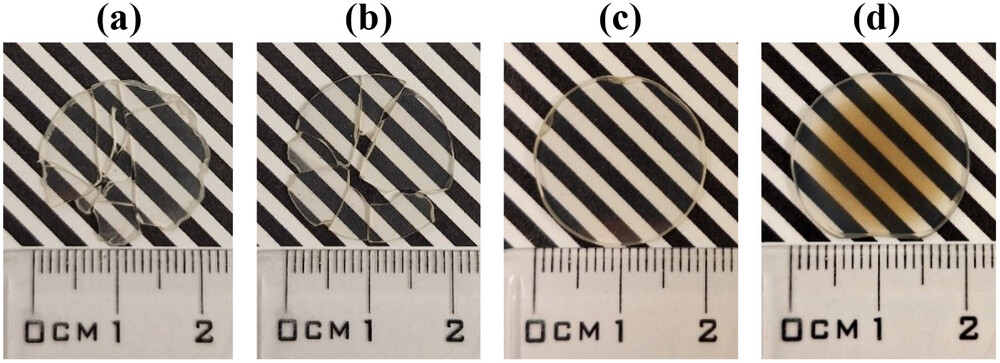
[Image above] Photographs of transparent LiAl5O8 ceramics sintered at 1,400°C for 30 min using different cooling regimes: a) LA-SPS4, b) LA-SPS5, c) LA-SPS6, and d) LA-SPS7. The average thicknesses of these samples are 1.034, 1.053, 1.032, and 0.974 mm, respectively. Credit: Thoř et al., Journal of the American Ceramic Society (CC BY 4.0)
Opacity is traditionally a hallmark characteristic of ceramics, as their polycrystalline structure prevents light from passing cleanly through. But starting in the mid-20th century, scientists discovered that when ceramics are specially processed to reduce pores and secondary phases, it is possible for ceramics to achieve high levels of light transmission—even achieving optical-grade levels of performance.
The combination of optical clarity, durability, and heat resistance offered by transparent ceramics makes them a desirable material for various optical, energy, and defense applications. As such, the market is expected to experience rapid growth in the coming years and reach a value of nearly $2 billion by the end of 2030.
This market demand is driving research on various synthesis methods and material systems to achieve consistent fabrication of high-performing transparent ceramics. In the recently published May 2026 issue of Journal of the American Ceramic Society, four studies provide a close look at the fabrication and application of several different transparent ceramic systems.
Crack-free transparent LiAl5O8 achieved through optimized sintering process
Within the Li2O–Al2O3 system, three distinct phases can be distinguished: the lithium-rich Li5AlO4, the intermediate LiAlO2, and the aluminum-rich LiAl5O8. Among these phases, only the last one (LiAl5O8) is known to form an optically isotropic cubic structure.
In 1972, G.E. Gazza from the Army Materials and Mechanics Research Center (Watertown, Mass.) presented a study on preparing transparent LiAl5O8 ceramics through hot pressing at ACerS 73rd Annual Meeting. Unfortunately, “his promising results regarding the transparency and mechanical properties of the ceramics did not spark further interest, and no follow-up research on the topic of LiAl5O8 transparent ceramics has since been published,” the researchers of a new open-access paper write.
The researchers come from the University of Chemistry and Technology in Prague as well as the Institute of Plasma Physics and the Institute of Physics of the Czech Academy of Sciences. Last year, they published a paper investigating the effects of powder preparation method, powder heat treatment, and sintering temperature on transparent LiAl5O8 ceramics. The ceramics achieved transmittance of up to 75.4% at 500 nm, but they were prone to cracking. So, the new study “is a further optimization of the [spark plasma] sintering process to achieve crack-free and highly transparent LiAl5O8 ceramics,” the researchers write.
The researchers focused on optimizing two parts of the sintering process: dwell time at the sintering temperature and the cooling rate to room temperature.
- Dwell time: The highest transmittance was achieved using a dwell time of 30 min at the sintering temperature.
- Cooling rates: Cooling was a two-step process, involving slow cooling from the sintering temperature to 1,100°C followed by rapid cooling to room temperature.
Using this optimized process, the researchers achieved crack-free LiAl5O8 ceramics with high transmittance exceeding 80% at 500 nm.
The open-access paper, published in Journal of the American Ceramic Society, is “Highly transparent LiAl5O8 ceramics prepared by spark plasma sintering and its luminescence” (DOI: 10.1111/jace.70781).
High-density green bodies allow lower temperature sintering of transparent alumina
Alumina ceramics with submicron grain sizes are considered an important class of transparent ceramics due to their excellent mechanical properties and favorable thermal conductivity. However, the strong covalent bonding in alumina inhibits its densification, meaning that it requires higher sintering temperatures compared to other transparent ceramics, such as magnesium oxide and zinc oxide.
The higher sintering temperatures are often accompanied by significant grain growth, which negatively affects the alumina’s mechanical and optical properties. Researchers have explored various strategies to constrain grain growth, such as the addition of sintering aids and the use of novel sintering methods. However, “most of these prior studies have ignored the intrinsic characteristics of the green body itself … specifically, achieving agglomerate-free, small pore size, narrow pore size distribution, and high green density,” the researchers of a new paper write.
The researchers come from the University of Shanghai for Science and Technology and the State Key Laboratory of High-Performance Ceramics of the Chinese Academy of Sciences. In their paper, they investigated the density, pore size distribution, and sintering activity of alumina green bodies formed by either pressure filtration or spontaneous coagulation casting, using 180 nm particles as the starting materials.
They determined that high density green bodies could be formed using either method, which is useful because “Compared to low-density green bodies … grain growth begins at a relatively higher sintering density,” they explain. The density was slightly higher in the alumina ceramics created through pressure filtration (65%) versus spontaneous coagulation casting (58%), which allowed the former to be sintered to full density at just 1,210°C in contrast to 1,250°C for the latter.
Final properties of the alumina created through pressure filtration included an average grain size of 0.46 µm, in-line transmittance of 55.4%, and flexural strength of 829 MPa. In contrast, the alumina created through spontaneous coagulation casting had an average grain size of 0.54 µm, in-line transmittance of 51.6%, and flexural strength of 696 MPa.
Based on these results, the researchers conclude that “optimizing forming techniques to enhance green body with high density and narrow pore size distribution is an effective strategy for fabricating high-performance transparent alumina ceramics and other ceramics at lower temperatures.”
The paper, published in Journal of the American Ceramic Society, is “Delayed coarsening of submicron-grained transparent alumina ceramic” (DOI: 10.1111/jace.70777).
Investigating the potential of MgF2–MgO nanocomposites for infrared applications
Infrared-transparent windows play a key role in the safety and maintenance of electrically charged and high-temperature systems, as they provide technicians a way to externally monitor the internal components. They are also useful as protective coverings for sensitive infrared guidance and tracking sensors on missiles and aircraft.
In recent years, the development of next-generation energy and aerospace systems has required the concurrent development of new infrared-transparent windows that can withstand the more extreme operational environments. Nanocomposite ceramics have emerged as a promising material platform for these new windows, but many of the conventional infrared-transparent ceramics do not appropriately balance the mechanical, transmittance, and dielectric properties required for these advanced systems.
In a new paper, researchers from the Infrared Optical Materials Research Center of the Chinese Academy of Sciences explored the fabrication and properties of MgF2–MgO nanocomposite ceramics. They synthesized the ceramics (volume ratio of 5:5) through a solvent-controlled surface fluorination approach followed by densification through hot-pressing sintering.
The final MgF2–MgO ceramics exhibited a maximum optical transmittance of 59.6% in the 3–6 µm range and a Vickers hardness of 9.57 GPa. Compared to pure oxide and fluoride ceramics, the MgF2–MgO nanocomposites maintained a relatively low dielectric constant while retaining satisfactory mechanical properties. However, “the large refractive index contrast [between MgO and MgF2] induces severe scattering losses, significantly limiting its practical application in infrared window systems,” the researchers write.
Modifications to the sintering process may help address this challenge, the researchers suggest, and provide a pathway for the nanocomposites’ use in infrared-transparent windows.
The paper, published in Journal of the American Ceramic Society, is “Fabrication and characterization of infrared transparent MgF2–MgO nanocomposite ceramics” (DOI: 10.1111/jace.70828).
Doping tin oxide thin films to achieve thermal stability
Transparent ceramics that conduct electricity are indispensable components in modern optoelectronic and energy devices, serving as electrodes in solar cells, displays, and transparent thin-film heaters, among other uses. Indium tin oxide is the most extensively used transparent conducting ceramic due to its excellent electrical and optical properties, but the high cost, scarcity, and toxicity of indium have prompted increasing interest in developing indium-free alternatives.
In a new open-access paper, researchers from Jaume I University in Spain used spray pyrolysis to synthesize transparent tin oxide thin films doped with niobium, molybdenum, tungsten, and antimony. They deposited these films on both glass and thermally resistant ceramic substrates, which allowed them to investigate the structural, optical, and electrical properties of these films—as well as their thermal endurance up to 1,000°C under both oxidative and inert conditions.
Analysis of the films revealed that those incorporating tungsten, molybdenum, and antimony demonstrate the highest potential to serve as robust and reliable alternatives to conventional transparent conducting ceramics. In particular, their potential for application in high-temperature or chemically aggressive environments was extremely notable. While commercial indium tin oxide begins to degrade around 300°C in air, the antimony-doped tin oxide film demonstrated superior thermal stability, maintaining low sheet resistance up to 900°C under oxidizing conditions.
The open-access paper, published in Journal of the American Ceramic Society, is “Thermal stability of Sb-, Mo-, Nb-, and W-doped SnO2 for high-temperature transparent thin films” (DOI: 10.1111/jace.70809).
Update 06/18/26 – Corrected the estimated value of the transparent ceramics market by 2030.