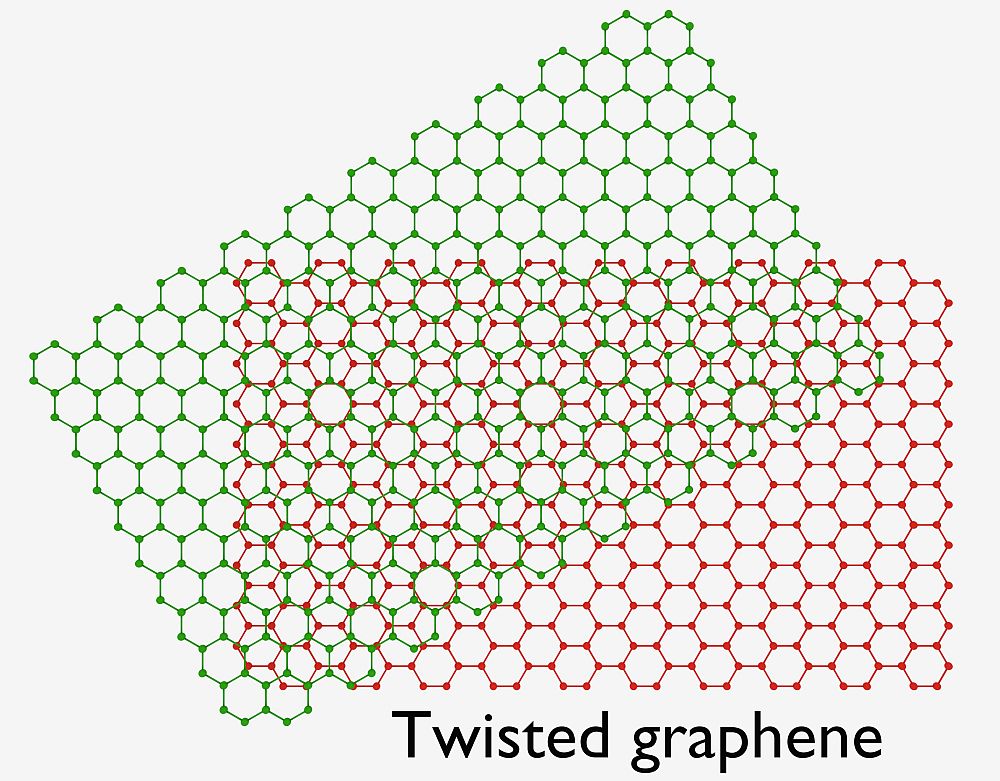
[Image above] Illustration of two twisted graphene sheets forming a moiré superlattice. Twisting a material’s layers can greatly change its electronic properties, and so the field of twistronics has become a highly studied nanoengineering technique. Credit: MZinchenko / Shutterstock
The proposed rule released by the U.S. Office of Management and Budget at the end of May 2026 is just the latest in a string of political maneuverings that target the practice of science in the United States. Fundamental science in particular has been in the crosshairs of these maneuverings, and many scientists have been left struggling to find funding for projects that do not align with the current administration’s science priorities.
Yet without basic science, we do not have the seeds of innovation that inspire the next generation of commercial techniques and technologies. That is why we must fund and celebrate the researchers who engage in basic science studies, as they are instrumental in “transforming our understanding of the big, the small, and the complex.”
The above quote comes from the “About” webpage of The Kavli Prize, which was established in 2005 to recognize outstanding scientific breakthroughs and promote public understanding in astrophysics, nanoscience, and neuroscience. Since the first awards in 2008, 73 scientists from 14 countries have been recognized, and 10 recipients have since gone on to receive The Nobel Prize for their discoveries.
Among this year’s recipients, the 2026 Kavli Prize in Nanoscience recognized three scientists who played integral roles in developing the field of twistronics. Twistronics studies how the electronic properties of atomically thin materials change when two or more layers are stacked with a slight rotational twist between them. This geometric manipulation to create “moiré superlattices” has unlocked a wealth of new phases of matter and quantum behaviors, such as unconventional superconductivity and highly controlled light propagation.
The scientists behind twistronics
The three scientists who received the 2026 Kavli Prize in Nanoscience are Eva Y. Andrei, Allan H. MacDonald, and Pablo Jarillo-Herrero.

Credit: Liwlig Norway
Andrei is Distinguished Professor and Board of Governors Professor at Rutgers, The State University of New Jersey. In 2009, she and her group used scanning tunnelling microscopy and spectroscopy to discover that small variations in twist angle profoundly modified the electronic structure of bilayer graphene. One specific twist angle, later known as the “magic” angle, provided what appeared to be the first evidence of an emergent correlated electronic state.
Read Andrei’s full life story at https://www.kavliprize.org/eva-andrei-autobiography.
Credit: Liwlig Norway
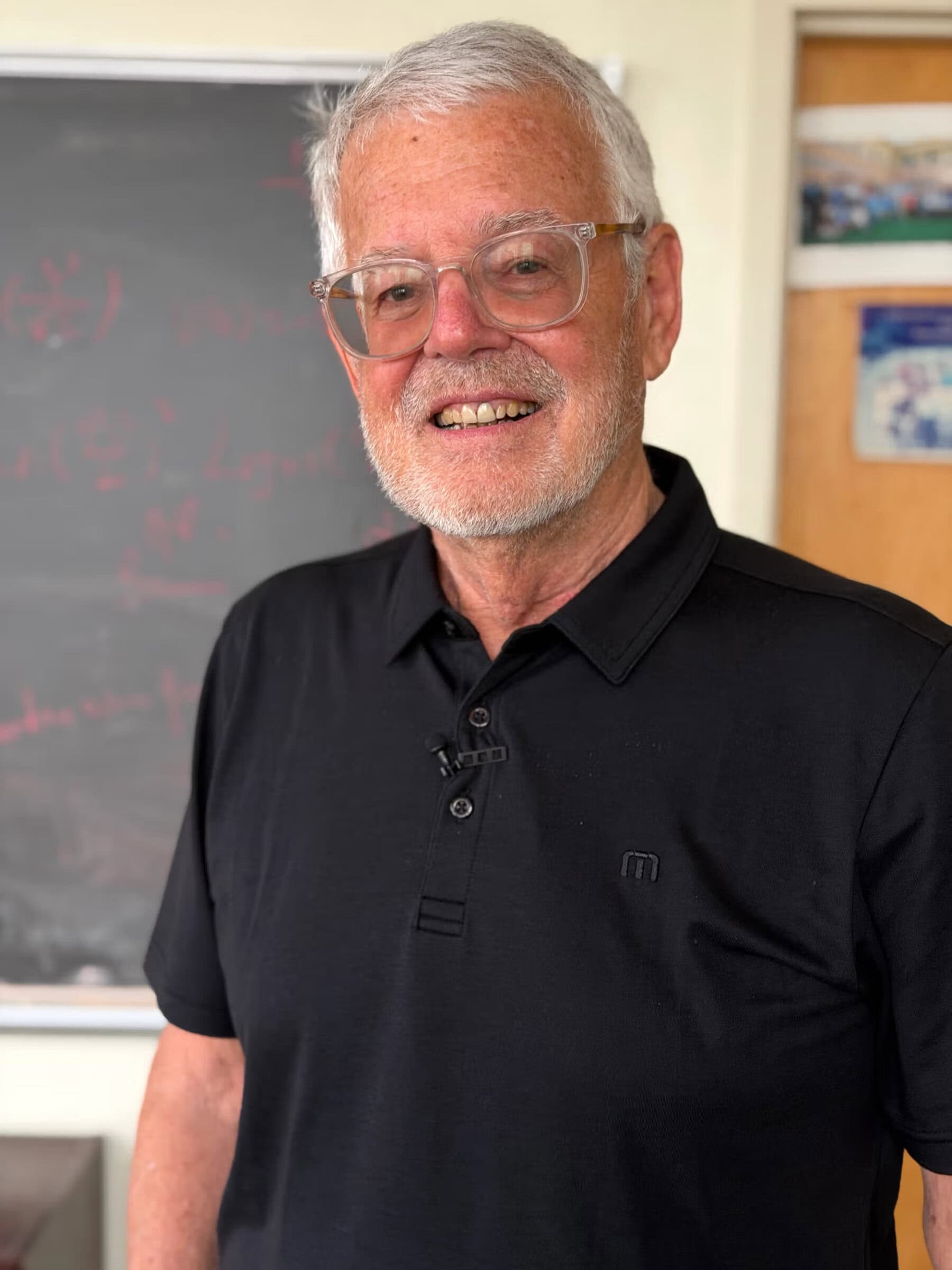
MacDonald is the Sid W. Richardson Foundation Regents Chair in Physics at The University of Texas at Austin. In 2011, MacDonald and then-postdoctoral scientist Rafi Bistritzer published a paper that provided a firm theoretical foundation for Andrei’s experimental discovery. Their continuum model described how an interlayer twist reshapes the electronic band structure of bilayer graphene, and it has now been used to guide subsequent experimental and theoretical developments across a wide range of twisted and layered systems.
Read MacDonald’s full life story at https://www.kavliprize.org/allan-macdonald-autobiography.

Credit: Liwlig Norway
Jarillo-Herrero is the Cecil and Ida Green Professor of Physics at Massachusetts Institute of Technology. In 2018, Jarillo-Herrero and his group demonstrated the broader significance of twist-engineered flat bands when they showed that superconductivity can emerge in a system composed of two weakly coupled graphene layers when tuned by the “magic” twist angle and electrostatic gating.
Read Jarillo-Herrero’s full life story at https://www.kavliprize.org/Pablo%20Jarillo-Herrero-autobiography.
Methods for fabricating 2D moiré structures
When Andrei and her group made their discovery about twist angle effects in bilayer graphene in 2009, their observations were based on naturally occurring, randomly twisted bilayers rather than purposeful manual maneuverings. These twisted bilayers were a stroke of “pure serendipity” caused by a student using “a nickel substrate rather than the standard copper to grow the sample” through chemical vapor deposition, as Andrei explains in her life story.
In contrast, Jarillo-Herrero and his group used a “tear-and-stack” mechanical assembly technique to carefully align and rotate one atomic sheet of carbon by precisely 1.1° relative to the other. This technique was developed by then-graduate student Yuan Cao, who is now assistant professor of electrical engineering and computer science at the University of California, Berkeley.
Other artificial manipulation methods such as flipped folding, rotational pushing, and twisted stacking are now commonly employed to construct twisted 2D superlattices as well. Additionally, recent innovations in chemical vapor deposition have enabled purposeful precise control of the twist angle using this technique, rather than the “pure serendipity” that Andrei’s group observed.
In February 2026, researchers from Zhejiang University and Westlake University in China published an open-access paper reviewing the methods for fabricating twisted 2D moiré structures. Besides the common direct growth and artificial manipulation techniques, it also includes descriptions of state-of-the-art ultraclean transfer in vacuum and in-situ dynamic twisting technologies.
The open-access paper, published in International Journal of Extreme Manufacturing, is “A review of the fabrication of twisted two-dimensional material moiré structures” (DOI: 10.1088/2631-7990/ae35e9).
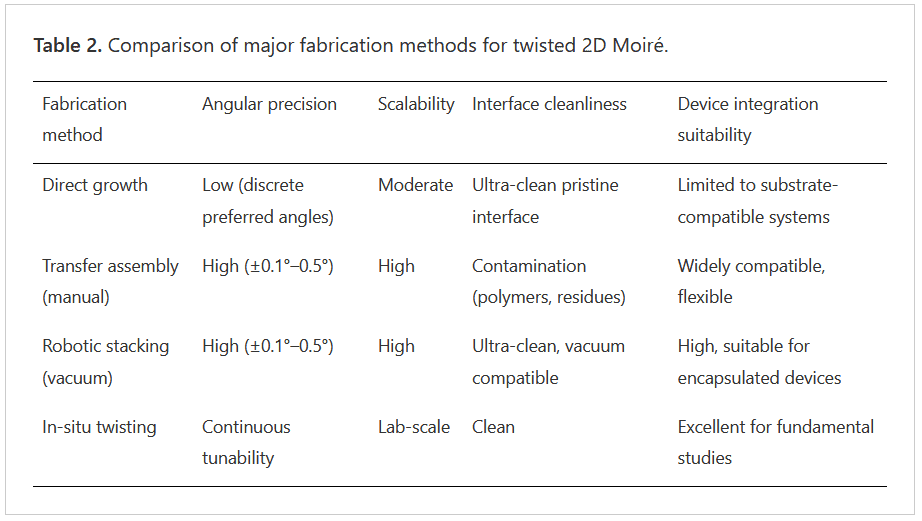
Table summarizing four major fabrication strategies—direct growth, transfer-based assembly, robotic stacking, and in-situ twisting—according to angular precision, scalability, interface cleanliness, and suitability for device integration. Credit: Shen et al., International Journal of Extreme Manufacturing (CC BY 4.0)
Twistronics beyond van der Waals
To date, many twistronics studies have focused on van der Waals material systems such as graphene. In these systems, atomic layers featuring strong in-plane covalent bonds are bound together by weak out-of-plane van der Waals forces. This structure makes it relatively easy to rotate the individual layers and create “moiré superlattices.”
As nanoengineering techniques have evolved, however, so too has the field of twistronics to include non-van der Waals material systems. In particular, perovskites are expected to benefit from geometric manipulations because they are commonly used in electronic and lighting applications, both of which rely on material properties traditionally tuned using twistronics.
In January 2026, researchers from Emory University and Purdue University in the United States published an open-access perspective article on the potential of perovskites to become a transformative non-van der Waals platform for twistronics. They argue that once certain bottlenecks are overcome, such as stringent lattice-matching requirements and the absence of in-situ twist metrology, perovskites could serve “as a critical bridge between fundamental moiré physics and room-temperature technological applications.”
The open-access paper, published in Small Structures, is “A new platform for twistronics: Perovskite moiré superlattices beyond van der Waals” (DOI: 10.1002/sstr.202500770).