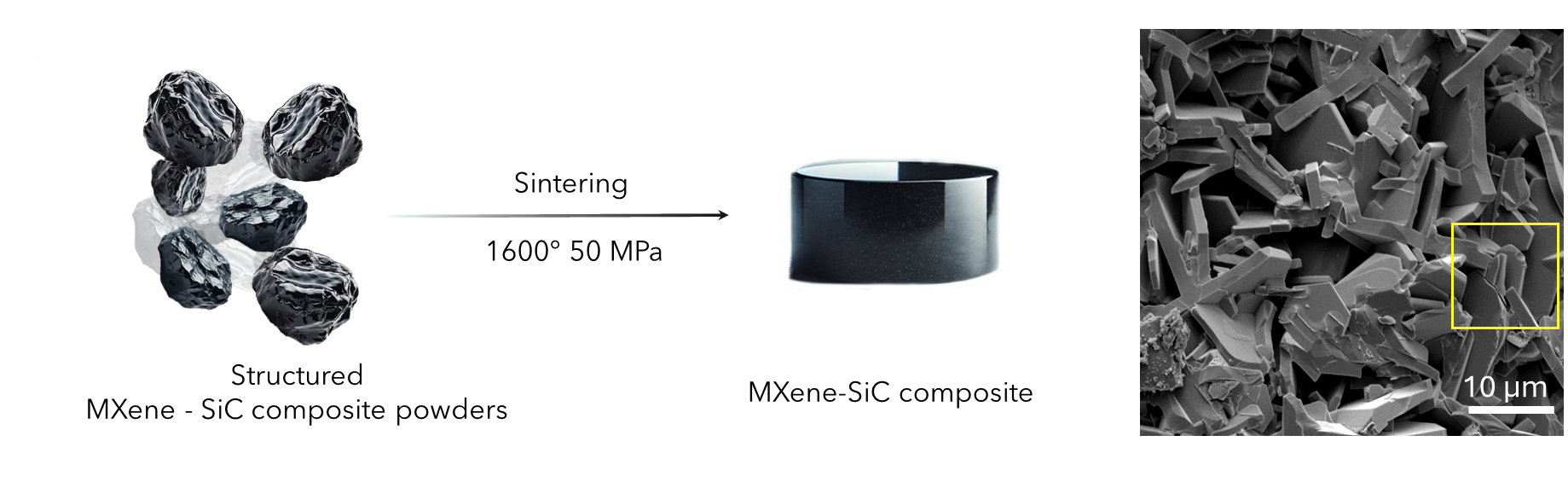
[Image above] Schematic showing the consolidation of pyrolyzed MXene-SMP-10 powders using spark plasma sintering, followed by a scanning electron microscopy micrograph of the sintered 5 wt.% MXene content sample. Credit: Nemani et al., Advanced Composites and Hybrid Materials (CC BY 4.0)
Every day, thousands of scientific papers are published in journals and conference proceedings all around the world. With the total reaching millions of additions to the scholarly literature each year, it is rare for any given paper to be remembered as a seminal contribution to science. But that is exactly the position a relatively brief communication published in Advanced Materials has found itself—it is known as the study that initiated research on the ever-expanding 2D material family of MXenes.
MXenes are a family of 2D transition metal carbides and nitrides that, like the bulk MAX phases from which they are traditionally derived, demonstrate a wide range of chemical and structural diversity. This diversity provides them with a range of impressive material behaviors, including exceptional electrical conductivity and high-temperature stability, as well as excellent catalytic activity and electromagnetic interference shielding capabilities.
During the first decade of MXene research, which was launched by the Advanced Materials paper in 2011, scientists focused on understanding the full scope of MXene properties and the mechanisms behind them. The cover story of the June/July 2022 Bulletin gives a high-level overview of these behaviors and possible applications.
With this established knowledge base of fundamental MXene behavior, the second decade of MXene research is starting to explore the combination of MXenes with other materials. The properties of some bulk materials have been greatly enhanced through the addition of certain nanomaterials, as shown in the January/February 2026 Bulletin cover story, and so researchers anticipate that similar results could be achieved with MXenes.
Last year, researchers led by Purdue University created the first MXene-enhanced ultrahigh-temperature ceramic (UHTC) for experimental testing. In a CTT post on the study, lead author and then-Ph.D. student Kartik Nemani said, “Our findings mark a key step in bridging fundamental studies with practical applications, demonstrating MXenes’ real potential in UHTCs.”
Nemani is now a post-doctoral research fellow at the University of Alabama at Birmingham (UAB) working with Kathy Lu, professor and chair of the Department of Mechanical and Materials Engineering. They and colleagues at UAB and Purdue recently published an open-access paper that continues the additive exploration trend by incorporating MXenes into polymer-derived ceramics (PDCs).
PDCs are ceramic materials formed through the pyrolysis (thermal decomposition) of preceramic polymers. First synthesized in the 1960s, PDCs are now known “for their ability to fabricate near-net-shape advanced materials with precise control over composition, phase distribution, and microstructure,” Lu says in an email.
Some previous studies have explored incorporating MXenes into PDCs, but “a fundamental understanding of their integration mechanisms and thermal behaviors in oxide-free ceramics is yet to be established,” the researchers write. So, their study looked at how the interface interactions between the MXene and polymer matrix evolve during the thermally activated phase transformation and pyrolysis, as well as how this behavior impacts the resulting microstructure and stability of the MXene-enhanced PDCs.
They chose to use hydrophilic Ti3C2Tx as the MXene additive and allyl hydrido polycarbosilane (SMP-10) as the silicon carbide polymer precursor. This precursor undergoes a well-characterized conversion to β-SiC, Lu explains, and “The addition of MXene into this system is aimed to enhance thermal stability, structural integrity during pyrolysis, and ultimately ceramic yield.”
Before incorporation, the researchers functionalized the MXene flakes via organic silane coupling agents to enhance their compatibility with the nonpolar precursor. They then added either 0, 2, 5, or 10 wt.% MXene to the SMP-10 polymeric precursor.
After mixing the MXene-enhanced polymeric precursor with toluene to create a slurry, they crosslinked the mixture by heating it in an inert environment. Subsequent pyrolysis of the green bodies took place at 1,100°C to obtain powders, which were then further pyrolyzed using an electric field-assisted spark plasma process.
Using high-temperature X-ray diffraction and thermogravimetric analysis, the researchers determined that the thermal transformation pathway exhibits four distinct transformation regimes.
- 255–425°C: Compositions lose approximately 5–7% mass, which likely corresponds to the evolution of low molecular weight oligomers and the initiation of crosslinking reactions in the polycarbosilane structure.
- 425–722°C: Decomposition accelerates and causes a steep mass reduction of 10–13%. This reduction represents the primary polymer-to-ceramic conversion process, which involves hydrogen elimination, silicon–hydrogen bond cleavage, and initial amorphous silicon carbide network formation.
- 722–990°C: Decomposition decreases as the samples approach the ceramic state. Mass loss curves begin to differentiate based on the MXene content, and MXenes also typically show accelerated desorption kinetics of the functional groups.
- 990–1,500°C: Composites show composition-dependent behavior, with the 2 wt.% MXene composite consistently maintaining higher residual mass compared to both pure SMP-10 and 5 and 10 wt.% MXene samples.
Based on this information, the researchers determined that having an intermediate amount of MXene (2 wt.%) in the preceramic polymer can more effectively inhibit mass transport during structural reorganization, resulting in improved ceramic network stabilization under the processing conditions. This finding, plus the discovery of a sub-20 nm titanium–silicon–carbon interfacial nanostructure, “provide actionable design parameters for next-generation ceramic composites,” Lu says.
Lu notes the multiagency funding that made this study possible, which “reflects the cross-cutting relevance of the work—nuclear fuel coating for energy, extreme environment structural materials, and fundamental materials processing science.”
In future studies, the researchers plan to focus on the effect of MXene content on the composite’s mechanical properties.
The open-access paper, published in Advanced Composites and Hybrid Materials, is “Understanding phase and microstructure evolution of Ti3C2Tx MXene-polymer derived silicon carbide” (DOI: 10.1007/s42114-026-01804-9).