
[Image above] Illustration of a future smart city, demonstrating connection network reciprocity over the area. Credit: Summit Art Creations / Shutterstock
Engineered ceramics are vital materials in modern society, enabling everything from advanced electronics to precision medicine to high-temperature energy and transportation applications. Yet most people are unaware of the critical role that ceramics fill, which is what led to the somewhat embarrassing oversight when refractories were left off the essential industries list of many countries during the early weeks of the COVID-19 pandemic.
Raising public awareness of ceramic and glass materials and technologies is a main goal for The American Ceramic Society. Tying these materials to high-profile global trends is an effective method for accomplishing this goal, and the World Economic Forum’s annual Top 10 Emerging Technologies report series offers a good framework for this purpose.
Since 2012, the World Economic Forum has used the Top 10 Emerging Technologies report as a way to highlight technologies that are expected to positively impact society within the next three to five years. Even though some of the technologies do not ultimately deliver on their potential, the report “remains one of the most authoritative technological bellwethers for what’s coming,” says Andrew Maynard, professor at Arizona State University, in an article describing the origins of the report series.
The 2026 report published in June, and we will look at how ceramics fit into the “tipping-point” technologies highlighted in this year’s report.
1. Everything-to-grid energy
Everything-to-grid technology is an energy framework enabling large-scale, multidirectional power flow. Rather than large power plants providing electricity in a one-way street to passive consumers, electricity can be pulled back into the grid from everyday connected assets (such as electric vehicles and home battery systems), thus helping balance supply and demand in real-time.
High-voltage direct current transmission infrastructure is expected to play a key role in the future everything-to-grid framework. Ceramic materials will help enable this infrastructure, as described in a May 2026 Ceramic Tech Today post.
2. Direct lithium extraction
Lithium is a vital component in modern battery formulations, but sourcing it traditionally relies on the yearslong, water-intensive brine evaporation process. In contrast, direct lithium extraction uses engineered systems such as sorbents, membranes, and solvents to extract lithium from brine within hours.
Various oxides serve as sorbents and membranes in different direct extraction systems. An April 2026 open-access review article describes some of these systems.
3. Passive radiative cooling materials
The negative environmental impacts of air conditioning units are well known, so researchers are interested in using passive radiative cooling materials to cool buildings through light reflection rather than energy-intensive refrigerant systems.
Both ceramic and glass materials are being investigated as passive radiative cooling materials, as explained in a December 2023 Ceramic Tech Today post. Terracotta-based evaporative systems may also complement passive radiative cooling, as described in a June 2026 Ceramic Tech Today post.
4. Breaking down ‘forever chemicals’
Per- and polyfluoroalkyl substances (PFAS) are a large group of synthetic chemicals with many negative environmental and health effects. Human activities have made PFAS a widespread contaminant in environments worldwide, but traditional remediation treatments can only remove PFAS rather than destroy them. So, researchers are developing methods that can break down the strong carbon–fluorine bond to ensure these chemicals do not escape back into the environment.
Ceramic structures have been used to adsorb PFAS, such as the indium oxide monoliths described in an August 2024 Ceramic Tech Today post. By pairing these structures with degradation methods such as high-frequency ultrasound, PFAS can be effectively and permanently removed from the environment.
5. Precision fermentation
Precision fermentation is an advanced biotechnology process that uses microorganisms such as yeast, fungi, or bacteria as “cell factories” to produce specific, highly pure functional ingredients. It replaces traditional animal- and plant-derived extraction methods, thus reducing land use and climate impacts.
Ceramics can support precision fermentation processes by serving as filtration membranes to separate cell debris and purify target proteins. The October 2025 webinar by Protein Production Technology International dives into this topic.
6. Exosome drug delivery
Exosomes are organic, membrane-bound particles that carry proteins and genetic material between cells. Loading these exosomes with anticancer molecules can overcome the barriers faced by synthetic vessels because the body recognizes exosomes as its own, thus allowing it to bring the therapeutic drugs safely to the treatment site.
Bioactive glass microspheres can serve as complementary inorganic drug carriers that also network well with the body. The July 2023 Ceramic Tech Chat podcast episode with Steven Jung, chief technology officer at specialty glass manufacturer Mo-Sci, describes the development of TheraSphere, the first commercially developed glass-based cancer treatment.
7. Personalized mRNA cancer vaccines
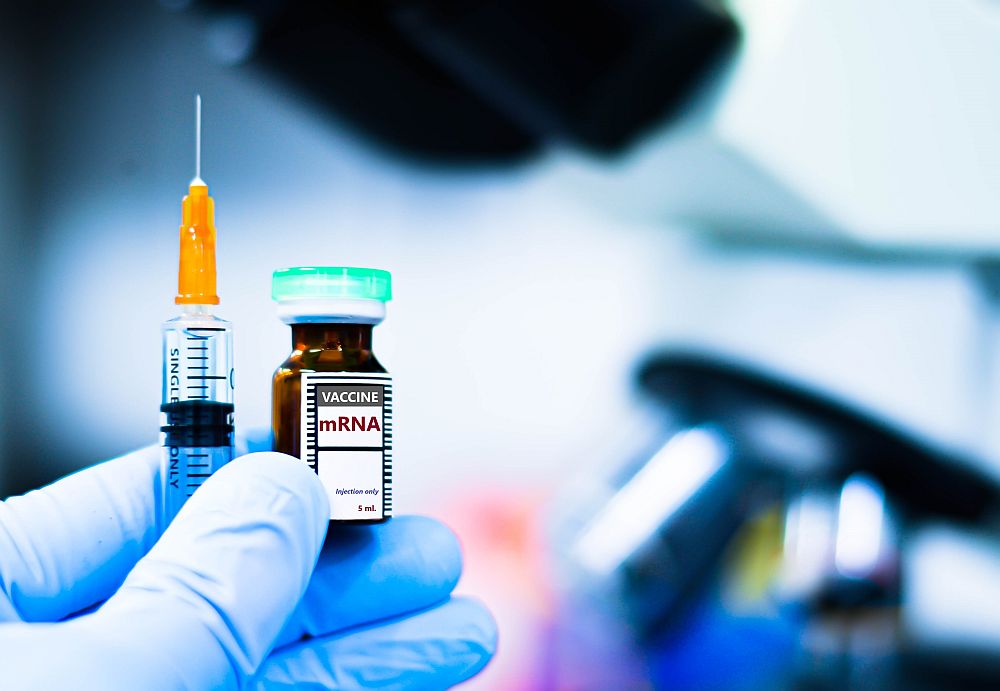
The COVID-19 pandemic accelerated and validated the field of mRNA vaccines, which teaches your cells how to build harmless viral proteins rather than introducing weakened, inactivated, or partial pieces of the actual virus (the traditional vaccine approach). This alternative approach to treatment means mRNA vaccines can be personalized and scaled up much more easily than conventional vaccines.
Ceramics can be used as nanoporous microneedle patches to deliver mRNA vaccines. A September 2023 open-access article describes the safety and immunogenicity of a ceramic nanoporous microneedle array for SARS-CoV-2 vaccination.
8. Quantum simulation for drug discovery
Materials researchers in all fields are flocking to quantum computing as an opportunity to improve their simulations, as these systems have the potential to map molecular states directly instead of translating them into binary. For fields that hinge on understanding atomic interactions, such as drug discovery, this benefit of quantum-driven models is significant.
Quantum systems traditionally rely on diamond as the primary hosting material. However, other ceramic materials are being investigated, such as the engineered silicon carbide described in a June/July 2024 ACerS Bulletin feature article.
9. World models
World models are machine learning systems that can predict how a given environment may change over time in response to certain actions. It accomplishes this feat by using data from multiple sources (video, sensors, text) to build a working representation of the environment.
The refractory industry can benefit from world models by using these systems to accurately predict the wear of different refractory linings in various high-temperature and corrosive environments. The March 2025 ACerS Bulletin cover story looks at some of the ways machine learning systems are currently used in the refractory industry.
10. Lattice-based cryptography
Lattice-based cryptography is an emerging approach to encryption that can defend against classical and quantum attacks. It involves hiding data in complex mathematical structures called lattices and adding small pieces of random information, making it extremely difficult to tell the correct solution from the many false ones.
For ceramic and glass manufacturers to make use of lattice-based cryptography and other advanced computer methods in their operations, they must have at least a basic understanding of data science. Case Western Reserve University offers an applied data science program through its School of Engineering to prepare materials scientists to use these advanced systems, as described in a June/July 2026 ACerS Bulletin feature article.