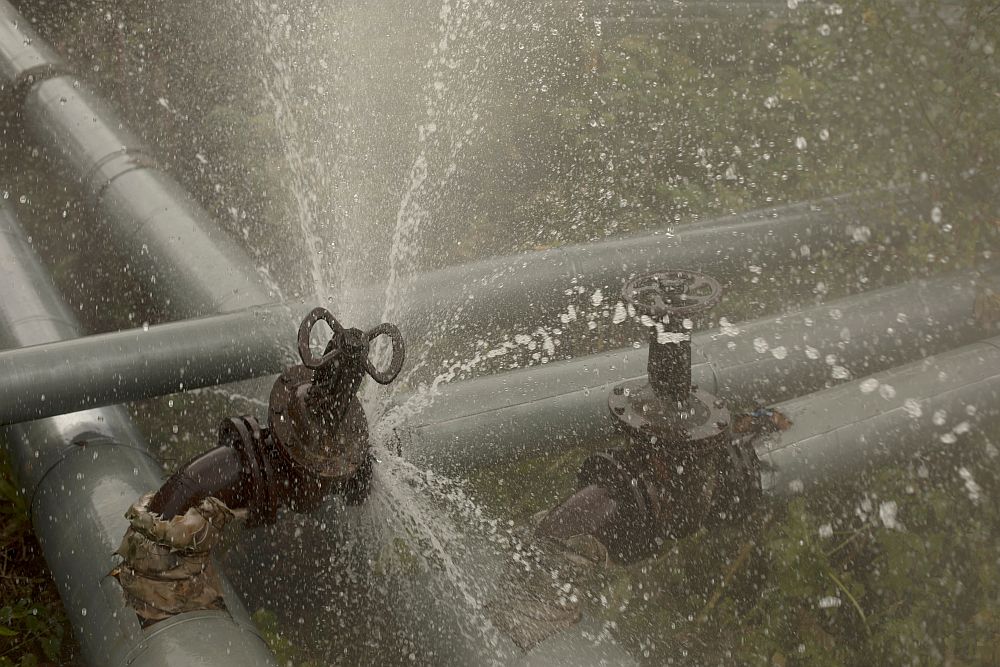
[Image above] Example of a burst pipe at a boiler station. A new superhydrophobic coating developed at Rice University can withstand hot liquids and could be ideal for applications such as the boiler pipe. Credit: Oleg Kopyov(opens in new tab) / Shutterstock
Standard superhydrophobic materials rely on a combination of low surface energy and textured surfaces to trap air beneath liquid droplets (a phenomenon known as the Cassie–Baxter state(opens in new tab)). This air cushion gives superhydrophobic materials their self-cleaning, anti-icing, and antifouling properties, making them valuable for everything from aircraft bodies(opens in new tab) to road signs(opens in new tab) to biomedical products(opens in new tab).
However, these materials face a sharp limit under thermal stress. Above approximately 40°C, many liquids start to evaporate rapidly and recondense inside the microscopic pores, destroying the trapped air cushion and causing the liquid to adhere to the surface. At even higher temperatures, oxidation and open flames rapidly degrade common organic superhydrophobic coatings.
A CTT post earlier this month explained how nano- and microtexturing can be used to engineer industrial sapphire for superhydrophobicity(opens in new tab). This second post on superhydrophobic materials for extreme environments explores how ceramic engineers are using thermal insulation and ceramization to preserve superhydrophobicity at high temperatures.
Heat-shielding surfaces for hot liquids
The degradation of hydrophobic materials in steamy, high-temperature environments has historically limited their applications in industries that consistently deal with warm or hot liquids, such as food processing and chemical manufacturing.
Previous research on heat-resistant hydrophobicity in humid environments has focused on improving the chemical and mechanical durability of the hydrophobic surface, such as MIT’s iCVD polymer grafting(opens in new tab). But new research(opens in new tab) at Rice University focuses instead on preventing vapor condensation to begin with.
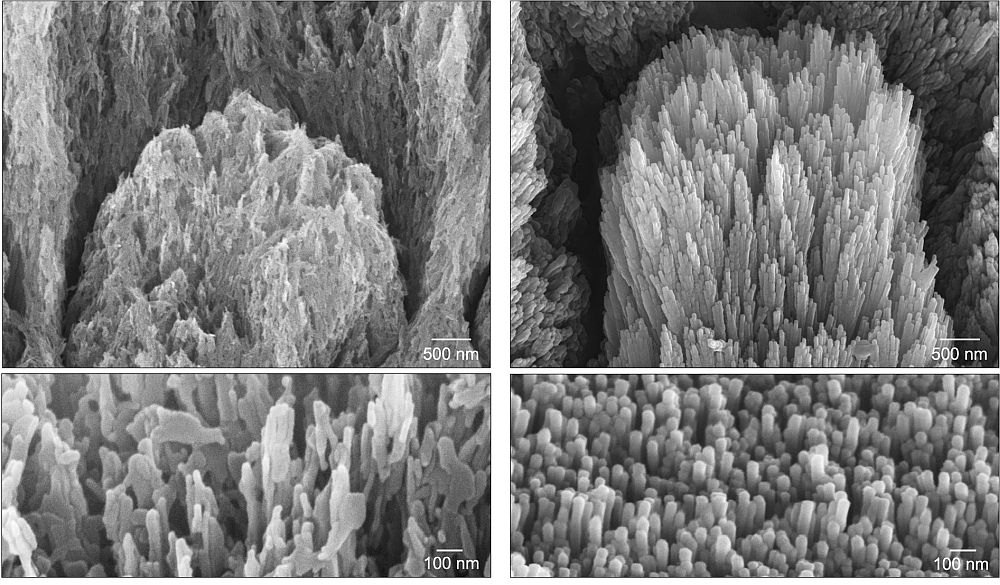
The multilayered insulated superhydrophobic (MISH) system designed by Rice mechanical engineers places a thin, thermally insulating underlayer beneath the superhydrophobic topcoat. By preventing rapid heat transfer from hot droplets to the substrate, the insulation suppresses localized evaporation and internal condensation, keeping the air layer intact.
The MISH-treated surface repels water and complex liquids (e.g., coffee, soups, hot oils) up to 90°C with less than 1% surface residue left behind (compared to more than 31% residue on standard coatings, according to the team’s research). During testing, the coating’s effectiveness was sustained for more than 80 hours (approximately 1 million hot droplet impacts).
Because this coating is applied using a spray-on process, it easily “accommodates curved geometries and large surfaces,” the researchers write in the paper(opens in new tab) describing their work. Additionally, “it is over 4 orders of magnitude less expensive than cleanroom-nanofabricated alternatives,” making it promising for industry applications.
To extend their work, the Rice team plans to look at more insulating top layers, new coating structures, and manufacturing approaches beyond spray coating. These investigations will leverage the self-cleaning and antifouling capacities of superhydrophobic materials to extend their usable lifetimes and increase their efficiency.
The paper, published in ACS Applied Materials & Interfaces, is “Scalable hot-water-repellent superhydrophobicity via thermal insulation(opens in new tab)” (DOI: 10.1021/acsami.5c17943).
Ceramifiable fire-retardant and superhydrophobic coatings
The 9/11 terrorist attacks in 2001 permanently transformed many aspects of national security, travel, and public life in the United States. This month, as we remember and honor the lives lost during the attacks, let us also commend the materials scientists and civil engineers who have spent the past 25 years reshaping global building standards to prevent such a tragedy from happening again.
Fire-retardant coatings for structural steel is one area of engineering that has received lots of attention following the 9/11 attacks. These coatings work to prevent heat transfer to the metal below, which starts to lose structural strength at around 400°C and begins to significantly soften at 500°C. While the steel structures in the World Trade Center towers did have fire-retardant coatings, these coatings faced long-term bonding issues(opens in new tab) that allowed them to be forcefully dislodged by the airplane collisions.
In contrast to the spray-applied thermal foams used back then, the emerging technology of ceramifiable flame-retardant coatings offers significant advantages in terms of durability. These polymer coatings transform into hard, noncombustible ceramics when exposed to high temperatures, allowing for long-term structural integrity.
In a recent paper(opens in new tab), Chinese researchers developed a novel two-step ceramifiable coating(opens in new tab) that combines ceramifiable intumescent technology with surface-modified titanium dioxide nanoparticles to create superhydrophobic fire-retardant coatings to protect structural steel and rigid polyurethane foam.
An intumescent coating is a passive fire-protection surface that swells into a thick insulating layer when exposed to heat. Ammonium polyphosphate, pentaerythritol, and melamine are widely used as intumescent flame-retardant systems that generate a swellable char.
This new method incorporates low-melting-point glass powder into the intumescent matrix. When it is exposed to fire, the material melts and converts the honeycomb-like char into a rigid ceramic shield.
These specific materials also become superhydrophobic after activation. A sprayed top-layer of perfluorodecyltrichlorosilane-modified titanium dioxide provides a water contact angle of 157.5° and a roll-off angle of 4°.
This work is notable because standard intumescent coatings(opens in new tab) absorb ambient moisture over time (hygroscopic decay) and also only produce a low-strength char material. The superhydrophobic shell of this two-step material seals out water while preserving flame retardancy and adding structural rigidity.
Potential applications of this new ceramifiable coating include structural steel framing and industrial storage tanks (to minimize softening), marine/offshore infrastructure (to minimize hygroscopic degradation), and high-voltage grid insulation (minimize fire hazards).
The paper, published in Progress in Organic Coatings, is “A two-step method to construct a superhydrophobic, ceramicizable intumescent fire-retardant coating suitable for steel and RPU(opens in new tab)” (DOI: 10.1016/j.porgcoat.2026.109951).
The future of high-temperature superhydrophilic coatings
Current superhydrophobic coatings often face two separate challenges: thermal transport (droplet condensation disrupts the air cushion) and thermal breakdown (polymeric coatings degrade in high-temperature environments). The studies described here are promising for their potential to extend the applications of superhydrophobic materials into areas where heat had previously made them impractical.
Additionally, both new methods of creating heat-resistant superhydrophobic materials avoid expensive clean-room fabrication(opens in new tab) by using low-cost materials. This accessibility could foster broad adoption in industrial processing and structural fire protection.
As ceramic engineering continues to merge texturing technologies with extreme thermal environments, superhydrophobicity evolves from a laboratory-scale novelty into a rugged industrial reality.