[Image above] Credit: freedomnaruk / Shutterstock
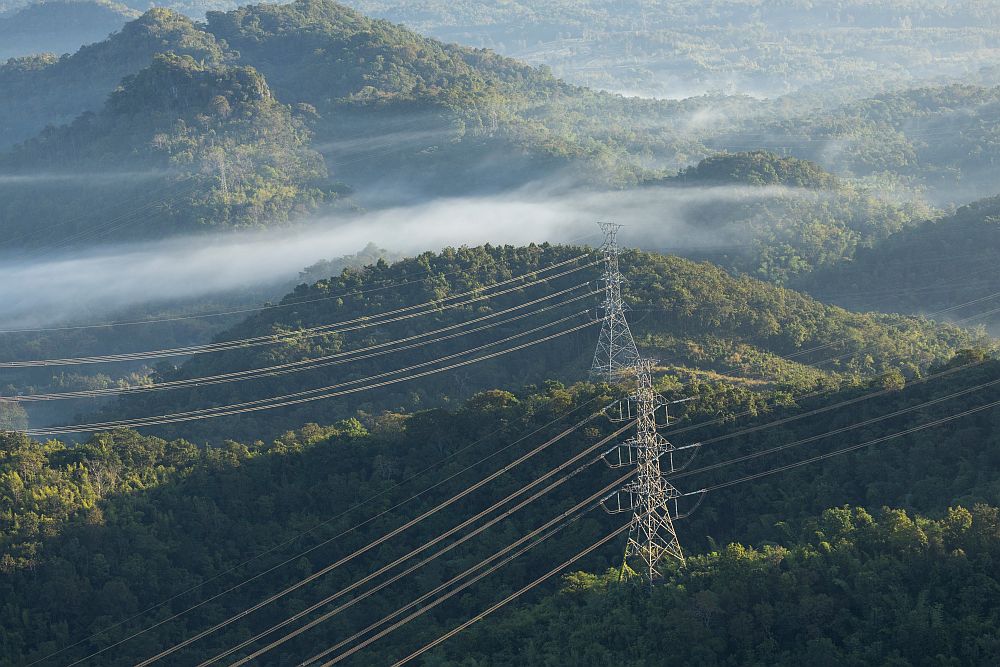
Our energy infrastructure is undergoing a global transition, with electric technologies showing a significant upward trend in contrast to their fossil fuel equivalents. However, electrification efforts require sufficient channels to transfer electricity from source to demand, and that is where the method of high-voltage direct current (HVDC) transmission is seeing a surge in implementation.
This CTT will explain the advantages and challenges of HVDC compared to traditional alternating current (AC) grids, describe the progress toward large-scale implementation, and document the role of ceramic dielectric insulators in making implementation possible.
Electricity transmission basics
As students learn in introductory physics classes, a changing electric field creates a magnetic field and vice versa. During AC transmission, the electric field continually changes direction, pushing the electrons to flow primarily on the surface of the wire. The center of the wire transmits fewer electrons, and this uneven distribution of current transmission—called the skin effect—increases the resistance of the wire, which leads to higher energy losses in the form of heat.
Alternating current also creates reactive power, i.e., a nonuseful electric power that is generated whenever the current and voltage waves fall out of phase. Reactive power oscillates between the source and reactive components, taking up space on the line that reduces the available capacity for transmitting electrons. As a result, AC transmission requires expensive booster equipment, such as shunt reactors, to work over long distances.
In contrast to AC transmission, the electric field in direct current transmission does not change direction. So, it generally has fewer energy losses related to heat and reactive power, making it superior for long-distance transmission.
The War of the Currents
Despite the advantages of direct current systems, most long-distance transmission lines currently in operation are AC. Why? The answer lies in the War of the Currents during the late 19th century.
Thomas Edison’s first incandescent lightbulbs were powered with low-voltage direct current systems, the standard for electricity in the U.S. at the time. However, Nikola Tesla believed that AC was the better choice for the electric grid because, unlike direct current, its voltage could be easily increased (for efficient transport) and decreased (for safe use in homes and factories) using existing technologies.
George Westinghouse’s winning bid to power the Chicago World’s Fair (the World’s Columbian Exposition) with Tesla’s AC system in 1893 was the deciding factor. (Westinghouse had licensed Tesla’s technology in 1888.) Since then, most electrical grids and devices run on AC (with the notable exceptions of computers, LEDs, solar cells, some commuter train lines, and electric vehicles).
Advantages of HVDC
Unlike during Edison and Tesla’s time, technology now exists to efficiently “step up” direct current voltage for long-distance transmission. That makes HVDC an attractive option to address some of the challenges in today’s energy environment.
Integration of remote renewables
HVDC addresses a key issue with renewable energy—getting the power from where it is produced to where it is consumed.
Renewable energy production is often located far from population centers, such as offshore wind farms or massive solar arrays in the desert. Moving power from these remote locations to cities via AC would require substantial investments in reactive power compensation and intermediate substations.
HVDC provides a cost-effective express lane that delivers bulk power over vast distances without these intermediate substations. (However, the converter stations at each end are multimillion-dollar investments.)
Asynchronous grid interconnection
HVDC technology can function as a firewall between different power grids. You may be aware that the U.S. has three main grids: Eastern, Western, and Texas interconnections. This setup is partly because keeping an entire continent’s worth of AC equipment exactly in phase all the time would be impossible. If connecting equipment slips too far out of phase, the resulting mismatch can quickly destroy some expensive infrastructure.
Different regional grids (or countries) often operate at different frequencies or have different phase angles. HVDC converters can connect these unsynchronized grids because they convert AC to DC, and then back to AC at the specific frequency required by the receiving end. This conversion prevents a failure or frequency oscillation in one grid from cascading into another.
Right-of-way efficiency
When building new transmission lines, finding space (the right-of-way) is increasingly difficult and expensive. An HVDC transmission line can carry significantly more power than an AC line of the same physical dimensions, making it possible to replace AC lines with HVDC lines in the same footprint. Additionally, HVDC is well suited for underground or subsea high-voltage cables, where AC transmission is limited by high capacitive charging currents.
Controllability
The power flow in an AC network follows the laws of physics based on impedance; it is essentially passive and difficult to steer. HVDC systems use power electronics (such as voltage source converters) that allow operators to inject or withdraw power at specific points in the network with high precision. Utility companies can balance loads dynamically, which is essential for managing the intermittent nature of wind and solar energy.
Challenges of adopting HVDC
Replacing AC systems with HVDC is not a simple switch, due in large part to the materials currently used for transmission line insulators.
Transmission line insulators are materials used to electrically isolate live high-voltage conductors from grounded supporting towers and poles. They not only prevent short circuits and current leakage but also provide mechanical support for the weight and tension of the conductors.
Transmission line insulators have been made of ceramic or glass materials since the first telegraph lines were strung back in the 1830s. Ceramic became the material of choice for electrical insulators, however, due to their higher mechanical strength, better thermal shock resistance, and greater design flexibility for high-voltage applications.
Although polymer insulators are becoming more popular due to their lightweight and hydrophobic nature, they are susceptible to ultraviolet light degradation and other defects under the constant electrical stress of high-voltage transmission. In contrast, a well-engineered ceramic insulator has an expected service life of 50 to 100 years, and they can be easily recycled after decommissioning. These characteristics make them the most sustainable choice for a low-carbon future.
However, transitioning from alternative to direct current changes the physical demands on the material. In an AC system, the voltage constantly switches direction (50 or 60 times a second). Because of this rapid cycling, the insulator behaves like a series of capacitors, and the distribution of electrical stress depends on the permittivity of the materials (the ceramic, the air, and the metal caps). The electrical stress is relatively predictable and stable because the physical geometry and material types do not change much with temperature or time. The shape of the electrical field essentially stays the same.
In a direct current system, the voltage is a steady, constant pressure. Once the line is energized and reaches a steady state, the capacitive effects disappear. Now, the electrical stress is distributed based on the resistivity of the material—how much it resists the flow of current. This point is where it gets tricky for ceramic applications.
The resistivity of porcelain is extremely temperature sensitive. If one part of the insulator is in the sun and the other is in the shade, the resistivity of those two sections will be vastly different. Because the stress depends on resistance, the voltage will naturally concentrate on the parts of the insulator that are the most resistive (usually the coolest parts). When the electrical field concentrates in one area and exceeds what the air or the ceramic can handle, you get a catastrophic failure.
Another concern with HVDC transmission is ion migration. Under a constant, unidirectional electric field, mobile ions within the silicate matrix of the porcelain slowly migrate toward the electrodes. Over decades, this electrolysis of the ceramic body can lead to localized changes in material properties, potentially compromising the insulator’s integrity.
Furthermore, the constant polarity of HVDC lines pulls dust, salt, and industrial pollutants out of the air by electrostatic precipitation. This accelerated pollution buildup increases the risk of dry band arcing. When the surface becomes unevenly wet, high-voltage arcs can form across dry patches, leading to a total flashover.
To combat this phenomenon, engineers must manage thermal runaway. As a ceramic heats up, its resistivity decreases, allowing more current to flow, which in turn creates more heat. Modern HVDC porcelain is engineered with precise resistive characteristics to ensure stability even under extreme thermal loads.
Ceramic engineering solutions for HVDC
One of the most significant breakthroughs in managing HVDC challenges is semiconductive glaze technology. Traditional glazes are purely insulating, but for HVDC, a bit of controlled leakage is a good thing.
Resistance Graded (RG) insulators by western New York–based Lapp Insulators use a semiconductive glaze that allows a tiny, constant current to flow over the surface. This leakage current generates just enough heat (often a few degrees above ambient temperature) to keep the insulator surface dry and prevent the formation of the moisture films that lead to dry bands.
Glazing the insulators correctly is a technological feat. Maintaining a consistent resistance across the entire surface of a large insulator requires incredible kiln control. If the glaze thickness varies by even a few microns, or if the kiln atmosphere fluctuates, the resistance can become uneven, defeating the purpose of the glaze.
In third-party testing per IEC 60507, the RG insulators demonstrated superior performance in salt-heavy or high-pollution environments compared to standard porcelain or polymer alternatives. By ensuring a linear voltage distribution along the entire insulator, the glaze prevents the electrical hot spots that typically cause failure.
Beyond the surface, the ceramic must be capable of handling immense mechanical loads. HVDC towers often support massive conductor bundles over spans of several hundred meters. Manufacturers use high-alumina porcelain bodies to maintain the required tension. By increasing the alumina content and refining the particle size of the raw materials, the resulting ceramic achieves the high flexural and tensile strength necessary for dead-end or tension strings on an HVDC transmission line.
The geometry of the ceramic has a role to play, too. Although traditional cap-and-pin insulators are still common, the porcelain long rod is becoming the preferred choice for HVDC. Long rods are inherently puncture-proof because the core is a single, solid piece of porcelain. The umbrella-like ridges (sheds) are engineered for self-cleaning. In desert or coastal HVDC corridors, these profiles are designed so that wind and rain naturally whisk away the sand and salt that the DC field attracts.
The future of transmission thanks to the oldest ‘new’ technology
One of the quirks of modern engineering is that the potential transition to a 21st-century supergrid—managed by high-speed silicon computers and satellite-synchronized converters—depends entirely on one of humanity’s oldest technologies. As we push the limits of how much energy we can move across a continent, we find that the most sophisticated solution is still a carefully fired piece of earth. In the race to electrify everything and reach net-zero carbon emissions, the most advanced supergrid will only be as strong as its ceramic backbone.