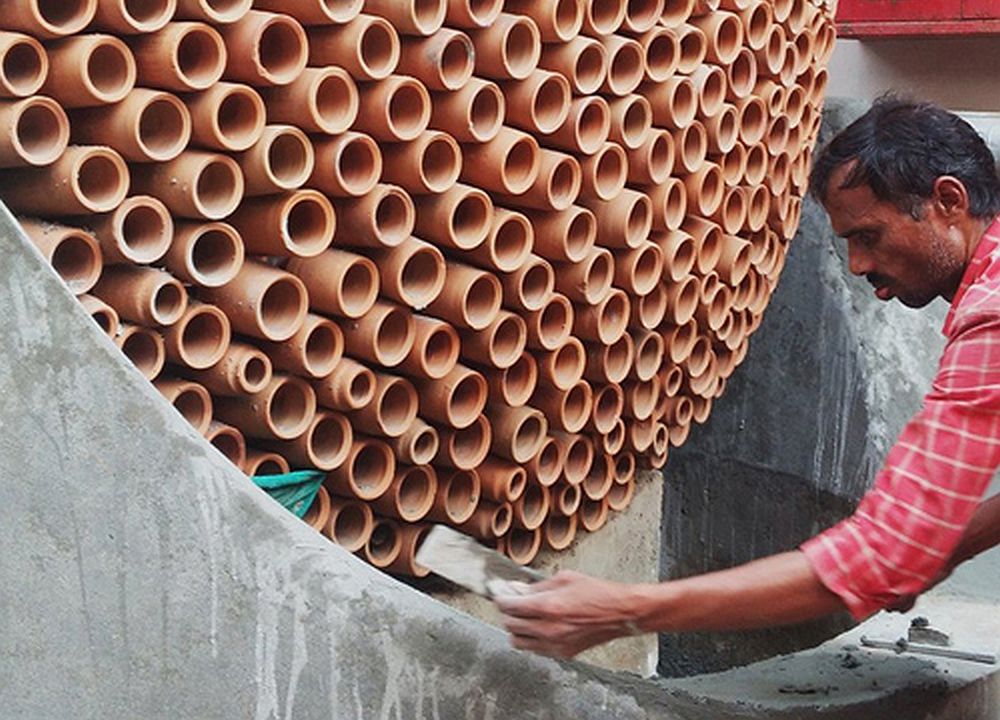
[Image above] Example of a terracotta-based evaporative cooling system designed by Indian architecture company CoolAnt. Credit: Chitrao et al., Urban, Planning and Transport Research (CC BY 4.0)
June 21 marked the first day of summer in the Northern Hemisphere, and meteorologists are forecasting that temperatures will only climb up from here. People globally will need ways to stay cool in the coming months, and in certain cases, terracotta structures may be an affordable, eco-friendly solution to this need.
Terracotta, Italian for “baked earth,” is a type of earthenware pottery that fires to a distinct reddish-brown color. It has been around for thousands of years, serving in various applications spanning architecture, art, and functional household items.
Like other earthenware, terracotta is highly porous due to being fired at lower temperatures. This property allows it to be used as a conduit for evaporative cooling.
The science of evaporative cooling
Evaporative cooling is a natural thermal regulation technique that uses the phase change of water to lower air temperature.
Water requires energy to transition from a liquid to a vapor, and it gets this energy from the heat in its surroundings. As water absorbs the ambient thermal energy, it converts this energy from sensible heat (causes a temperature change) to latent heat (causes a phase change). Because this conversion lowers the amount of sensible heat in the system, the air temperature drops, resulting in a cooling effect.
Clay is a naturally porous substance, which allows it to hold water within its internal structure for evaporative cooling purposes. As the water moves through the clay’s pores, it eventually reaches the outer surface, where it is evaporated by hot, dry air passing over the structure. More water can then move from the interior through the pores, providing a continuous cooling experience.
Terracotta evaporative systems in history
Since ancient times, clay structures have been used to support household thermal regulation. However, during the early days of sun-dried bricks, cooling was achieved purely through the structure’s thickness delaying heat transfer, as too much water could destroy the clay’s cohesion and cause it to crumble. It was only after the invention of fire-based processing that clay structures became resistant to water-driven degradation, allowing them to be used for evaporative cooling systems.
Examples of terracotta evaporative cooling systems throughout history:
- In India, terracotta pots called matka have been used for more than 3,000 years to naturally cool and store drinking water.
- In Ancient Egypt and the Middle East, terracotta jars called zeer or jarrah were placed or hung in shaded areas to cool both water and the surrounding air. (Zeer, which consisted of a unique nested two-pot design rather than a single-walled design, were also used to keep food cold.)
- In the region now known as Arizona, various Indigenous groups used earthenware pots called olla to keep water and food cool.
As these examples demonstrate, terracotta traditionally was mainly used for cooling and storing water and food rather than cooling entire living areas. While that focus remains true today (see recent examples in the “Further information” section at the end of this article), some modern companies are designing terracotta structures that are meant to regulate temperature on a larger scale.
(Similar to the early days of sun-dried bricks, terracotta façades are used to cool buildings through passive thermal buffering. However, the following section focuses on terracotta structures designed to harness the evaporative cooling effect instead.)
Terracotta evaporative systems in modern times
The recent interest in using terracotta structures to cool not just water and food but entire living areas is driven largely by the environmental downsides of modern air conditioning systems.
Increasing global temperatures combined with the urban heat island effect is causing cities around the world to experience more extreme heatwaves. Indian cities in particular regularly dominate global heat charts, with temperatures reaching more than 49°C (120°F). Extreme heat is estimated to have claimed more than 700 lives in India in 2024, its hottest year on record.
With these high temperatures comes high demand for air conditioning, which has increased in recent years. For example, the need for air conditioning in Indian cities saw the country’s average hourly demand for power rise 28% from 2019 to 2023. This demand is likely to result in the installation of 130–150 million new room air conditioners between 2025 and 2035, according to a report from the India Energy and Climate Center at the University of California, Berkeley.
Air conditioners come with a host of environmental downsides, however. Besides straining a city’s power grid, air conditioners can also make the urban heat island effect more severe because they simply extract hot air from indoors and vent it outside. In addition, most air conditioning units use hydrofluorocarbons, a group of synthetic gases with very high global warming potentials. Common alternative refrigerants have lower global warming potentials, but they often break down into forever chemicals.
To avoid using more air conditioners than necessary, companies around the world are exploring alternative cooling systems, such as radiative coatings, ceramic façades, and ice-based cooling systems. Included in these innovations are terracotta-based evaporative cooling systems.
Indian architecture company CoolAnt, part of design and research firm Ant Studios, developed an evaporative cooling design called the Beehive. This design consists of around 800 to 900 terracotta cones arranged in a honeycomb pattern and fitted around a stainless-steel framework. Recycled water is pumped over the structure to enable the cooling effect, which can reportedly achieve an up to 15°C (27°F) drop in temperature.
CoolAnt has installed at least 35 Beehive cooling towers in schools, public spaces, airports, and commercial buildings across India. The company has also experimented with designs that stack the terracotta in different shapes, and even with one that uses no water at all.
A somewhat similar design was developed by students at Yashwantrao Bhonsale Polytechnic in Maharashtra, India, which combines terracotta tubes and a fan to blow air over the tubes. This design resulted in a 1.5°C (2.7°F) drop in ambient temperature, but it does require an electric pump to recirculate the water.
Another design developed by Indian company A Threshold involves using recycled terracotta roof tiles to create screens around buildings. The screens are paired with an overhead sprinkler system, which turns on during the hottest part of the day to ensure evaporative cooling.
Over in Europe, industrial designers Andrin Stocker and Luc Schweizer from the Zurich University of the Arts designed a device called bloc° consisting of 3D-printed terracotta bricks combined with solar-powered air flow. Their award-winning modular design can reduce temperatures by up to 9°C on hot days.
Terracotta evaporative cooling systems do have some downsides, such as a decrease in efficiency as micropores become clogged and in areas with high humidity. However, it is still a promising alternative cooling method to deal with the world’s increasingly warm summers.
Further information
Check out this open-access review paper on conventional passive cooling methods.
Learn more about the mechanisms driving heat transfer and evaporative cooling in pot-in-pot coolers, like the zeer.
Learn how cooling efficiency can be improved in terracotta evaporate systems using rice husk-enhanced pottery soil.
Modern evaporative cooling systems for water and food storage:
- Contemporary jarrahs made in Jordan use special glazing techniques to ensure food safety without compromising the jar’s evaporative cooling ability.
- The double-walled Zero Energy Cool Chamber (ZECC) allows fruit crops to be stored at the production site for longer periods.
- The terracotta refrigerator by MittiCool can keep food fresh for three to five days without power. This video tells the story of the refrigerator’s development and explains how it works without electricity or refrigerants.
- Beehive-shaped terracotta structures are used by rural Kenya residents to cool produce by 10–15°C.
This open-access paper shows how terracotta evaporate systems can be used for insulin storage.