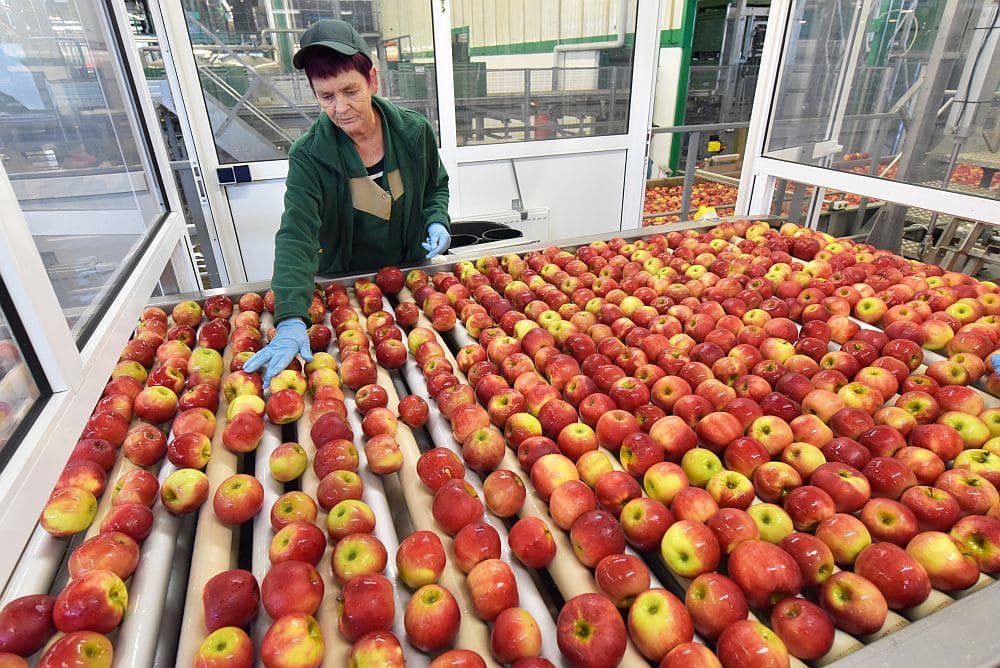
[Image above] Apples are one of the fruits that emit high volumes of ethylene, a gas that controls ripening. Producers must find ways to control ethylene emissions during transport to prevent spoilage. Credit: industryviews / Shutterstock
The recent lettuce-linked cyclosporiasis outbreak in the United States has once again brought people’s attention to the complexities and inefficiencies of the global food industry. Barring farmers markets, most of our produce comes from far-away places with numerous handling steps, increasing the chances of massive multistate contamination.
To ensure produce arrives safely at its destination, business owners must follow established sanitary transportation practices, which in 2011 were updated to focus on prevention rather than reaction. In other words, rather than fixing spoiled loads, these practices aim to stop contamination before it starts.
In the case of parasites such as Cyclospora cayetanensis, prevention can be largely accomplished by using clean water for irrigation. But preventing spoilage during transport is trickier because fruits and vegetables naturally produce a gas called ethylene, which controls their ripening. When produce is confined in closed packaging or containers, the concentration of ethylene in the air increases, accelerating the ripening process and causing a large part of the cargo to rot before reaching its final destination.
Temperature and atmosphere management can help slow the biological processes that synthesize ethylene, as well as placing adsorbent materials inside the packaging to trap and neutralize the gas. In a recent open-access study, researchers led by the University of Copenhagen revealed the mechanisms that make smectite clays a good adsorbent option.
Smectite is a group of highly adsorbent sheet silicate minerals that are abundant, low cost, and demonstrate tunable interlayer chemistry. These properties have allowed smectite to be used as an adsorbent for pharmaceutical, pesticide, and pollution remediation applications. However, the mechanisms by which smectite uptakes and retains ethylene remain poorly understood.
In their study, the researchers investigated pristine sodium montmorillonite (NaMt) and its chemically modified derivatives, acid-activated (AA-NaMt) and choline-functionalized (ChMt), to untangle the relationship between interlayer confinement, mesopore adsorption, and surface adsorption. They used numerous experimental methods to accomplish this objective, including wide-angle X-ray scattering, quartz crystal microbalance, evolved gas analysis, Fourier transform infrared spectroscopy, and inelastic neutron scattering.
The researchers determined that ethylene interacts with NaMt through both interlayer intercalation and external surface adsorption. However, the relative contributions differ significantly among the three samples, as the researchers explain below.
- NaMt: “Ethylene mainly interacts with external surfaces or defects but does not penetrate the interlayer with measurable stability.”
- AA-NaMt: “Combination of mixed intercalation and mesopore adsorption, facilitated by increased interlayer accessibility and stronger interactions with defect sites created by acid activation.”
- ChMt: “Exhibits intercalation-dominated uptake, stabilized by the combined polar (choline −OH/headgroup) and non-polar (alkyl chain) interactions in the modified galleries.”
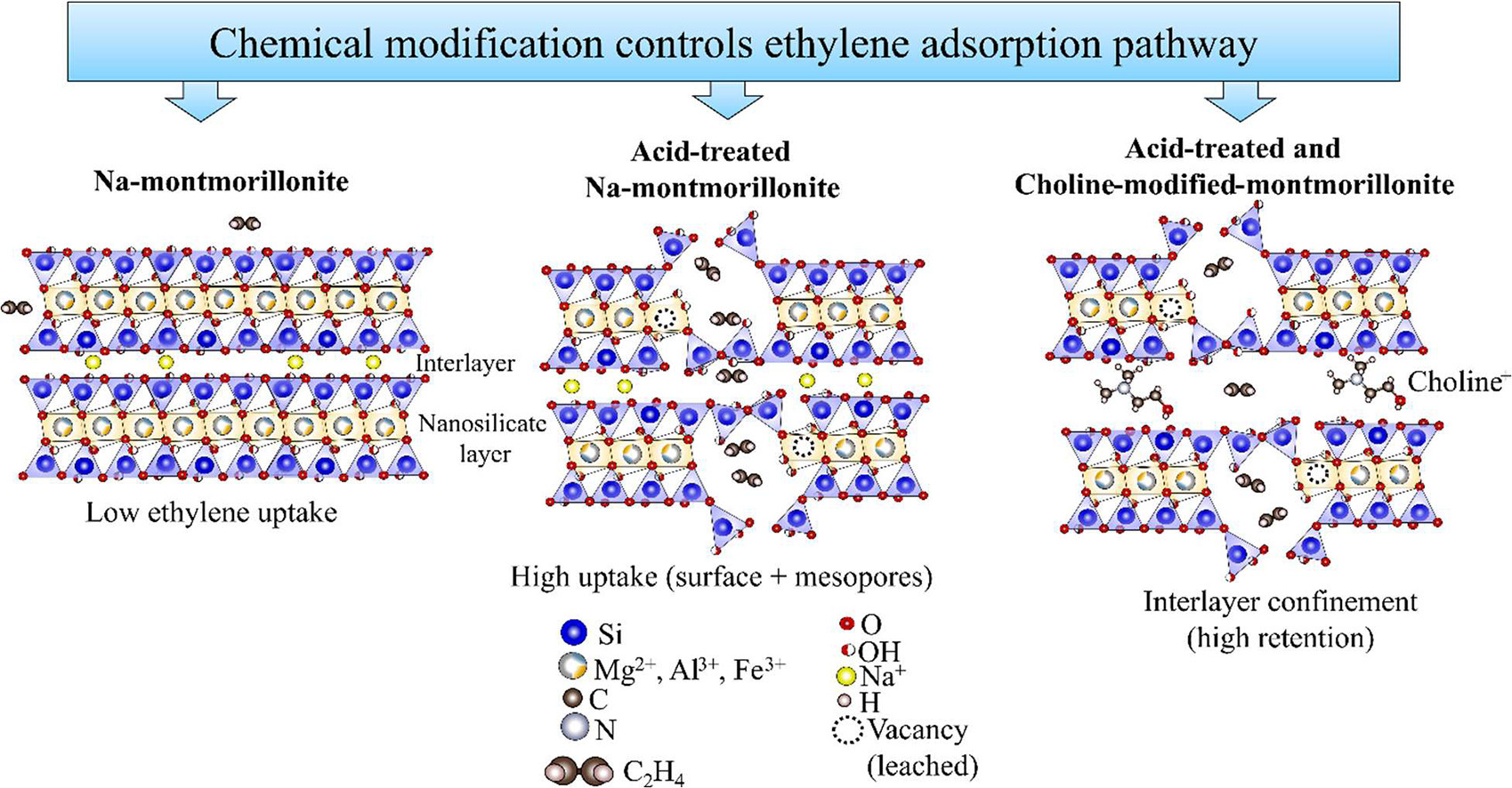
Graphical abstract showing the ethylene adsorption mechanisms of sodium montmorillonite and its derivates. Credit: Kovalchuk et al., Applied Surface Science Advances (CC BY 4.0)
With this new understanding of the fundamental physics and chemistry of ethylene adsorption, “we can control and optimize the process, which is necessary for it to be used in industry,” says first author Karina Kovalchuk, a member of senior author Heloisa Bordallo’s group at Lawrence Berkeley National Laboratory, in a press release.
The researchers are now working on optimizing the chemical process to strike the right balance between effectiveness and environmental friendliness. If successful, their technology could allow fruit to be harvested later in the ripening process, which would allow them to develop their full flavor.
The open-access paper, published in Applied Surface Science Advances, is “Disentangling interlayer confinement and pore surface adsorption in functionalized smectites for tunable ethylene gas capture” (DOI: 10.1016/j.apsadv.2026.101010).