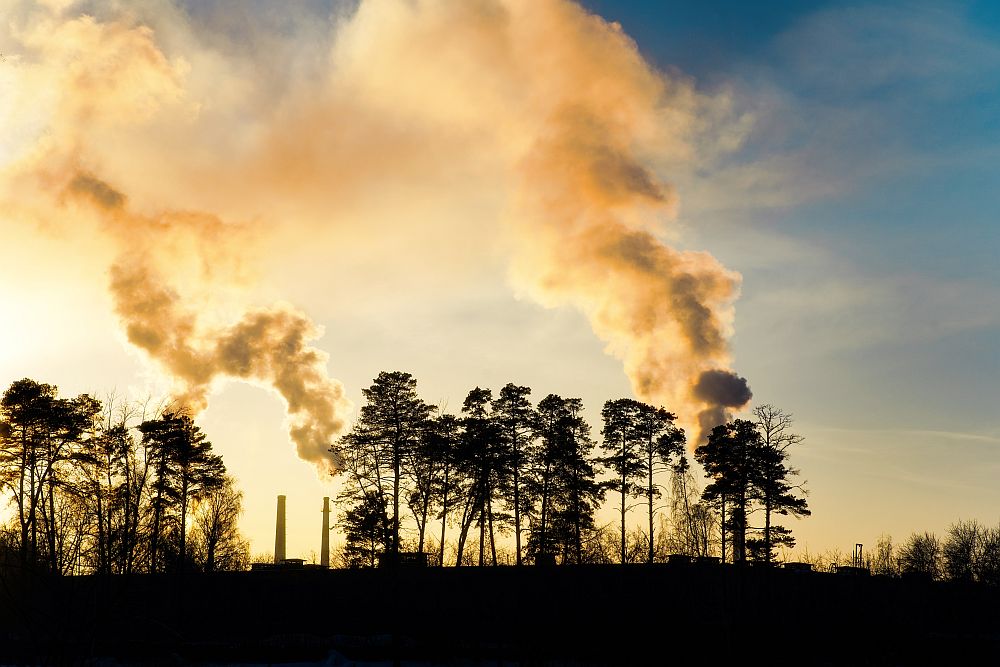
[Image above] Picture of industrial chimneys releasing smoke into the air. Several large-scale carbon capture projects are underway in the United States to trap emissions from industrial operations. Credit: IRA_EVVA(opens in new tab) / Shutterstock
There are numerous ways(opens in new tab) to reduce industrial emissions, from changing the raw material inputs and fuel sources to implementing optimized or alternative manufacturing processes. Yet for some heavy industries, such as cement and steel, the ability to adopt these solutions at scale is not yet commercially feasible. Or, as in the case of crude oil refining, it is physically impossible to completely eliminate emissions due to the inherent nature(opens in new tab) of the material being processed.
In these cases, carbon capture and storage (CCS) technologies offer a way to reduce the environmental impact of remaining emissions. CCS is the process of trapping carbon dioxide and storing it in such a way that it cannot affect the atmosphere. There is the possibility of utilizing these stored emissions(opens in new tab) for industrial purposes, but for now, that technology remains less developed.
The early 2000s(opens in new tab) saw a major global push to commercialize CCS technologies. However, many of these early projects failed because of high costs, regulatory hurdles, and slow market incentives.
In December 2020, researchers led by the University of California, San Diego, published an open-access paper(opens in new tab) looking at the obstacles that have prevented CCS from growing into an established industrial technology. But they also identified opportunities for CCS, as described in a CTT blog post(opens in new tab), and it appears some of those opportunities are coming to fruition in 2026.
Since January, several companies in the U.S. have announced the launch or expansion of major CCS projects. These massive industrial facilities are a far cry from the small pilot projects taking place just a few years before. Today’s CTT provides a glimpse into some of these projects.
CRC achieves first CO2 injection in California
In May 2026, California Resources Corporation announced(opens in new tab) that it had achieved the first carbon dioxide injection at Carbon TerraVault I, a CCS project located at the century-old oil field Elk Hills. The project involves leveraging existing infrastructure at two depleted oil and natural gas reservoirs in Elk Hills to safely and permanently store CO2 from CRC’s cryogenic gas plant more than one mile underground.
There is some controversy surrounding Carbon TerraVault I due to California failing to adopt state-level carbon storage rules before the project’s launch. Without those rules in place, there is uncertainty about who would be responsible for anything that may go wrong, as explained in a CalMatters article(opens in new tab).
BKV announces two new Texas CCS facilities are now operational
In June 2026, BKV Corporation announced(opens in new tab) the successful start-up of its Cotton Cove and Eagle Ford CCS facilities. The Cotton Cove facility, located in the Fort Worth Basin, and the Eagle Ford facility, located near Freer in South Texas, together will sequester more than 120,000 metric tons of carbon dioxide annually.
These facilities join BKV’s Barnett Zero site(opens in new tab) in North Texas, which launched in 2023. BKV is progressing additional CCS projects as part of the company’s goal of achieving a 1.5 million metric ton annual CO₂ injection rate by 2028.
Occidental Petroleum anticipates start of Texas operations by the end of 2026
Back in 2023, Occidental Petroleum formally unveiled(opens in new tab) and held a groundbreaking ceremony for its planned direct air capture project in Ector County, Texas. Later named Stratos, the facility was originally supposed to come online by the end of 2024. However, various delays(opens in new tab) have pushed the launch date to the end of 2026.
Once operational, Stratos will be the world’s largest carbon removal plant, reportedly stripping up to 500,000 metric tons of carbon dioxide from the air each year. The current largest direct air capture plant, Climeworks Mammoth facility(opens in new tab) in Iceland, can remove 36,000 metric tons per year.
Bonus: Cardinal commits to world-first float glass carbon capture installation
In August 2026, Cardinal Glass Industries announced(opens in new tab) its commitment to develop the world’s first float glass carbon capture installation at its float glass facility in Winlock, Wash. The project, which follows Cardinal’s feasibility, design, and engineering work with Italian equipment supplier K2-CO2, is expected to capture approximately 130,000 metric tons of CO2 per year.
In the announcement, Cardinal President Bowie Neumayer says this project will provide “a concrete operations target and the opportunity to generate the performance data needed to evaluate future deployment across additional float glass lines.”