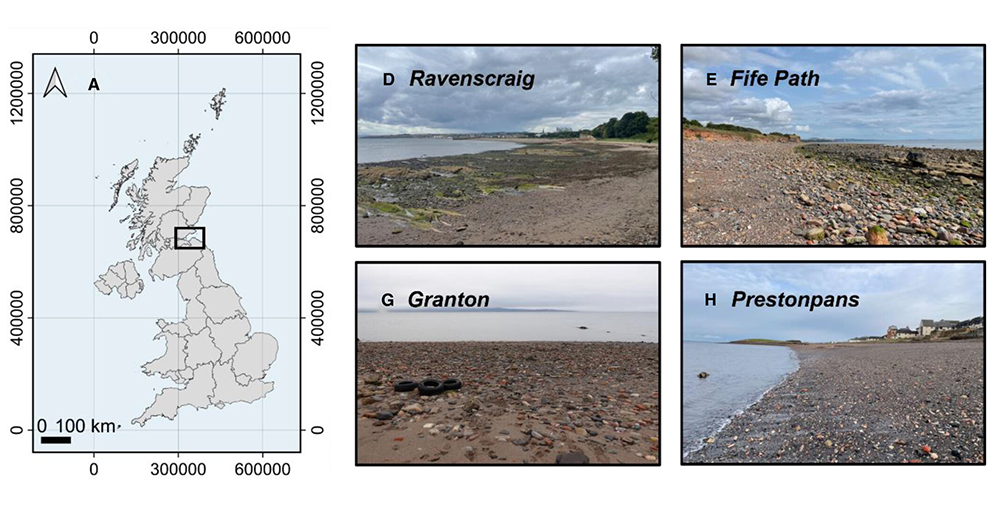
[Image above] University of Glasgow researchers surveyed six sites in the Firth of Forth region and determined that most beaches are mixed with large amounts of human-made materials. Pictured is a map of the region and photographs from four of the sites. Credit: Wang et al., Sedimentology (CC BY 4.0)
The upcoming Fourth of July weekend is usually a time for cookouts and beach trips, although this year’s celebrations will be hampered somewhat by the heat wave scorching much of the central and eastern United States. But while local outdoor excursions may be put on hold, extreme heat is not deterring such outings entirely but rather where and when they occur, with travelers showing a growing preference for destinations with more comfortable summer temperatures.
Scotland is one country experiencing growing demand as a “coolcation” destination. It is generally cooler there than the rest of the United Kingdom due to its higher altitude and more pronounced exposure to chilly Atlantic and North Sea winds. As a result, Scotland welcomed 25% more visitors in 2024 compared to pre-pandemic levels, with further growth expected.
There are ample opportunities for a beach day when vacationing in Scotland. However, visitors may discover that human activity has encroached on these once-pristine areas more than expected.
Last year, researchers at the University of Glasgow published a paper describing how steel slag leftover from local industrial processes was triggering rapid and unplanned-for rock development at Derwent Howe in West Cumbria. The discovery “challenges our understanding of how a rock is formed, and suggests that the waste material we’ve produced in creating the modern world is going to have an irreversible impact on our future,” says Amanda Owen, senior lecturer in the School of Geographical and Earth Sciences at the University of Glasgow, in a press release.
While Derwent Howe is not a popular tourist destination, the Firth of Forth estuary region is. This UNESCO World Heritage site has played a vital role in Scotland’s trade, transportation, and military strategy for centuries, and it continues to play a significant role in connecting different parts of Scotland.
This past winter, another group of researchers at the University of Glasgow published a new paper showing that anthropogenic geomaterials, such as bricks, concrete, glass, and industrial waste, make up far more of the region’s beach surface than previously realized. Specifically, materials of human origin made up around 22% on average of the pebble-sized or above sediments on the six beaches surveyed, with brick fragments being the most common at five of the sites.
Very few of the surveyed materials fell into the “fine” category (below 11 mm), suggesting that most of the materials are deposited into the Forth as larger fragments. Based on this observation, postgraduate researcher Yuchen Wang notes in a press release that “if these six beaches have accumulated so much coarse sediment through human activity, others around the country and indeed around the world are likely to be similarly affected.”
The researchers found that currently the anthropogenic geomaterials are not impacting beach morphology. However, with more tourists likely contributing to increased amounts of human-made materials accumulating along the coastline, there are “critical questions about how such materials may influence longer-term sediment dynamics and morphological evolution,” they write.
The open-access paper, published in Sedimentology, is “How natural are the sediments on our beaches? Characterising urban anthropogenic mixed beaches in Scotland” (DOI: 10.1111/sed.70072).