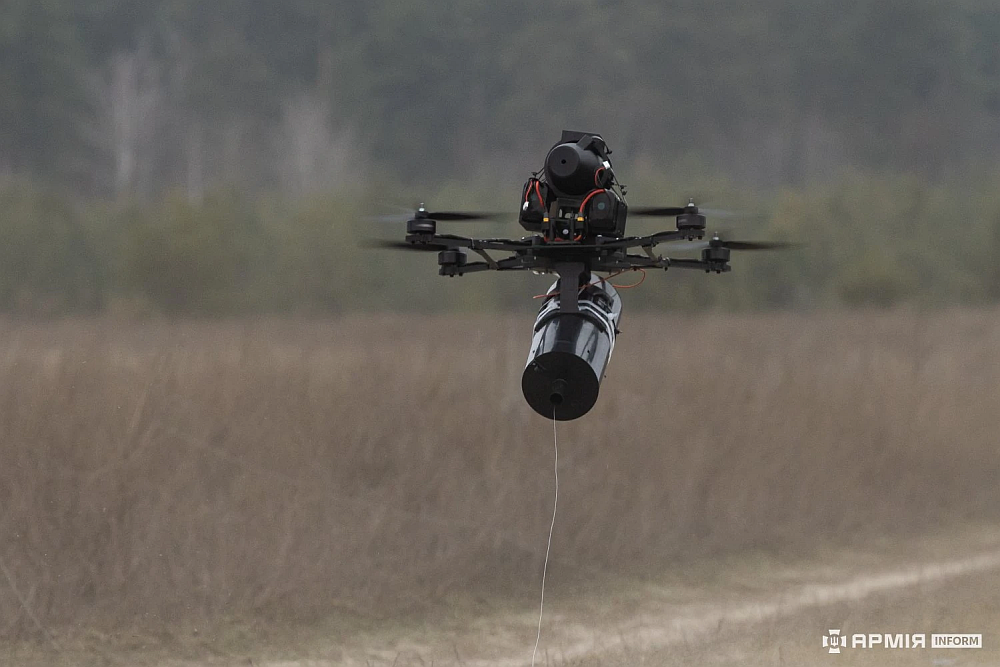
[Image above] Example of a fiber-guided drone from the war in Ukraine. The rise in fiber-guided drone warfare is creating a strain on global optical fiber supplies. Credit: Ministry of Defense of Ukraine, Wikimedia (CC BY 4.0)
For manufacturers, forecasting future demand has always been a critical part of planning production schedules, ordering supplies, and controlling costs. This practice works well during times of steady or gradual market shifts, but with the rise of increasingly globalized supply and information networks, sudden shifts are becoming the standard rather than the exception.
To improve our supply and demand planning abilities, the discipline of market forecasting must evolve to handle larger and more complex data sets. While these data sets may focus primarily on a product’s immediate or obvious markets, accounting for seemingly tangential events can be important, as these events could trigger ripple effects that ultimately impact the business.
In today’s CTT, we will look at two global trends impacting the fiber optics market. These examples demonstrate the nuances that come with modern market forecasting.
AI-driven data centers consume optical fiber supplies
The environmental impacts of data centers and artificial intelligence systems is a much-discussed topic, with their demands on local water supplies and electricity grids frequently covered in the news. But these projects consume many other resources at higher rates than traditional computer infrastructures as well, such as optical fibers.
As explained in an article on the Fiber Broadband Association’s website, optical fiber needs and requirements within data centers have steadily evolved over the past decade as the industry has moved from baseline volume server warehousing to high-performance hyperscaling. In today’s AI-driven centers, “it’s anything between a 10-to-20-fold increase in fiber,” says Keith Sullivan, director of strategic innovation at fiber optics provider AFL, in the article.
Besides a higher density of optical fibers within data centers, the physical footprint of such facilities is growing larger as well. With different parts of the center now spread out, achieving campus-level connectivity requires the use of hollow core fibers to maintain performance over the longer distances. While these fibers offer lower latency and better signal integrity compared to traditional solid core fibers, constructing their internal photonic structure is a more complex—and expensive—process.
In 2024, data centers accounted for less than 5% of total global fiber demand. But in 2025, data center fiber demand grew roughly 76%, according to global consultancy firm CRU Group, and will likely account for 30% of total global fiber demand by 2027.
This rapid growth in fiber demand means major Chinese optical fiber manufacturers have already booked orders stretching into early 2027, according to a DigiTimes report. Additionally, some manufacturers have shifted production from standard G.652D fiber (used in telecom networks) to higher-margin G.657A fiber (used in data centers and drones), which is creating secondary shortages in conventional telecom-grade fiber and contributing to broad price increases.
In response, companies such as Meta are locking in multiyear supply commitments from optical fiber manufacturers. But building new facilities to produce optical fiber preforms typically takes between 18 to 24 months, “which limits near-term supply regardless of how quickly downstream cable production can scale,” explains technology journalist Luke James in a Tom’s Hardware article.
Drone warfare an unexpected drain on optical fiber inventory
While data centers are starting to become a major player in the fiber optics market, the main driver behind the current surge in fiber prices is the massive and sustained demand for optical fiber in fiber-guided military drone systems.
Unlike radio-controlled drones that can be jammed or intercepted by electronic warfare systems, fiber-guided drones use a thin optical fiber as the primary data link between the ground control station and the munition. This setup provides numerous benefits:
- Extremely high bandwidth for real-time 4K or even 8K video transmission
- Near-zero latency (critical for precision targeting)
- Effectively immune to electronic warfare tools
On the downside, these drones require significant amounts of optical fiber for each mission. For example, modern military and surveillance units regularly deploy lengths ranging from 5 km to 20 km, with some prototypes reaching up to 50 km.
The growth of the fiber-guided drone market can be tied directly to the ongoing war in Ukraine. As explained in an article by the U.S. think tank Atlantic Council, “Fiber-optic drones first emerged at scale in August 2024 in response to Ukraine’s surprise cross-border incursion into Russia’s Kursk region. … After Kursk, the trend soon spread. Fiber-optic drones began proliferating across other areas of the front, graduating from a niche capability to a staple weapon.”
The Atlantic Council reports that the use of fiber-guided drones is now expanding beyond the war in Ukraine, with Sudanese militias, Mexican cartels, and the Chinese People’s Liberation Army reportedly incorporating such drones into their arsenals. But with this new technology comes an increasingly urgent problem—the fibers left behind after a mission.
As stated before, fiber-guided drones rely on physical tethers that link them to the ground control station. These tethers are prone to snagging on obstacles, tangling during sharp maneuvers, or breaking if the drone encircles too many objects. When that happens, the fibers are typically left behind on the battlefield.
However, drone fibers are designed to be strong and durable, meaning they can remain in the soil or hanging from trees for a long time. With millions of kilometers of optical fibers now covering Ukrainian territory, it creates a new challenge for humanitarian mine clearance teams after the war, as explained in a Ukrainska Pravda article.
“The first problem is that long cables lying in the grass or hanging in bushes and between trees may become tangled up with ammunition. An unexploded drone may even be lying at the end of the wire. If these strands are pulled, it could trigger an explosion or start a large fire,” the article says. “In addition, fiber-optic cable resembles a tripwire. Mine-clearance personnel will have to check every single strand, which will slow their work enormously.”
Besides its effect on mine clearance procedures, the optical fibers could negatively impact the wildlife that become entangled in them. Furthermore, once the fibers sink into the soil, metal detectors will not be able to detect them. How this contamination impacts future farming in the area is an open question.
“There is always room for technological innovation in this field. Perhaps, in time, Ukrainian mine-clearance specialists, engineers, or scientists will find an effective way to study this problem and produce a ready-made solution to overcome it,” the article concludes.