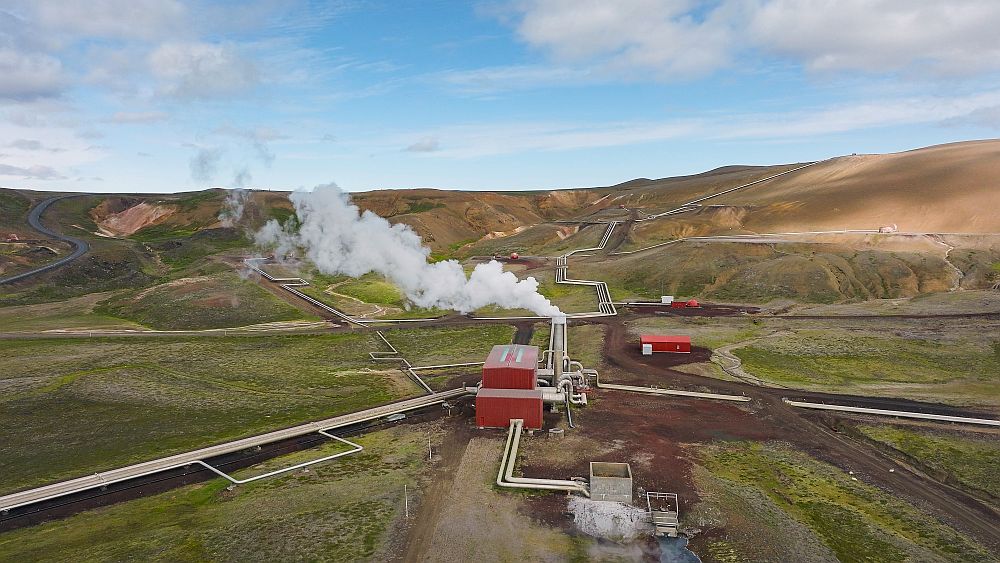
[Image above] Example of a geothermal power station in Iceland. The country is one of the rare spots on Earth that can easily make use of geothermal energy. Credit: 24K-Production / Shutterstock
The interior of the Earth holds enormous quantities of thermal energy in the form of hot water reservoirs and superhot rocks, i.e., deep subterranean rock formations with temperatures exceeding 374°C (705°F). Unlike solar or wind power, geothermal energy is continuously available, and the facilities used to extract this energy offer one of the smallest land footprints per megawatt of any utility-scale power source.
However, there are significant challenges to extracting this energy on a large scale. Hot water reservoirs with temperatures ranging between 50–100°C exist relatively near the Earth’s surface, typically 2–3 km deep. Accessing and extracting water from these reservoirs is not too difficult, but their presence is largely limited to tectonically active regions with the right geological conditions, such as geysers or volcanic zones (think Iceland).
In contrast, superhot rocks are available all around the world and can be used to heat pumped water that is then extracted as a dense fluid. However, accessing superhot rocks is typically extremely difficult. These geological formations are often found 10 km below the surface, which is more than double the depth of a conventional oil well.
Under the immense pressures and soaring temperatures found at this depth, conventional tungsten carbide or diamond-tipped drill bits fail fast. The mechanical teeth are pulverized, and the bearings wear down to nothing in a matter of hours. Consequently, traditional hard-rock drilling proceeds at less than a meter per hour. Worse, replacing a ruined cutting head requires extracting kilometers of heavy driving rods piece by piece just to swap a bit, a costly process in both time and money.
Because mechanical drilling becomes exponentially more expensive the deeper and harder the rock gets, grid-scale superhot rock geothermal systems have been effectively locked out of 95% of the planet. But millimeter-wave (MMW) gyrotrons may be the key to overcoming this limitation.
MMW drilling is a paradigm-shifting directed-energy approach to achieving universal superhot rock access by melting and vaporizing rock rather than grinding it. It is more efficient than traditional drilling because there are no cutting heads to wear out. Rather than fighting the superhard bedrock, it simply melts it out of the way—a unique (and realistic) solution to the logic puzzle of when an unstoppable force meets an immovable object.
This CTT looks at the potential of MMW drilling to not only increase access to superhot rock geothermal energy but also its efficiency as an energy source.
A closer look at small-scale geothermal energy
One of the great things about our Earth is that the shallow subsurface (down to about 10 meters or 32 feet) acts as a massive thermal battery. It absorbs solar radiation throughout the year and insulates that energy against the rapidly shifting temperatures of the air above. As a result, the temperature stays relatively constant at approximately 10°C to 15°C (50°F to 60°F).
To capitalize on this stored energy, water with an antifreeze agent (typically propylene glycol or ethanol) or a refrigerant (in direct-expansion systems) is pumped through loops of pipe buried at 2 to 9 meters (6 to 30 feet). The fluid either heats up or cools in relation to the temperature difference between the entering fluid and the surrounding soil. It then circulates through a heat exchanger that efficiently uses the thermal energy picked up by the fluid.
When my parents moved to Delaware approximately 20 years ago, one of the first things they did was remove their oil-burning furnace and install a horizontal-loop geothermal heat pump. Although this system worked well for controlling the temperature in their single-family home, tapping enough energy to power a city requires the extraction of geothermal energy from much deeper depths.
Currently, geothermal energy accounts for less than 1% of global electricity. If geothermal producers can reach depths of 10 kilometers or deeper to access superhot rock, up to 10 times more energy can be extracted than modern enhanced geothermal systems (i.e., artificial hot water reservoirs).
The science and technology of MMW drilling
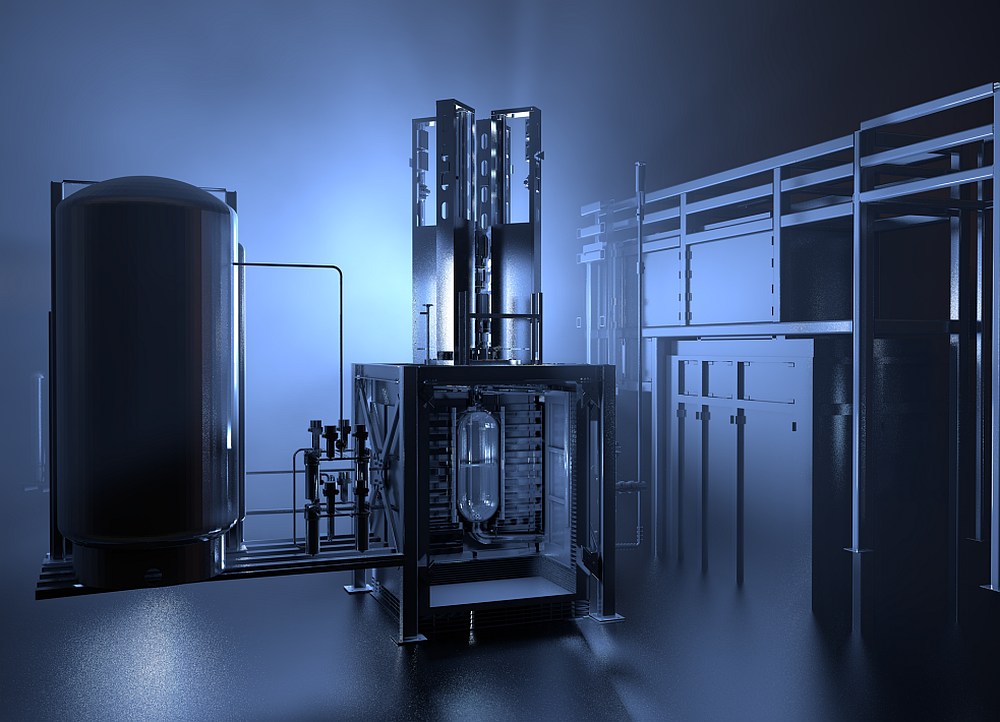
MMW drilling leverages a well-established nuclear fusion technology: the gyrotron. A gyrotron is a high-powered vacuum tube that emits millimeter-wave electromagnetic radiation. These waves are traditionally used to heat plasma in fusion reactors, but ceramic engineers may also use them to sinter advanced ceramics. In the case of MMW drilling, the gyrotron is used to melt and vaporize the hard bedrock.
Taking a temporary detour through introductory physics, you may remember that wavelength and frequency are inversely related. MMW wavelengths are hundreds of times longer than those of thermal far-infrared cutting lasers, and their frequencies are proportionally lower.
The long wavelength allows the MMW energy beam to pass cleanly through clouds of vaporized rock nanoparticles without experiencing severe energy scattering or attenuation. This fact makes gyrotrons up to five times more energy efficient at heating and melting rock than standard, shorter-wavelength lasers.
To capitalize on the strengths of both traditional drilling and the gyrotron, MMW drilling is a hybrid mechanical/directed-energy process. Conventional rotary drills begin the operation by penetrating the softer, top sedimentary layers of the Earth’s crust. Once the ultrahard crystalline basement rock is reached, the mechanical bit is pulled and the MMW gyrotron system is activated to blast downward.
High-pressure gas streams (such as nitrogen or argon) are continuously injected downhole to flash-cool the hot rock vapors into fine nanoparticles, flushing them cleanly up and out of the wellbore.
The intense high-frequency thermal energy fundamentally alters the borehole walls. As the primary beam vaporizes the central core of the hole, the peripheral heat partially melts the surrounding rock walls. As this molten layer cools, it transforms into a permanent glass-like liner. Vitrification has the following intrinsic advantages:
- Real-time sealing: It automatically seals microfractures and wall cracks as the drill proceeds, structurally casing the hole without additional steps.
- Extreme pressure resistance: The glassy boundary reinforces the borehole walls to withstand thousands of atmospheres of pressure.
- Eliminating casing costs: It removes the need for expensive metal casings and traditional drilling muds, both of which routinely fail or break down under extreme deep-well temperatures.
The commercialization timeline
MMW drilling had its beginnings in 2008 at Massachusetts Institute of Technology (MIT) when Paul Woskov, senior research engineer at MIT’s Plasma Science and Fusion Center, and Dan Cohn, an MIT research scientist and professor emeritus, secured funding from the MIT Energy Initiative to prove the theoretical physics of directed-energy drilling. In 2009, they validated the physics of MMW drilling, successfully transitioning the concept from math into small-scale laboratory experiments on basalt samples.
In 2017, Aaron Mandell from Seattle-based renewable energy company AltaRock Energy—already working on enhanced geothermal systems and studying the economics of superhot rock geothermal systems—introduced Woskov to AltaRock Energy engineers Carlos Araque and Matt Houde. Mandell, Araque, and Houde collectively spun the MMW technology out of MIT in 2018, co-founding Quaise Energy to commercialize the gyrotron hardware.
AltaRock Energy secured an independent ARPA-E grant in 2019 to advance MMW deployment pathways. Then in 2020, Quaise Energy successfully closed a US$6 million seed funding round to scale laboratory testing.
AltaRock and Quaise are synergistic collaborators rather than competitors. Quaise is the primary tech developer scaling the MMW hardware, while AltaRock provides the geological expertise and field site execution.
Quaise is now targeting a 4.8-km (3-mile) deep hole at the Newberry Volcano crater in Oregon. Newberry is the perfect geological testbed because shallow magma allows the team to hit superhot conditions at a fraction of the depth required in intraplate regions.
Outlook on economics and scale
Quaise has evolved from using a modest 10-kW gyrotron for centimeter-deep laboratory samples to engineering a massive gyrotron at Oak Ridge National Laboratory capable of boring holes in large-scale rock formations at up to five meters per hour.
Traditional mechanical deep-well drilling can easily surpass US$20 million per well due to component wear. At extreme depths, MMW drilling holds the potential to be up to 10 times cheaper overall than traditional rotary methods because it is not mechanical and operates continuously. These two factors combined remove millions of dollars in wasted operational expenses spent stopping operations just to pull kilometers of pipe up to change worn-out bits.
The best part of this technology, in my opinion, is the opportunity to reuse existing infrastructure. Quaise’s long-term goal is to deploy MMW drilling rigs at soon-to-be-decommissioned coal and natural gas power plants. By drilling deep, localized superhot rock loops at these facilities, they can swap out the old fossil-fuel boilers and feed clean geothermal energy directly into the plant’s turbines and export it through the existing electrical grid connection. This setup preserves local energy jobs and saves trillions in capital expenditures.
Technical challenges and pitfalls
By now, maybe you are wondering what’s the catch. There are some technical issues that remain to be addressed. For example, as the borehole extends past 10 kilometers, maintaining beam coherence and preventing energy loss along the walls of the waveguide remains a primary engineering hurdle.
Additionally, injecting purge gases miles into the earth to clear out rock nanoparticles causes immense fluid friction against the narrow borehole walls. The resulting pressure drop requires scaling exponentially more powerful surface compressor pumps.
The third potential issue is the common environmental concern that deep drilling may trigger local microearthquakes. This concern stems from the fact that traditional enhanced geothermal systems target unstable, highly fractured, young tectonic boundaries (such as fault lines) because that is where the shallow heat is found. However, MMW drilling allows you to dig deep enough to access heat anywhere, so 95% of future commercial operations can take place in stable, intraplate settings that are entirely isolated from active fault lines (and risk of seismic activity).
The vitrified heart of clean energy
MMW drilling bridges the technological and economic gap that has held back geothermal energy adoption, allowing it to compete directly on cost with wind and solar while providing the ultimate missing puzzle piece: always-on baseload reliability. And at the core of this method are vitrified boreholes, giving this technology a glassy heart.