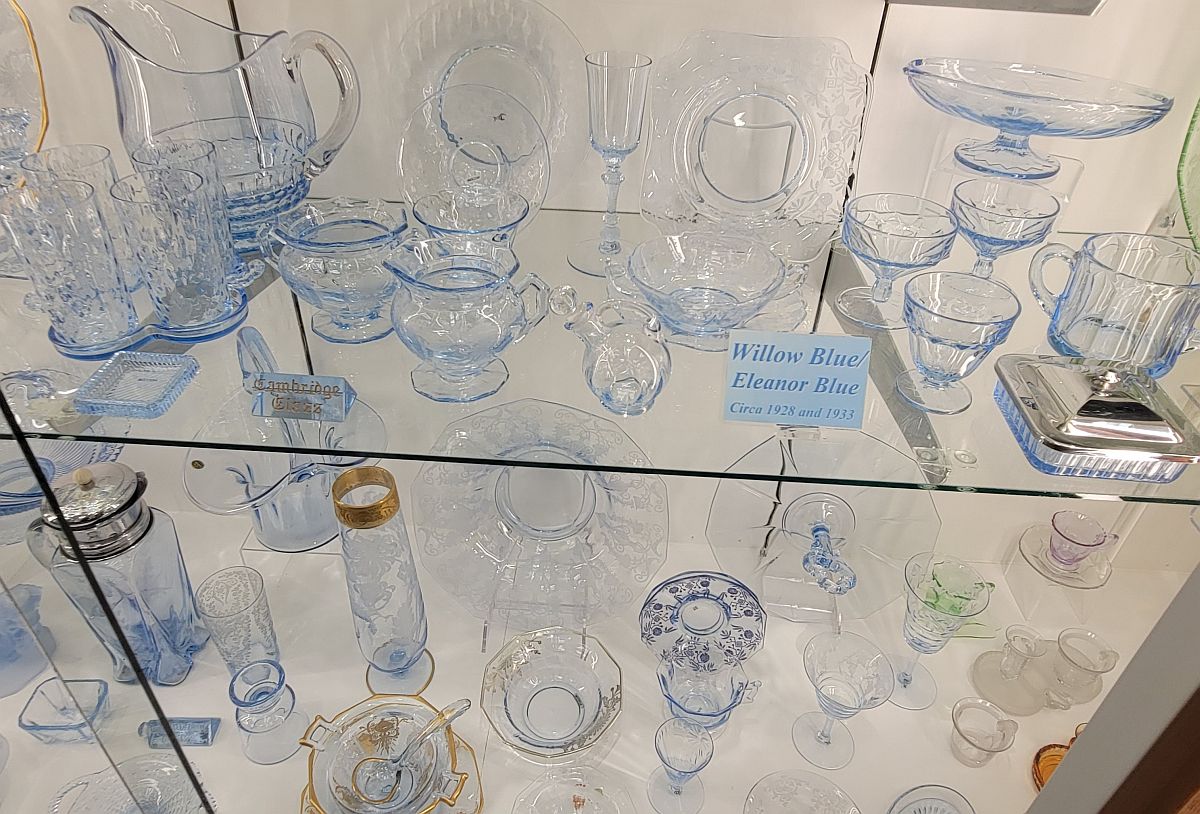
[Image above] At the 1933 U.S. presidential inauguration, First Lady Eleanor Roosevelt wore a slate-blue silk crepe evening gown that caused a stir in the fashion scene. The Cambridge Glass Company subsequently renamed their color “Willow Blue” to “Eleanor Blue,” as seen with the glass containers in the picture above. Credit: Laurel Sheppard
Learn more about the CTT special series on the Ohio Creativity Trail and find links to all the ceramic and glass sites highlighted in this post.
As we travel around Ohio for this series, who knew there would be so much glass history! At least, I didn’t. This month, we head east to the city of Cambridge (about 80 miles from Columbus) and the village of Bellaire (about 50 miles east of Cambridge) to take a closer look at three sites on the trail: the National Museum of Cambridge Glass, Mosser Glass, and the Imperial Glass Museum.
Cambridge Glass: Genuine hand-made glass for more than 50 years
Although The Cambridge Glass Company was chartered in 1873 by a group of local businessmen, it did not start operating until almost 30 years later. The catalyst for operation was when the newly formed National Glass Company purchased the site in 1899. This company had the funds to start construction, and after nearly four years of development, the first piece of glass—a three pint pitcher—was produced in May 1902.
Cambridge Glass operated for five decades and prospered for most of these years under the leadership of President Arthur J. Bennett. By the 1920s, after Bennett introduced a variety of opaque colored items, the company had as many as 700 employees working three shifts a day with 56 pots of glass in use. During this period, complete dinner services were also added to the product line.
The next decade saw more new colors being added (such as Carmen, Royal Blue, Crown Tuscan, and Heatherbloom), as well as new patterns being developed (such as the 3400 line, Caprice line, Statuesque stem line, and Rose Point etching). In 1939, Bennett sold the company to his son-in-law, Wilber L. Orme, who continued to develop designs and colors.
After Orme closed the plant in 1954, it was reopened under new ownership in March 1955. The last president of the company, Mary Martha Mitchell, who had been secretary to both Bennett and Orme, closed Cambridge Glass for the final time in 1958.
Much of this history would have been lost if it were not for the National Cambridge Collectors Inc., which was founded in 1973. Their mission to establish and maintain a permanent museum in Cambridge, Ohio, was finally realized when the museum was dedicated in 1982. After a flood in 1998, the museum was moved to a former electric company office building and reopened in 2002.
I visited the museum in August 2025, when I was in Cambridge for a family bridal shower. In addition to the beautiful displays of glassware and other artifacts, the museum has a gift shop, where I found a souvenir to bring home. Watch the following video with pictures from my tour of the museum, where you will see connections to several celebrities.
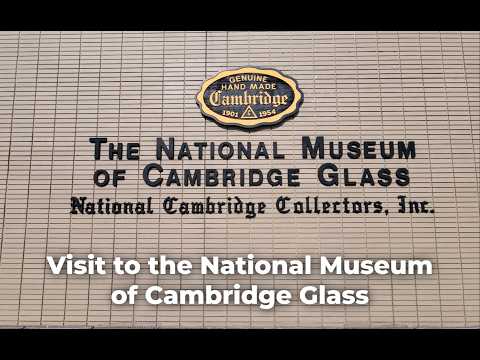
Credit: The American Ceramic Society, YouTube
Further information
Read this article for another take on the museum.
Learn more history at this link and take a virtual museum tour at this link.
To see more Cambridge glass in person, don’t miss the annual convention in June.
At the Virtual Museum, you will learn more about the company’s history, peruse 32,000 photos of Cambridge glass, and watch how glassmaking was done in the first half of the 20th century.
Mosser Glass: Premium hand-pressed glassware since 1971
About two miles from the National Museum of Cambridge Glass is Mosser Glass, which my husband and I visited in March 2026. An operating factory, Mosser uses a multistep process to make their glassware, which we got to see in person during a free factory tour:
- Raw materials are melted in five day tanks and three pot furnaces at a temperature of 2,500°F. Working temperatures range from 1,800°F to 2,000°F.
- Cast iron molds are heated up to 1,000°F before production.
- The gatherer removes the melted glass from the furnace, which is pressed into the mold pattern. Air is blown onto the glass to cool and harden.
- Polishing takes place in a glazer, which melts off the very outer layer of the glass for a smoother finish.
- The glassware is annealed for 3.5 hours through a tunnel to prevent it from shattering or breaking.
- The annealed glassware is inspected and packed for shipping or sent to the stockroom.
It should be no surprise that Mosser Glass has a connection to Cambridge Glass. Orie Mosser was a plant manager at Cambridge, and his son Tom worked there as a teenager to learn the trade. After Cambridge Glass closed, Tom decided to start his own company, which took five years to establish. He eventually formed Variety Glass, which made pharmaceutical glassware.
In 1971, Tom established Mosser Glass. The company produced glassware based on Viking, L. G. Wright, and Cambridge Glass designs, as well as their own. Family members continue to operate the company, including Tom’s son and two daughters, providing fresh ideas for glassware designs. Mosser Glass also continues the tradition of supplying the White House (2016 Annual Glass Heirloom Easter Egg) and several celebrities, such as singers Cher and Kate Perry.
After the tour, we checked out the beautiful gift shop. A few minutes later, a young woman entered the store, and serendipitously, it was the relative whose bridal shower I had attended last year! We enjoyed catching up and shopping together, both making a purchase: Mine was a housewarming gift, and she bought something for herself. It was a good thing our visit to Mosser was that day!
View the following video to see pictures from the factory tour and gift shop.

Credit: The American Ceramic Society, YouTube
Further information
Watch SciFi Channel’s How It’s Made (at the 9:00 mark) to see how pressed glass is made at Mosser Glass.
Read more about Mosser Glass at this link.
Imperial Glass: 80 years of production
The Imperial Glass Company’s history is almost as colorful as its glass. The company rose from the ashes of the Crystal Glass Company of Bridgeport, Ohio, which was established by Edward Muhleman. He had sold that company to the National Glass Company in 1899, but after two years, he decided to start his own company in Bellaire. After building a new factory, production began on Feb. 3, 1904.
Within six months, Imperial Glass became a major player in the handmade glass industry, producing bottles, tumblers, jelly jars, electric and gas lamps, and tableware. Over the next several decades, the company continued to expand by introducing new products and making lucrative deals with the likes of F. W. Woolworth and its 500 stores. Popular designs included Free Hand, Candlewick, and Cape Cod.
Although Imperial Glass survived a bankruptcy in 1931, a direct result of the Depression, it was faced with increasing foreign competition during the 1960s. Bankruptcy soon loomed again, so an effort was made to save the company by selling it to Lennox in 1972, followed by others. Sadly, these sales could not stop the decline, and Imperial Glass was forced to close in 1984.
As with Cambridge Glass, collectors came together to save the history of Imperial Glass and its glassware. The Imperial Glass Collectors’ Society, formed during the 1970s, established the National Imperial Glass Museum in 2003. The museum has more than 3,000 pieces in its collection.
A virtual tour of the museum is available on the Ohio Department of Development, TourismOhio website. The museum is open to visitors Thursdays through Saturdays from 11 a.m. to 3 p.m. starting in April and going through October.
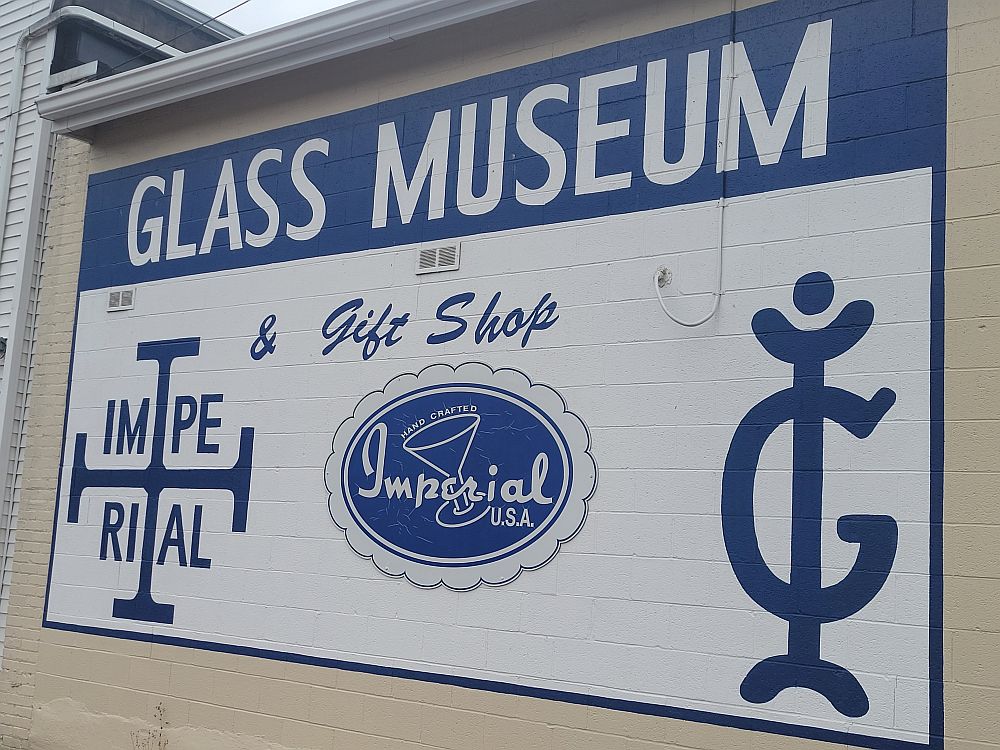
Sign outside the Imperial Glass Museum. It was not yet open for the year when the author visited the area in March 2026. Credit: Laurel Sheppard