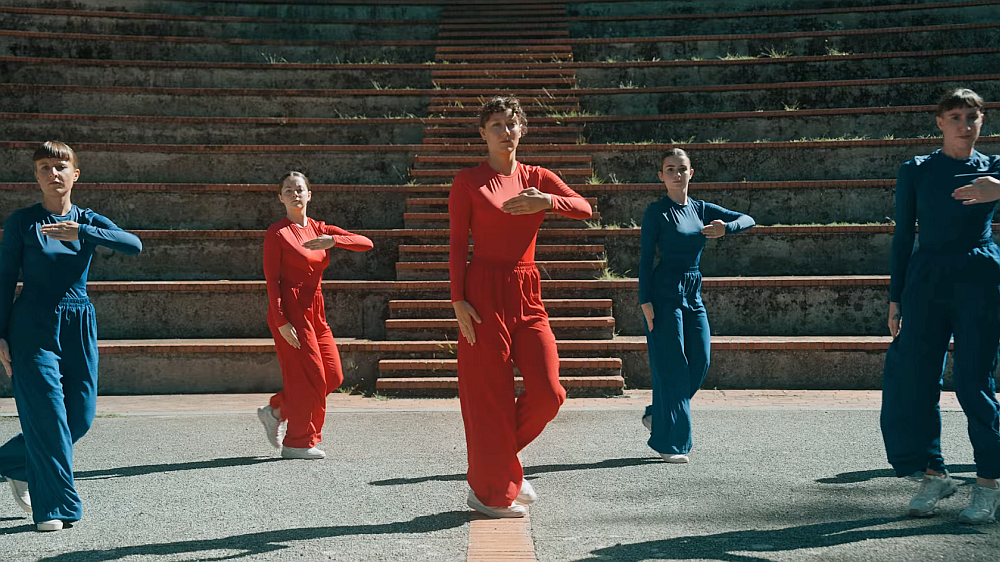
[Image above] Sofia Papa’s winning video explained the concept of piezoelectricity through the movement of professional dancers. Credit: MOV, YouTube
Defending your Ph.D. thesis can be an intimidating experience. It requires standing in front of a panel of respected professionals who may not fully grasp the intricacies of your experiments, and you must explain the science in such a way that they understand its importance and approve the awarding of your degree.
It is easy to get caught up in the weeds of your research when preparing for this presentation. Stepping back from the overwhelming details of the study and instead focusing on the broad picture is essential, and the annual Dance Your Ph.D. contest can help students do just that.
Dance Your Ph.D. is an annual contest run by the American Association for the Advancement of Science and Science, the peer-reviewed academic journal of AAAS. It was created in 2008 by John Bohannon, former Science correspondent and now data scientist at South Park Commons.
Dance Your Ph.D. challenges scientists to interpret their Ph.D. theses through movement rather than the traditional formats of PowerPoint presentations or academic journals. The contest is divided into four categories—biology, chemistry, physics, and social sciences—and videos of each performance are judged by a panel of dancers, scientists, and artists.
Artificial intelligence and quantum technology company SandboxAQ sponsors the contest, which this year included a new prize for entries that utilize AI to support their videos. View all the winners for 2026 below, and perhaps be inspired to submit your own research next year!
Overall winner and physics category winner
Sofia Papa, Sant’Anna School of Advanced Studies, “Piezoelectric polymer materials for printed wearable ultrasound transducers”
Sofia Papa is a third-year Ph.D. in biorobotics at the Sant’Anna School of Advanced Studies in Italy. Her research focuses on the study of piezoelectric polymeric materials for the creation of printed wearable ultrasonic transducers.
Papa is a member of the professional dance group COMPANY.MOV. When she learned about the Dance Your Ph.D. contest, she choreographed a sequence that explains “how manufacturing parameters and subsequent treatments influence the crystalline structure of chitosan films and therefore their piezoelectric response,” she says in a press release. Six members of COMPANY.MOV then performed the choreography, and their movements reflected the behavior of the materials.

Credit: MOV, YouTube
Biology category winner
Laura Ihalainen, University of Eastern Finland, “Quantifying the benefits and cost-effectiveness of real-ear measurements (REM) for hearing aid fitting”
Laura Ihalainen works as a clinical lecturer at the University of Eastern Finland and as a specialist in otorhinolaryngology at Kuopio University Hospital. Her thesis work examined different hearing‑aid fitting methods and their effects on the patient’s auditory performance and satisfaction.
The University of Eastern Finland issued a congratulations on LinkedIn following the announcement of the 2026 contest winners.

Credit: Laura Ihalainen, YouTube
Chemistry category winner
Dina Haddad, University of Cambridge, “Extraction of cell-free DNA using magnetic nanoparticles for urine biopsy”
Dina Haddad is a Ph.D. student at the University of Cambridge in the U.K. She is working on the development of nanocomposite materials for the extraction of cell-free DNA from urine, a technique that could enable earlier and less invasive disease detection.
Haddad says in a press release that participating in the contest was her way of “having some fun with my research.” The research depicted in the music video “has progressed exceptionally well, culminating in award-winning work, a patent, and the launch of a successful spin-out company,” according to a Cambridge Trust LinkedIn post.

Credit: Dina Haddad, YouTube
Social sciences category winner
Asia Kaiser, University of Colorado Boulder, “The landscape and socioecological drivers of insect biodiversity in cities”
Asia Kaiser is a Ph.D. candidate in the University of Colorado Boulder’s Department of Ecology and Evolutionary Biology. She studies how human land use affects different insect groups and, consequently, the ecosystem services they provide in coupled human–natural systems.
Kaiser explains in a press release that “I was a dancer all through college, so I have a background in belly dance and Latin dance. And I like to make music [she is a cellist], so I thought this could be a really fun way to explain my research.” She and Ella Henry, another Ph.D. student and violinist, recorded the music for the video, which was shot in front of the Department of Ecology and Evolutionary Biology’s greenhouses.

Credit: Asia Kaiser Research, YouTube
Special AI prize winner
Kate Kondrateva, Maastricht University, “Why tumors ‘light up’ on contrast MRI: Gadolinium delivered by blood shortens T1 relaxation, increasing signal on T1-weighted images”
Kate Kondrateva is a Ph.D. candidate in clinical data science at Maastricht University in the Netherlands. Her research focuses on MRI scans and making brain volume measurements comparable.
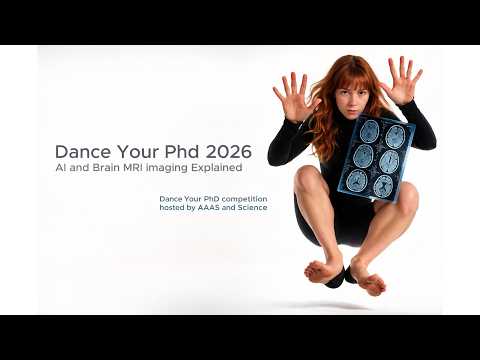
As explained in a press release, Kondrateva used ChatGPT to formulate a shot-by-shot script for her video, which demonstrates why information from MRI scanners varies slightly from machine to machine. She then fed related prompts into Google’s AI video generator Veo to develop visual effects, including bright lights and intense colors, which she overlaid on her own dancing.