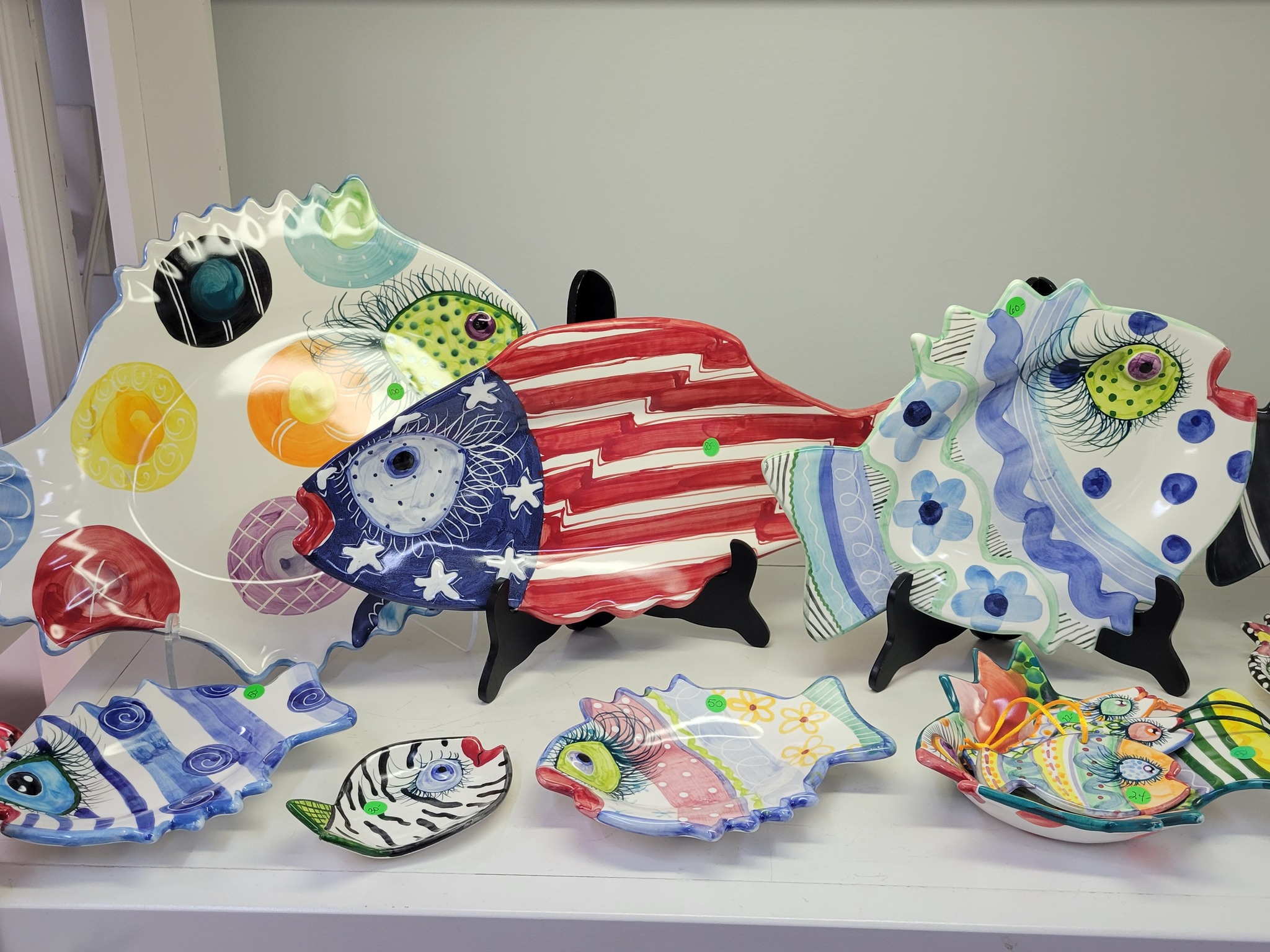
[Image above] Example of majolica fish for sale at Packer Creek Pottery. Credit: Laurel Sheppard
Learn more about the CTT special series on the Ohio Creativity Trail and find links to all the ceramic and glass sites highlighted in this post.
This month, we continue our exploration of the Ohio Creativity Trail by featuring two places in northwest Ohio: a small pottery and a glass museum. The two locations are about a 40-minute drive from each other and were visited after first touring the Blair Museum of Lithophanes in Elmore, Ohio, in October 2025. Fortunately, the pottery was only 10 minutes away from the lithophane museum, so that was the second stop.
Packer Creek Pottery: Magnificent majolica
In the village of Genoa, located in Ottawa County, a small pottery called Packer Creek Pottery is making majolica in almost the same way it was produced centuries ago.
Majolica, previously known as maiolica, is a style of earthenware pottery with an opaque white tin glaze. Its name is derived from the port of Mallorca, a Mediterranean island off the east coast of Spain, where the Italians imported Hispano-Moresque pottery during the 15th century (this pottery inspired the development of majolica).
In the 19th century, Wedgwood and Minton in England started producing majolica, as well as Sarreguemines in France. Several Portugal locations also produced majolica, including Caldas da Rainha (read more here).
Majolica is decorated by applying metal oxide colorants by hand to the raw glaze surface. After firing, a brightly colored pottery results. Packer Creek Pottery, founded by Jan Pugh in 1979, uses the following process:
- The clay is shaped and formed by hand using a potter’s wheel.
- The formed clay is placed into kilns and fired into bisqueware.
- Bisqueware is dipped by hand into a large batch of opaque white glaze, a combination of frit (ground glass) and other materials.
- After the glaze dries for several days, it is hand painted with decorative patterns and designs.
- The decorated ware is loaded onto stilts (clay platforms with wire prongs to prevent the glaze from melting the pots to the kiln shelves) and placed into kilns for the final firing at 1,600°F for 24 hours.
- After unloading, the bottom stilt marks are sanded to a smooth finish. Each item is then catalogued and labeled.
In 1993, the White House commissioned Pugh to create an angel for a Christmas tree in the Blue Room. The original now resides in the National Archives. Packer Creek Pottery ware can also be found in the homes of many celebrities, including Jerry Seinfeld, Julie Andrews, Barbara Bush, Queen Noor of Jordan, Jamie and Joy Farr (Jamie Farr played Klinger on the classic TV show MASH; his wife Joy is also an actress), Katie Holmes, and Lebron James.
When I visited Packer Creek Pottery in October 2025, it was a cloudy, chilly day. But all thoughts of the poor weather vanished as I stepped inside. The burst of color found in the pottery displayed on the shelves brightened the gloom outside. I soon forgot about the weather with all the colorful wares. As my friend and I looked around, we were greeted by almost every hue and shade of the rainbow. Once we had perused all the pottery, we had a difficult decision to make: what to purchase as a souvenir to remember our visit (I chose several ornaments).
Enjoy the beautiful majolica by watching the video below. (You can order online if you can’t resist!) If you want to see the pottery in person, you can tour the studio on the following upcoming dates:
- May 6 (Wednesday): 11 a.m., 1 p.m., and 3 p.m.
- June 12 (Friday): 11 a.m., 1 p.m., and 3 p.m.

Credit: The American Ceramic Society, YouTube
Further information about majolica
Learn more at the Majolica International Society’s website.
More historical information on the majolica industry.
Learn about the different types of majolica here.
Advice on how to collect majolica.
An online exhibit of maiolica at the Art Institute of Chicago.
For bookworms, there is even a mystery involving majolica.
Fostoria: An early glass manufacturing powerhouse
Northwest Ohio saw a burgeoning glass industry in the late 1880s and early 1890s when natural gas was discovered on the Karg property in the city of Findlay on Jan. 20, 1886. The Karg well produced 40 million cubic feet of gas per day and allowed streetlights to burn 24/7. “Free Gas in Findlay, Ohio, The Center of the Universe,” one sign read at the time.
Unfortunately, Fostoria did not have a source of natural gas within the city, and it had to spend a significant amount of money to pipe in gas from a large well in the nearby village of Bloomdale. But after the gas line was completed, numerous glass companies set up operations in the area, which you can learn about at the Glass Heritage Gallery.
Established in 1992, this museum is dedicated to preserving and illustrating the history of Fostoria’s glassmakers. In total, there were 13 glass companies in Fostoria, Ohio, from 1887 to 1920. During the early years, there were about seven or eight plants operating at any given time in Fostoria.
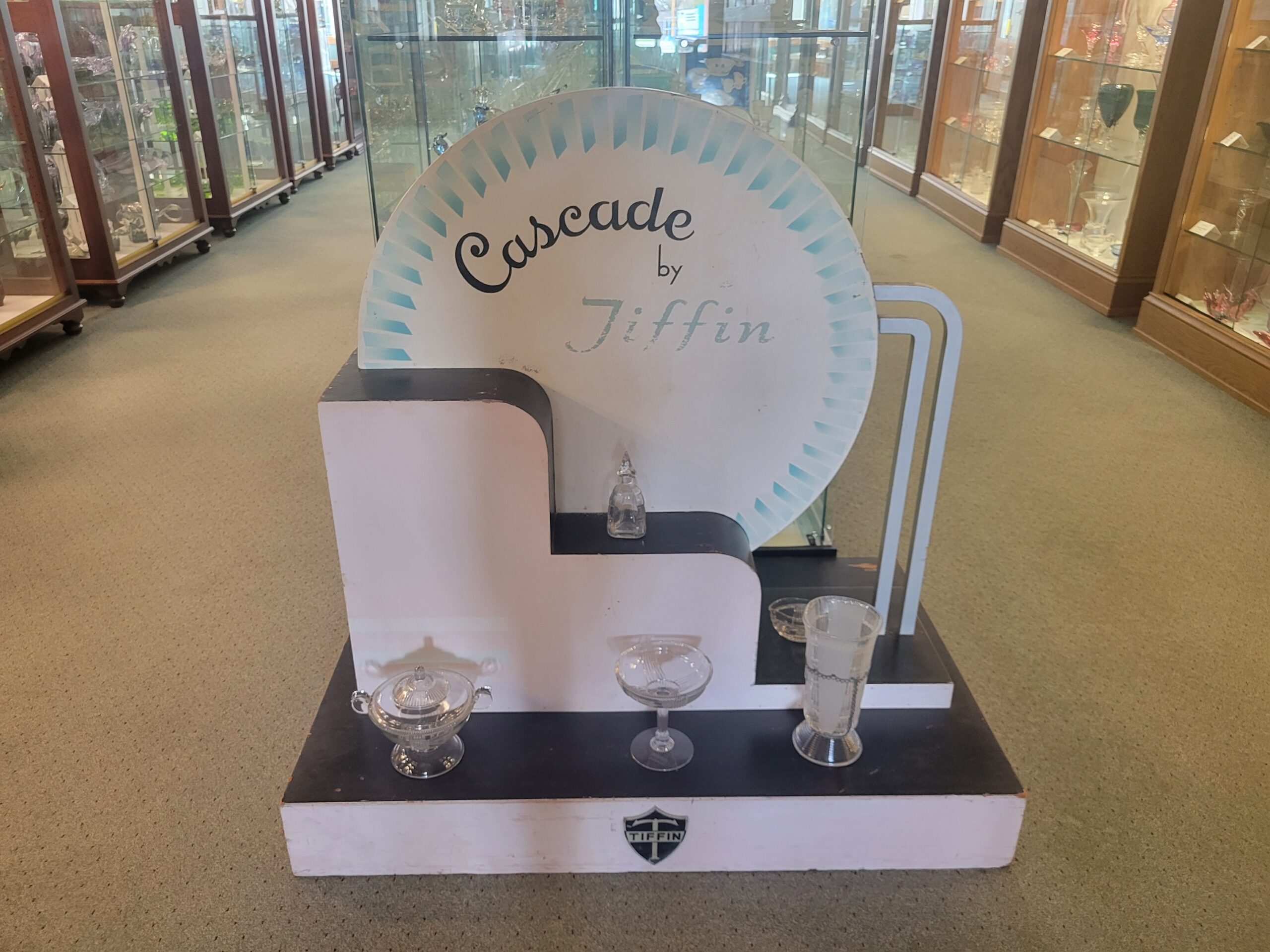
Although none of these companies still exist, the Glass Heritage Gallery displays 1,000 pieces of glassware from 10 of these companies, which are shown in the video below. Then keep reading to learn more about some of the most prominent Fostoria glassmakers.

Credit: The American Ceramic Society, YouTube
After the gas line between Fostoria and Bloomdale was completed, the first glass plant in Fostoria was the Mambourg Glass Company, which began operations in late 1887 to make window glass. At the same time, the Buttler Art Glass Company was being built. By January 1888, Buttler was making lamps and shades, art tiles, and cathedral glass.
Unfortunately, the Buttler plant was burnt to the ground the following year. Instead of rebuilding, the shareholders moved to a location with better fire protection, becoming the Fostoria Shade and Lamp Company. The company produced Fostoria’s most colorful glass, making shades, lamps and other products, with the help of Nicholas Kopp Jr., an expert in colored ware. In 1890, Fostoria Shade employed more than 200 workers.
In 1893, the Consolidated Lamp and Glass Company was established and subsequently acquired Fostoria Shade by the end of the year. Two years later, Consolidated operated three shifts at its Fostoria plant, producing 150 different styles and decorations in a variety of lamps. After Consolidated built a plant in Coraopolis, Pa., in 1896, the Fostoria plant was no longer needed.
Nicholas Kopp Jr. also left Fostoria the same year for Coraopolis. He later formed the Kopp Lamp & Glass Co. in Pittsburgh. In 1926, Kopp formed another company bearing his name that produced colored glass for railroad flares, stop signals, and radio beacon light.
Meanwhile, a new group of shareholders had built a plant on the old Buttler site, which was named the Novelty Glass Company. Eventually, Novelty was taken over by the United States Glass Company. Ironically, the Fostoria Glass Company, which began operations at the end of 1887, moved to Moundsville, W.Va., four years later. Fostoria Glass lasted almost a century until foreign competition and changing preferences forced the company out of business.
Another Fostoria company was the Nickel Plate Glass Company, named for the adjacent Nickel Plate railroad tracks, as well as Fostoria’s Nickel Plate Subdivision. The plant, established in 1888, manufactured white and blue opalescent lamps, as well as tableware. It later introduced other colors, as well as several popular patterns.
In 1891, Nickel Plate was also acquired by the United States Glass Company, becoming Factory or Plant N. Two years later, Nickel Plate closed during the Panic of 1893; local glassworkers tried to start up the old Mosaic Glass Company, which failed. Another effort, The Cooperative Glass Company, failed shortly after it opened in 1894.
Five years later, the Fostoria Glass Specialty Company was established, which manufactured a variety of lamps. The company expanded in 1907, buying the buildings previously used by Mambourg Window Glass Company, where they made tubing and light bulbs. Both factories were purchased by the General Electric Company under the name of National Electric Illuminating Company in 1910. Eventually all operations were moved to the cities of Cleveland and Niles by 1920.
Besides the companies described above, you will also see some glass pieces by the Mosaic Glass Company and the Seneca Glass Company at the Glass Heritage Gallery. Learn more about these companies by clicking the preceding links.
Further information about Fostoria’s glassware
Learn more about the history on the Fostoria Ohio Glass Association website and watch a short video.
Frances Bones, Fostoria Glassware, 1887–1982: Identification & Values, Collector Books, 1999.
Ann Kerr, Fostoria: An Identification and Value Guide of Pressed, Blown & Hand Molded Shapes, Collector Books, 1994.
Melvin L. Murray, History of Fostoria, Ohio Glass, 1887–1920, Gray Printing Company, 1972.
Melvin L Murray, Fostoria, Ohio Glass II, 1992 (the author bought the book at the museum and reviewed it for this article)
Fostoria Glass Company Records at the Ohio Historical Society.