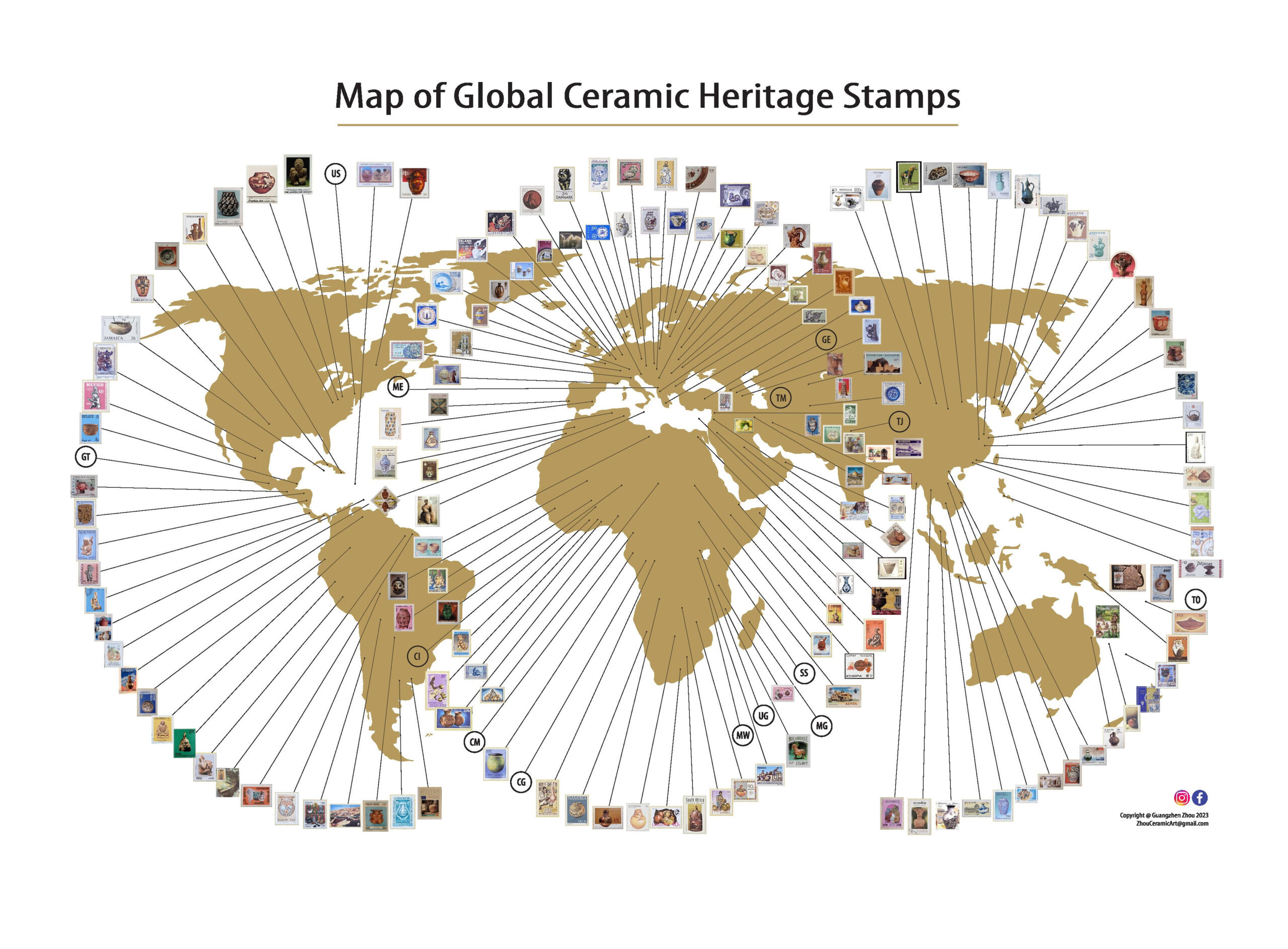
[Image above] A map showing some of the many stamps in the Global Ceramic Heritage collection. The personal stamp collection of California-based ceramic artist and researcher Guangzhen “Po” Zhou makes up the bulk of this new collection. Map republished with Zhou’s permission. Credit: Global Ceramic Heritage
For Guangzhen “Po” Zhou, a California-based ceramic artist and researcher, the practice of stamp collecting—called philately—is about more than just postage. To him, the artwork on stamps represents a compact archive of human history—one that is worth preserving.
In November 2025, Zhou took a significant step toward preserving this history by entrusting his massive collection of ceramic-themed stamps to the International Academy of Ceramics (IAC). Zhou is a Goodwill Ambassador of IAC, and his personal collection makes up the bulk of the new IAC Global Ceramic Heritage collection, which currently comprises approximately 3,000 stamps from more than 160 countries and regions.
Zhou was gracious enough to correspond with me about the intersection of ceramic history and philately as well as his efforts to have this collection recognized by UNESCO. His responses, included below, have been lightly edited for clarity.
Postage stamps: A look at the origins of this miniature archive
Adhesive postage stamps for public mail are a relatively new invention. Great Britain introduced them in 1840 as part of a larger postal system reform, which in part involved shifting costs of letters and packages from the recipient to the sender.
Those first stamps depicted young Queen Victoria, but the country’s name was not included in the stamp design. Even now, no stamp from the United Kingdom has ever had the country’s name on it; they are the only country to follow this convention.
From their earliest years and continuing to today, postage stamps are an avenue through which a country can showcase its national pride and cultural heritage. They are often issued to commemorate special events, such as John Glenn’s 1962 orbit of the Earth. It is no wonder, then, that stamp collecting remains one of the world’s most popular hobbies.
In Zhou’s case, he says that “Both coins and stamps have been my hobbies since childhood.” But although many philatelists collect for financial investment, Zhou says, “I never thought about investment and financial value but the academic value of ceramic history.”
Stamps as a time capsule for traditional ceramics
Zhou says, “Since ceramics became my profession, I started to collect ceramic-themed stamps, but I don’t remember when.” However, his personal collection took on a new meaning and life after he attended the 5th International Forum of NGOs in July 2015 as the Chinese Council member of the IAC.
After that meeting, Zhou says he was inspired to start a book project called Overview of the World Ceramic Cultural Heritage. The goal of this project was to highlight traditions that are often overlooked by the Western canon. As Zhou explains, “Most traditional and indigenous pottery created in developing countries is never able to be seen in major museums, nor any major ceramic historic book.”
Zhou spent the next decade traveling the world in search of these more hidden pottery types. His travels have taken him to every continent except Antarctica, and they even included a journey through the Ohio River Valley with a stop at the Museum of Ceramics in East Liverpool.
Zhou’s research into folk ceramics and indigenous pottery led him to the insight that in many cases, the most iconic ceramics do not exist in history books or museums but instead are often celebrated on postage stamps. As a result, his stamp collection grew alongside his work on the cultural heritage book project.
A global scope
In addition to traveling to more than 120 countries and regions himself, Zhou says that he has received support from hundreds of IAC members around the world to grow his stamp collection. Some of the stamps in the collection are more than 100 years old, with one of the oldest examples being from the International Exposition of Modern and Decorative Arts in Paris in 1925. However, most date from the 1950s to the present.
Many of the stamps in the collection are commemorative, meaning they are special issues designed to celebrate specific cultural or societal events. For example,
- One 1959 stamp from Nepal depicts a terra cotta temple.
- A 1967 stamp from Uruguay is an air mail stamp depicting a ceramic pot that was an archeological find.
- A 1975 Danish stamp commemorates the founding of the Royal Copenhagen porcelain company in 1775 with one of their iconic soup tureens.
- One U.S. stamp from 1977 depicts a ceramic pot from the Hopi Pueblo, a well-known center of ceramic art, and is one of a series of four Pueblo Art stamps issued in that year.
- An East German stamp from 1989 depicts Meissen porcelain, which made Dresden plates famous.
- A 1992 stamp from Gabon depicts a prehistoric pot, a relic of early human cave-dwellers in the area.
When asked how many of his stamps were circulated on mail, Zhou noted that most are uncirculated and only a few arrived on envelopes addressed to him from international stamp dealers. However, for Zhou, the value remains in the depiction of the craft itself rather than the circulation condition.
From private collection to global heritage
Zhou says his decision to donate the collection to the IAC in late 2025 was driven by a desire for permanent preservation and education. He is now working with the IAC to have the collection recognized under the UNESCO Memory of the World Programme. He noted that the project has already received letters of support from both the ceramic and philatelic communities.
Zhou’s next goal is to share the collection with the broader public. “I have been to many stamp and postal museums” that most people will never visit, Zhou says, and he wants to make this history accessible to a wider audience.
Zhou is currently curating an exhibition that pairs these stamps with ceramics on the UNESCO Intangible Cultural Heritage list. This exhibition is set to debut at the IAC Jingdezhen Congress in late June 2026.
Zhou’s enthusiasm for the project, for ceramics, and for the cultures that produce them came through clearly in his responses to these questions. We are fortunate that Zhou’s diligence in collecting and highlighting examples of traditional pottery has produced a collection of postage stamps that recognize hidden histories from almost every corner of the globe.
Additional information about Zhou’s travels and this project can be found in the upcoming issue of NCECA Journal (#46), which will be available for purchase soon through the NCECA website.