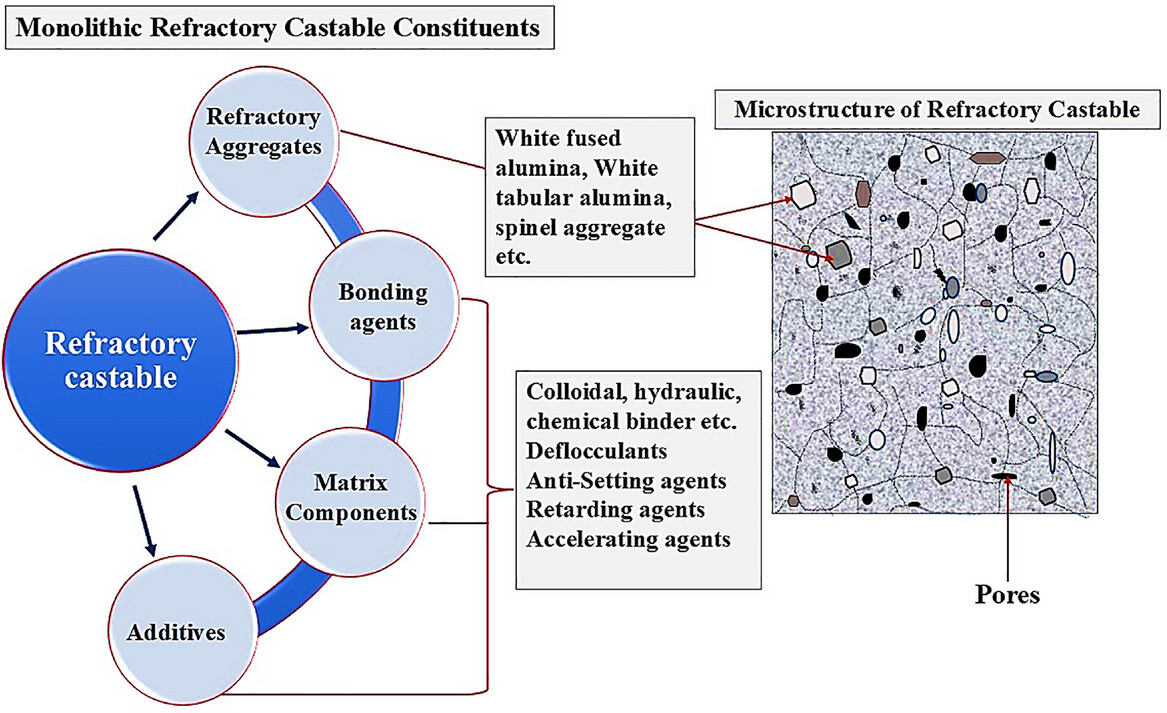
[Image above] Diagram showing the constituents of a typical monolithic castable refractory, along with a schematic of the castable’s typical microstructure. Credit: Kandulna and Dana, International Journal of Applied Ceramic Technology
Many people know about the efforts taking place in the concrete industry to reduce reliance on cement, a carbon-heavy binding material that is responsible for roughly 8% of global carbon dioxide emissions. But concrete is not the only product that relies heavily on cement binders—the refractories industry makes heavy use of cement binders as well.
Calcium aluminate cement (CAC) is a rapid-hardening, heat-resistant cement that stands up well to many corrosive substances. These properties make CAC a great binder for monolithic refractories.
However, like the Portland cement used in concrete, CAC is created by reacting a lime-containing material with other components, producing carbon emissions. So, researchers are exploring various cement-free organic and inorganic binders that can be used instead of CAC for monolithic refractories.
Colloidal binders are heterogeneous mixtures consisting of small particles dispersed in a suspending medium, typically water. These mixtures are introduced into the refractory matrix, where they transform into a gel and are subsequently converted into reactive inorganic phases at elevated temperatures.
Colloidal binders can not only lower carbon emissions but also effectively address some of the other challenges associated with CAC. For example,
- Mixing time: The mixing time for colloidal binders is reduced compared to CAC because they typically do not require additives, such as deflocculants or antisettling agents, to maintain optimal rheology.
- Water requirements: Less water is required for colloidal binders as the flowability is enhanced by the nanosized spherical particles in the mixture.
- Drying process: The permeable porous gelled structure and reduced water requirements result in shorter drying times and fewer drying defects for colloidal binders.
- Lifespan: In general, colloidal binder-bonded castables have a greater lifespan than CAC-bonded castables because they contain no hygroscopic phases, which result in volumetric expansion and crack generation.
To date, colloidal silica is the most widely used and commercially available colloidal binder for castable refractories. However, other colloids under investigation include alumina, spinel, and mullite, and a recent paper published in International Journal of Applied Ceramic Technology overviews the merits and limitations of each option.
Nelson Kandulna and Kausik Dana of the Refractory and Traditional Ceramics Division of the CSIR-Central Glass & Ceramic Research Institute in India wrote the 34-page review paper. Some highlights from the paper are below.
Synthesis methods for different colloidal binders
Colloidal binders can be synthesized through a variety of chemical routes, including sol–gel processing, controlled hydrolysis, and precipitation techniques. While the paragraphs below broadly outline the main routes used for each binder system, the pH is an important parameter in each case because it controls whether the colloidal binder behaves like a stable dispersant medium (good for flow) or a rapid gelling agent (good for fast setting and strength).
Silica systems: Spherical amorphous silica particles are dispersed in water with a solid content of up to 50 wt.% with a diameter size below 15 nm. A 3D network of siloxane bonds (Si–O–Si) forms around the particles in the castable, and the ceramic bond formation takes place at a temperature of 1,000°C or more.
Alumina systems: Alumina colloids are often created using the peptization process, which involves shaking a freshly formed precipitate with a suitable electrolyte to convert it into a colloidal suspension. Precursor molecules, often aluminum isopropoxide [Al(OC3H7)3] and aluminum sec-butoxide [Al(OC4H9)3], are hydrolyzed in an adequate water media, and the resultant hydroxides are used to generate peptized colloidal particles.
Spinel systems: Magnesium aluminate colloids can be prepared through several routes using various organic and inorganic precursors, such as metal alkoxides or nitrate and chloride salts. For example, Pasquier et al. studied the formation of spinel colloids using four different routes in the presence and absence of seeds, while Ye et al. combined sol–gel and conventional precipitation methods to produce fully crystallized spinel powder.
Mullite systems: This aluminosilicate colloid is often synthesized using the sol–gel technique due to the resulting homogeneity and purity of the colloid. The precursors range from metal alkoxide to inorganic salt, but for the silica component, alkoxide precursors such as tetraethyl orthosilicate and tetramethyl orthosilicate are the best options.
Effects of different colloidal binders on monolithic refractories
In contrast to the well-established silica-bonded system, there are only a few studies using the other colloidal binders in monolithic refractories. However, the paragraphs below provide insight into each system’s preliminary potential.
Silica systems: Colloidal silica-bonded systems exhibited excellent permeability and dry-out characteristics, significantly lowering the risk of explosive spalling during initial heat-up compared to cement- or hydratable alumina-bonded systems. But these benefits come at the cost of weaker setting behavior, reduced green strength, and relatively lower mechanical strength in the cured state.
Alumina systems: Compared to silica-bonded systems, which can experience the formation of a liquid phase that diminishes the thermal and mechanical properties of the refractory castables, the probability of a low-melting phase forming in alumina-bonded systems is almost nonexistent. However, the low solid content, high water requirement, limited flowability, poor stability, and workability of alumina colloids, among other processing issues, have hindered its widespread application.
Spinel systems: Magnesium aluminate-bonded refractories tend to have cracks in their microstructure, which is attributed to the formation of the calcium hexaluminate (CA6) phase in these systems. While the formation of cracks and fissures within the net-like CA6 morphology forms an interlocking mass that may enhance the thermal shock resistance of the castable, it is likely to reduce density and strength values.
Mullite systems: Like the spinel-bonded systems, the mullite-bonded systems display improved thermal shock resistance, likely attributed to microcracking within the castable matrix. A mullite-bonded castable also outperformed all other samples in terms of corrosion resistance in one study. This system also maintains sufficient strength, however, unlike spinel-bonded systems. So, it could be tailored for applications where balanced mechanical and chemical stability are required.
Future areas of exploration
Kandulna and Dana concluded their review by suggesting possible directions for future research on colloidal binders for monolithic refractories. In particular, they argue that the “most critical” area of research involves enhancing the solid loading of colloidal binders while maintaining adequate stability. This objective can be accomplished by developing appropriate dispersants for each type of colloid, in addition to other methods.
The paper, published in International Journal of Applied Ceramic Technology, is “Colloidal binders for monolithic castable refractories: A review” (DOI: 10.1111/ijac.70147).