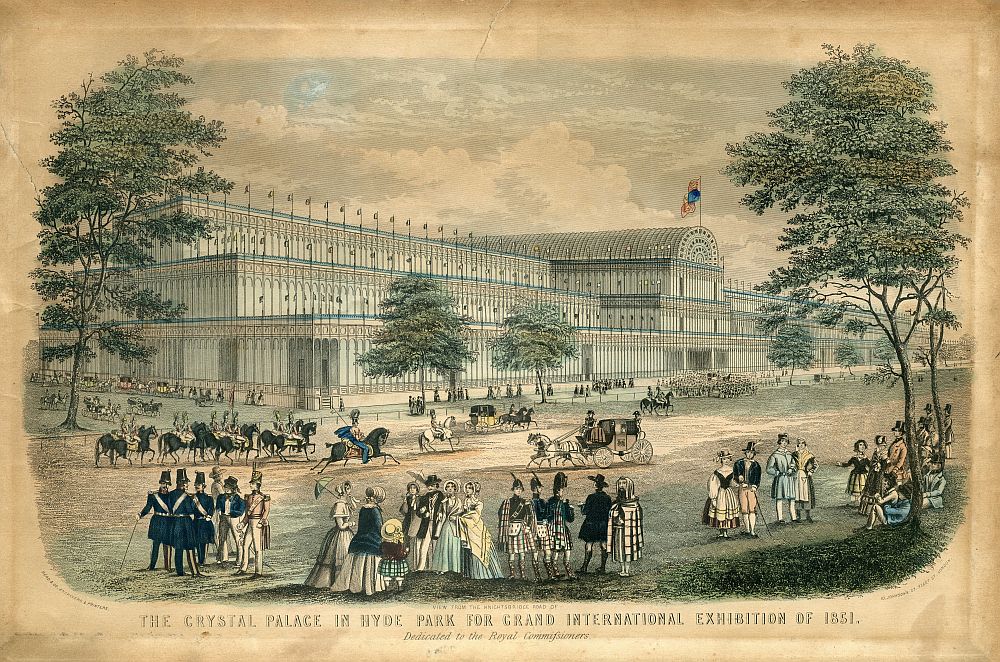
[Image above] A drawing of The Crystal Palace in Hyde Park, which was constructed to house the Great Exhibition of the Works of Industry of All Nations in 1851. Credit: Read & Co. Engravers & Printers, Wikimedia (public domain)
During my first year in college, I took a class on the Industrial Revolution. One of the things that fascinated me was London’s Crystal Palace (even before I knew about the concrete dinosaurs).
The Crystal Palace was commissioned to house the Great Exhibition of the Works of Industry of All Nations in 1851, the first in a series of events that became known as World’s Fairs. Over the next four decades, cities around the world hosted exhibitions modeled on this first one, with many of them featuring their own versions of a Crystal Palace.
This CTT looks at the economic and technological events that worked together to produce the world’s Crystal Palaces.
Shattering architecture’s glass ceiling
The first Great Exhibition in 1851 was championed by Prince Albert (Queen Victoria’s husband) and a progressive civil servant named Henry Cole. Together, they organized the event with three primary motivations:
- Flexing industrial dominance: By 1850, Britain was the undisputed workshop of the world. It produced more coal, iron, and textiles than any other nation. The exhibition was designed to put British manufacturing superiority on display, showcasing that its industrial output was unmatched.
- Championing free trade: Britain had recently repealed the Corn Laws (tariffs on imported grain), signaling a major shift toward global free trade. The exhibition invited all nations to bring their goods under one roof, sending a clear geopolitical message: Open your markets to the world, and let British manufacturing win on its own merits.
- Quelling domestic radicalism: The late 1840s were a time of intense political unrest across Europe (including the Chartist riots in Britain). The organizers believed that celebrating the achievements of the working man and showcasing the fruits of global commerce would be a stabilizing force, uniting the social classes under the banner of industrial progress.
To house this unprecedented display, the Royal Commission formed a Building Committee in early 1850 and put out an open call for designs. They solicited proposals based on a set of rigid, seemingly contradictory specifications:
- Vast scale: The building had to enclose roughly 19 acres (more than 800,000 square feet) of space in London’s Hyde Park to fit all the exhibits from more than 30 countries and accommodate tens of thousands of daily visitors.
- Temporary yet durable: The site belonged to the Crown, and the public was fiercely protective of Hyde Park. The building had to be temporary, capable of being completely dismantled and cleared from the park after the exhibition closed, without leaving permanent structural scars. Yet, it still had to be completely weather tight and sturdy enough to protect priceless global goods from the unpredictable British weather.
- Low cost and quick construction: Because of political delays, the committee did not finalize the site until mid-1850. The building had to be erected, outfitted, and opened by May 1, 1851—leaving less than a year for construction. Furthermore, the budget was incredibly tight.
- The tree clause: Hyde Park featured several ancient, beloved elm trees on the designated plot. The public and Parliament mandated that no historic trees could be chopped down for the exhibition.
The open call yielded more than 200 design submissions. The committee rejected all of them. The traditional architects of the era had an intractable brick-and-mortar mindset. Their designs for massive masonry structures with heavy foundations would have been impossible to build in under a year and wildly over budget. Additionally, these designs would require destroying the park’s trees.
Frustrated, the committee attempted to draft its own hybrid design. They proposed a brick structure with a massive dome. The public hated it; it would have been completely out of place in Hyde Park.
This total failure of traditional architecture created the opportunity that Sir Joseph Paxton was ready for. His design for a modular, prefabricated iron-and-glass system included a high, barrel-vaulted central transept that would sweep safely over the disputed elm trees rather than through them. Paxton met every single impossible specification, with a little help from his friends.
Brilliance through biomimicry
Paxton was the head gardener at Chatsworth House, the estate of William Cavendish, the sixth Duke of Devonshire. Paxton was also a self-taught architect, an engineer, a member of Parliament, and the popularizer of the Cavendish banana.
Paxton designed the Great Conservatory for the grounds at Chatsworth using the principles of biomimicry. It would house many tropical plants, including the Victoria amazonica water lily, its inspiration. This lily reaches an enormous size while simultaneously remaining strong and lightweight, thanks to its system of cantilevered ribs and perpendicular cross-ribs. Glasshouses of the era were not just for pleasure; they were high-stakes research labs for colonial economic botany. They produced global cash crops (such as rubber, tea, and medicine) to fuel the British Empire.
The Chatsworth Conservatory was built between 1836 and 1840 with cast iron and glass, two commodities that only recently had been put into mass production, and wooden curved supports. To obtain the large sheets of glass needed for the conservatory windows, Paxton partnered with the Chance Brothers glass factory in Smethwick, 80 miles away.
The Chance Brothers factory had produced the first British sheet glass using the blown cylinder technique in 1832. However, glass was treated as a luxury item at the time—heavily taxed by weight and size, limiting its use in windows.
The political catalyst: Lifted burdens
This story is as much about economics as it is about architecture and materials science. For more than a century, structural glass in Britain had been constrained by two deeply unpopular pieces of fiscal policy that valued revenue over public health and material innovation.
The Window Tax of 1696 had been designed as a progressive property tax based on the assumption that houses with more windows were inhabited by people with more money. But in practice, the tax targeted the working class, who typically lived in large tenement buildings. The landlords and homeowners who owned the tenement buildings often bricked up window frames to minimize their tax burdens, which left the urban poor living in dark, unventilated rooms that accelerated epidemics of cholera and tuberculosis. Conversely, if the windows were left in place, the costs of the window tax were passed on to the residents through higher rents.
The Glass Excise followed in 1746. This tax was levied on the weight of raw glass materials in the melting pot. Government excise officers were permanently stationed inside glassworks to monitor and lock furnaces at night. These actions transformed manufacturing flaws and chemical R&D into financial liabilities, which quelled innovation because no one wanted to take risks. Thus, the excise duty incentivized the production of lightweight, spun-disc Crown glass, which trapped buildings in a preindustrial aesthetic of tiny, distorted panes held together by thick glazing bars to keep the taxable weight down.
The Chartist movement and a growing middle class combined with public health advocates and industrial reformers finally caused these economic barriers to structural glass to reach a breaking point. The first to go was the Glass Excise tax, which Sir Robert Peel’s government abolished in 1845. Removing this tax instantly dropped the cost of window glass by 50% to 70% and allowed furnaces to run 24/7.
Free from raw material tax constraints, the Chance Brothers could fully capitalize on a high-stakes move they began in the 1830s: smuggling skilled French and Belgian master glassblowers into England to introduce cylinder-blown sheets.
The spread of cylinder-blown sheet glass had been historically suppressed in Britain by the Glass Excise. Enticing workers away from their trades was also illegal in France and Belgium at the time, making the Chance Brothers’ investments doubly risky. But the repeal of the Window Tax in July 1851—forced, in part, by public fervor for the Crystal Palace—erased the final barrier to structural glass success.
A logistical triumph
The Chance Brothers standardized the dimensions of their sheet glass to 49 inches by 10 inches. The maximum size of cylinder blown sheet glass was limited by the lung capacity of the glassblower and the physical distance they could swing the glowing cylinder into a trench below the floor without it touching the bottom.
Paxton used these dimensions as the geometric module for the framework of the Crystal Palace. The cast-iron pillars, the roof trusses, and the timber glazing bars (called the Paxton gutters) were all spaced and scaled precisely to hold rows of these specific panes without requiring custom cutting.
The Chance Brothers’ fulfillment of the contract for the Great Exhibition was close to miraculous. They produced almost 1 million square feet of glass (nearly 300,000 panes weighing 400 tons) in less than a year. At peak production in January 1851, their specialized continental glassblowers turned out 60,000 panes in a single fortnight.
Placed in perspective, the amount of glass that the Chance Brothers produced for the Crystal Palace amounted to roughly one-third of Britain’s average annual glass output. More impressive is that they managed this project without disrupting their standard commercial output.
Besides sheet glass, the Chance Brothers were also skilled lens manufacturers. Their optical glass rivaled that produced in France, and they exhibited their own first-order Fresnel lens at the Crystal Palace during the Great Exhibition.
The global ripple effect: Franchising enlightenment
The Chance Brothers had proved that cylinder sheet glass could be a mass-produced, standardized structural component rather than just a luxury craft material. Architects worldwide soon transformed the Crystal Palace model into a global phenomenon. Over the next four decades, cities rushed to build their own versions to project industrial dominance.
Each of these later versions relied on the data, structural tolerances, and glass chemistry standards pioneered by the Chance Brothers.
- New York (1853): The New York Crystal Palace, which housed the Exposition of the Industry of All Nations, was built with a Greek cross plan and a massive central dome, pushing the thermal and structural limits of glass roofing. It was located in Reservoir Square (now Bryant Park). It was destroyed by fire in 1858.
- Munich (1854): The Glaspalast was modeled directly after the London original for the First General German Industrial Exhibition. It used structural glass to create vast, open-span art exhibition spaces. It unfortunately fell victim to a catastrophic fire in 1931.
- Sydenham (1854): The relocation and massive expansion of the original London Crystal Palace showcased how the modular glass components could be disassembled, transported, and reconfigured. A new company bought the materials and rebuilt it on a grander, permanent scale at Sydenham Hill in South London. It was destroyed by fire in 1936.
- Montreal (1860): A Crystal Palace was erected for the Montreal Grand Exhibition of the Industrial Products of United Canada. The Exhibition was opened by the United Kingdom’s Prince of Wales (later King Edward VII). The Crystal Palace was relocated in 1878 and destroyed by fire in 1896.
- Porto (1865): The Palácio de Cristal was originally built for the International Exhibition in Portugal, but it was then used for different events over the next 85 years. In 1951, the building was controversially demolished to build a sports pavilion.
- Sydney (1879): Heavily inspired by the London structure, the Garden Palace was built for the Sydney International Exhibition in Australia but tragically burned to the ground in 1882.
- Madrid (1887): The Palacio de Cristal in Retiro Park demonstrates the late-century evolution of the style into highly ornate, permanent botanical and exhibition spaces. The exquisite greenhouse-style pavilion, which was heavily influenced by Paxton’s work, was built to house the General Exhibition of the Philippines. Unlike many of its predecessors, it still stands today (but is closed for renovations until 2027).
Despite their grandeur, these early glass enclosures faced severe thermodynamic challenges. They trapped intense heat in the summer and were freezing in the winter, which forced early innovations in mechanical ventilation, louvers, and canvas shading. Furthermore, their iron-and-glass architecture suffered intense thermal expansion stress, and when fires broke out, the cast iron warped and collapsed.
The foundation of the modern skyline
The legacy of the Crystal Palace Era remains undeniable. These structures were the proof of concept for the modern, glass-curtain-walled skyscraper. Without the technical tenacity of the Chance Brothers’ glassworks and the sudden removal of Britain’s oppressive tax system, the 19th century would have remained cast in brick, timber, and shadow—and the skylines of today would be quite different views.