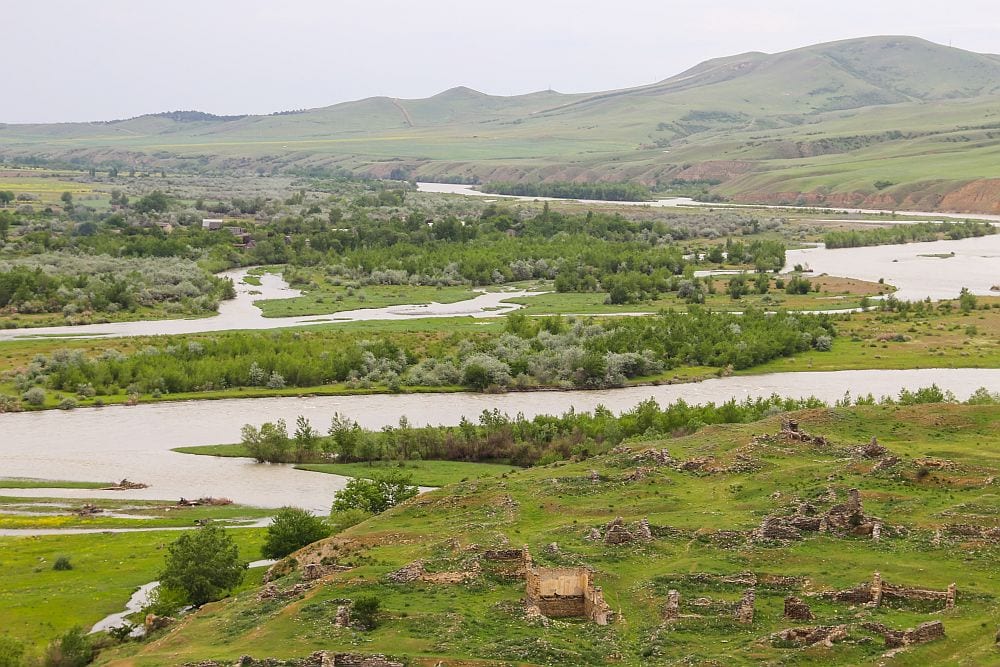
[Image above] View of the Kura River in Georgia. This region was home to the Kura–Araxes culture, or the most widespread cultural tradition of the early Bronze Age. Credit: Olya Solod / Shutterstock
On the border between Eastern Europe and West Asia lies a strategic geographical region known as the South Caucasus. This region, which roughly corresponds to modern Armenia, Georgia, and Azerbaijan, is considered a crucial transit corridor between Europe and East Asia that bypasses Russia. But thousands of years before its current role in geopolitics, this region was home to the most widespread cultural tradition of the early Bronze Age.
Originating between the Kura and Araxes rivers in the 4th millennium BCE, the Kura–Araxes (KA) culture was an expression of small-scale, household-based communities, in contrast to the contemporaneous urban trajectories of early city-state societies in Mesopotamia. Their resilient agropastoral lifestyle heavily influenced subsequent regional civilizations.
Analysis of macro-remains, such as animal bones and seeds, has allowed archaeologists to gain an advanced understanding of KA subsistence economy and diets. However, uncovering how the KA culture prepared and served their food (i.e., their foodways and culinary practices) is more difficult to pin down, thus leaving a gap in our understanding of their social and cultural practices.
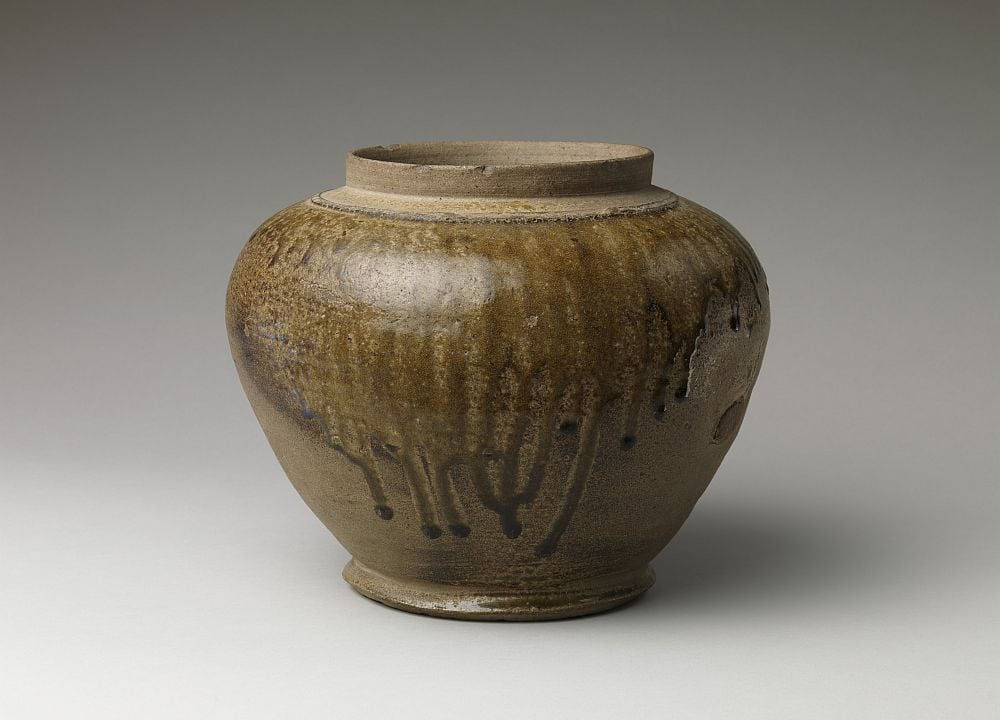
Fortunately, besides their agropastoral lifestyle, the KA culture is famous for its distinct, handmade red-black burnished ware (RBBW). By analyzing sherds from these vessels, as well as remnants of centralized, decorated hearths, archaeologists can reconstruct how food-related practices may have helped shape the identity, beliefs, and rituals in the KA communities.
A recent study by researchers from Germany, Austria, Azerbaijan, and France sheds light on how ceramics were used in the KA foodways. It also emphasizes the importance of grape-derived beverages and dairy products in the KA diet, as well as the thermal processing of carcass fats and dairy products.
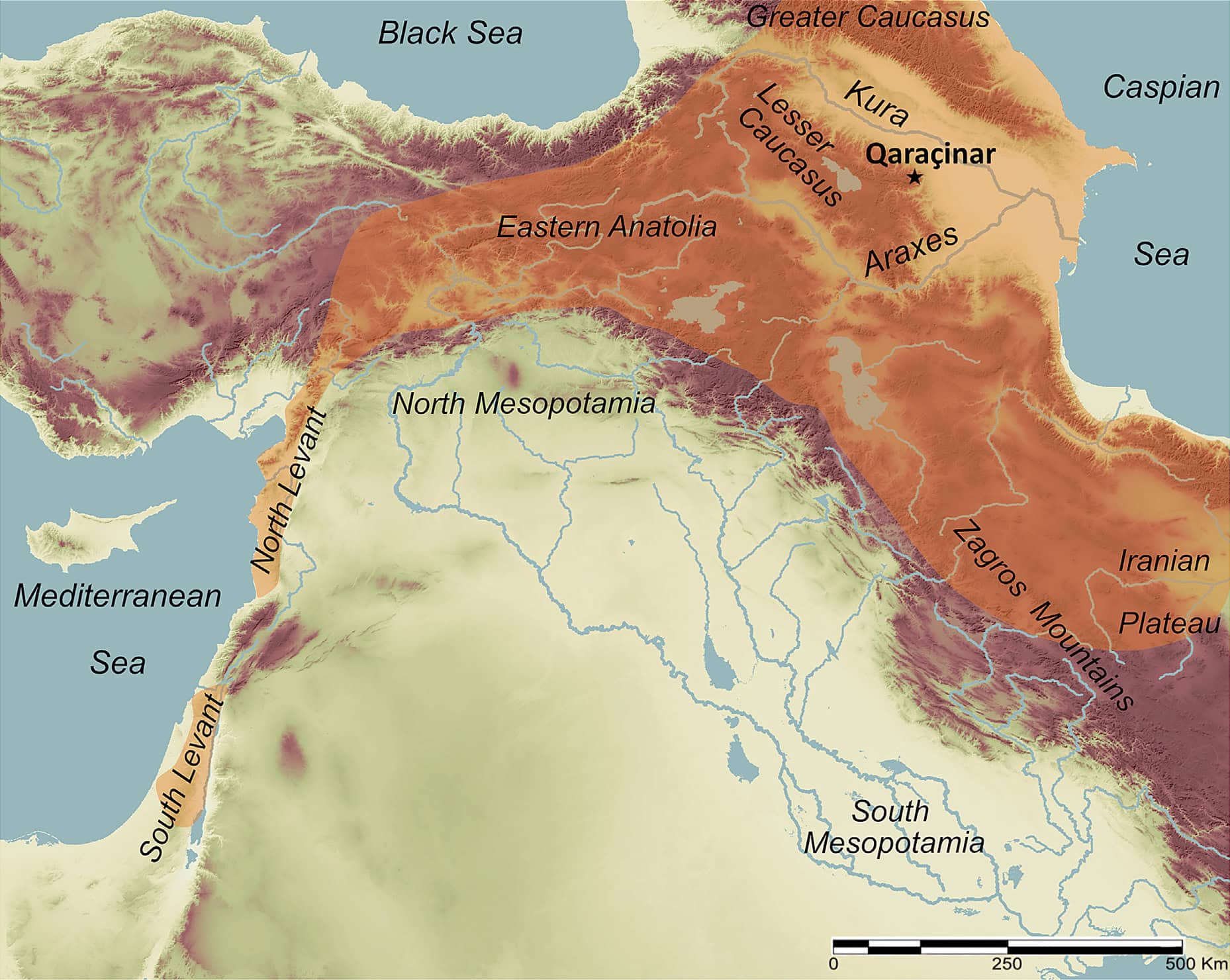
Map illustrating the location of Qaraçinar and the spread of Kura–Araxes ceramics from South Caucasus to neighboring regions. Credit: Rageot et. al., PNAS (CC BY-NC-ND)
The study focuses on Qaraçinar, a KA settlement located in the Lesser Caucasus mountain range. Much of the pottery at Qaraçinar was monochrome ware, or a style of pottery distinguished by a single overall glaze color rather than multiple colors or painted motifs. The monochrome ware at Qaraçinar was mainly done in shades of brown, buff, red, and yellow, although the researchers found lesser quantities of KA’s well-known RBBW as well.
RBBW has a characteristic bichrome effect of black external surfaces and reddish-brown internal surfaces, which results from the exposure of vessel surfaces to different firing atmospheres. Lesser quantities of black burnished ware were also found, and it is characterized by uniformly black external and internal surfaces produced under certain firing conditions.
The researchers used 52 pottery samples to investigate the functional diversity of the pieces. They also drilled into the ceramic sherds to secure some powder that could be analyzed for organic matter.
Thirty-eight out of the 52 analyzed vessels, or 73%, had organic residue, including lipid compounds (fatty acids, acylglycerols, cerides, sterols), terpenes, and/or short-chain dicarboxylic acids. The latter acids are important markers of fruits and berries. In particular, malic acid and tartaric acid are typically associated with grape products in western Eurasia, while succinic and pyruvic acids are known to be associated with fermentation for wine or vinegar. If tartaric acid occurs in certain percentages (35% or more), it usually indicates ripe grape products such as wine, vinegar, or syrup.
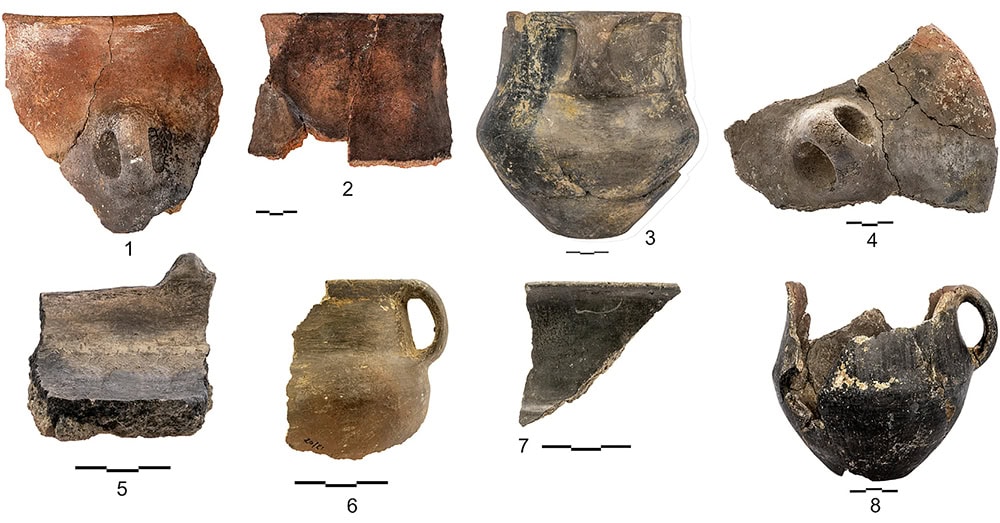
Selected ceramic shapes representing the different ware types identified at Qaraçinar: 1–2) monochrome ware jars used as cooking pots; 3) black burnished ware jar with traces of fire exposure; 4) monochrome ware lid with traces of fire exposure; 5) baking tray with traces of fire exposure; 6) monochrome ware goblet; 7) black burnished ware small-necked jar; 8) red-black burnished ware jar. Credit: Rageot et. al., PNAS (CC BY-NC-ND 4.0)
Three fruit-product signatures were identified in the pottery from the KA contexts at Qaraçinar: Ripe grape products (tartaric acid ≥ 35%) in six vessels, malic acid-rich fruits with significant tartaric acid in eight vessels, and malic acid-rich fruits with low or no detectable tartaric acid in 14 vessels.
The study emphasizes the importance of the ripe-grape markers found in six of those vessels, as three of those vessels were RBBW. This finding not only indicates that grape-derived products were consumed in the KA communities but also that there may have been a connection between these beverages and the aesthetics of the RBBW.
This finding supports the idea that RBBW may have been used for storage and consumption purposes rather than cooking or preparation. In contrast, the vessels with low or no detectable tartaric acid were likely used to store or prepare unripe grape products or other malic acid-rich fruits.
“In the South Caucasus, a major focus of research has been the investigation and detection of grape wine,” the researchers write. “The consumption of grape wine and, more broadly, the diverse alcoholic beverages are the subject of particular interest in the study of past communities, as they may reveal specific social practices that had the potential to shape social identities within society.”
Regarding the role of dairy and ruminant carcass fat in KA culinary practices, 23 vessels had the presence of animal fats with the detection of saturated triacylglycerols. A series of ketones were also identified in nine vessels, including asymmetric ketones, which are indicative of the thermal transformation of animal fats and can form during roasting or even through repeated heating.
The presence of saturated triacylglycerols indicates that the ceramic vessels were used to process either raw or lightly cooked animal products, while the presence of ketones indicates that the products were heated to high temperatures. Cookware was also identified by exposure to fire on the surface of the vessel.
Monochrome jars represented 92.7% of the fire-exposed vessels, and 40% of all sherds showed signs of use on the fire as well. This finding supports the idea that the monochrome ware may have been used for preparation and cooking purposes rather than storage or consumption.
One unique finding in this study was the presence of millet, which is a type of small grain found in arid or semiarid parts of the world. Millet was detected in one RBBW vessel, indicating that it may have been an imported product to the area, although further studies must be done to confirm. The study reports that there is currently no evidence of millet from Early Bronze Age contexts in the Southern Caucasus region.
The overall trends that emerged from the study show that differences in food consumption and eating practices were expressed via ceramics throughout KA communities.
“Two main trends emerge from our analysis: the multifunctional Monochrome Ware was primarily used for the preparation and cooking of carcass remains, dairy, and plant-based ingredients, including fruits such as grapes in solid, semiliquid, and liquid forms,” the researchers write. “In contrast, Red-Black Burnished Ware was dedicated to the storage or consumption of fruits, particularly grape, and raw dairy products.”
The paper, published in Proceedings of the National Academy of Sciences of the United States of America, is “Biomolecular analyses reveal grape-based beverages, dairy processing, and pottery function in Kura–Araxes culinary practices” (DOI: https://doi.org/10.1073/pnas.2529600123).