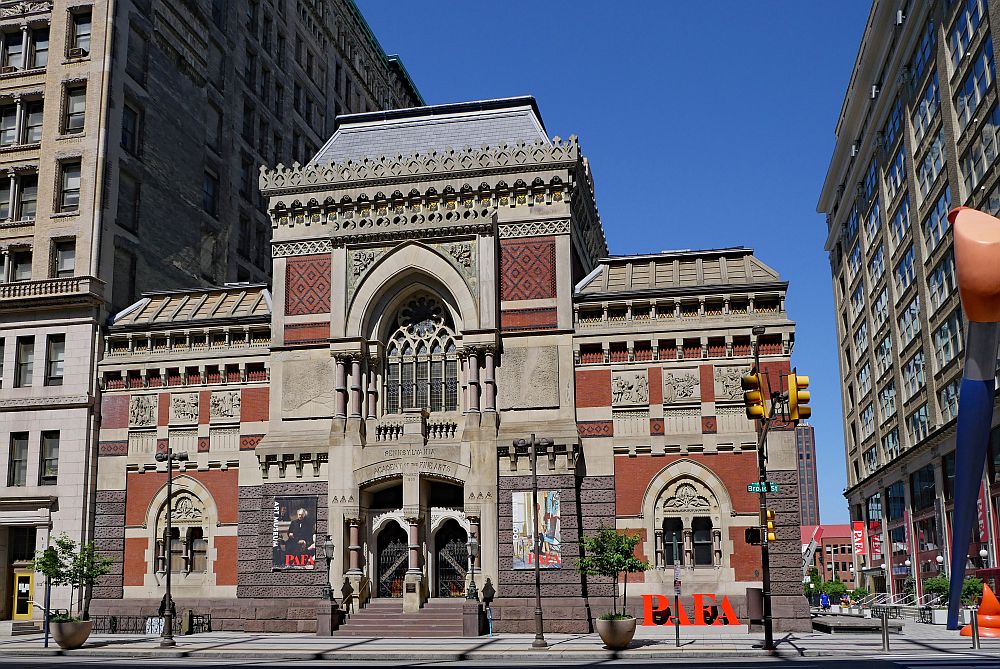
[Image above] The front entrance to the Pennsylvania Academy of the Fine Arts demonstrates the ornate ornamentation found throughout the building. Credit: Spiroview Inc / Shutterstock
In just four days, the United States will be celebrating its semiquincentennial (250th anniversary), or the day it officially declared independence from Great Britain in 1776. I am proud that my state of residence, Delaware, played a decisive role in this foundational event when lawyer Caesar Rodney rode nearly 70 miles from his home near Dover to Philadelphia on horseback, overnight, in a thunderstorm, to cast a deciding vote in favor of independence.
Even though the actual U.S. Semiquincentennial takes place on Saturday, all the U.S. states have been celebrating this milestone all year through special initiatives. For example, ACerS’ home state of Ohio developed a Creativity Trail to highlight the work of the state’s creatives, and Ceramic Tech Today has been doing a monthly feature visiting all the ceramic and glass sites.
Of course, Ohio is not the only state with a rich creative history. So, I decided to take a page from Rodney’s playbook and traveled from my home in Delaware to Philadelphia on June 18, 2026, to visit a historic building in our nation’s first capital. This building, which reopened just in time following renovations to celebrate its 150th anniversary, was built as—and remains—the home of the Pennsylvania Academy of the Fine Arts (PAFA). Its history, which I explored through the PAFA archives, provides a unique look at the development of modern architecture in the United States.
Constructing a home for PAFA
PAFA was founded in Philadelphia in 1805. It is the oldest school of fine arts in the United States.
The Academy’s first building opened in 1806 at the intersection of 10th and Chestnut streets, but it was destroyed by fire in 1845. (Many 19th century cities were devastated by fire before deciding to rebuild in fireproof materials, including brick.) The second building at that location opened in 1847 and was demolished in 1870 following damage from a hailstorm.
By 1870, the art school was attracting more students, and the collections were outgrowing the property at 10th and Chestnut. So, the PAFA board found land at the intersection of Broad and Cherry streets where they could construct the third (and larger) building.
When word spread that Philadelphia would be hosting the country’s Centennial Exhibition in 1876, the PAFA Building Committee determined that their building would be completed before the Exhibition opened to take advantage of the increased tourism. But before construction could begin, a design for the building needed to be decided on.
A masterwork in iron and stone
The design and construction of the new building was put out to bid, and the winning design was submitted by the architecture firm of Frank Furness and George W. Hewitt. Furness is one of my favorite architects because he designed, among other things, the Wilmington, Del., train station (1907) for the Pennsylvania Railroad. Although he is well regarded among architects, I am always advocating for his name to be better known among the wider public.
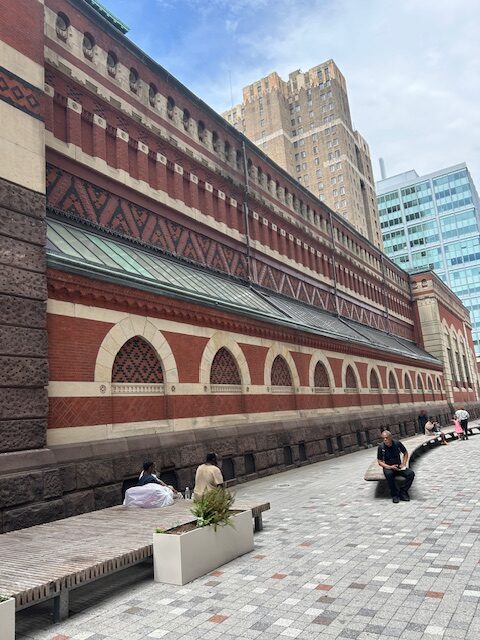
The building’s north side provides a clear view of the massive railroad trusses above the skylights, which Furness accented with brickwork. Credit: Becky Stewart
The Building Committee was a roster of Philadelphia’s industrial elite, such as locomotive tycoon Matthew Baird—another Delaware connection—and civil engineer Fairman Rogers. They expected the building’s architecture to be of the machine age, a challenge that Furness admirably rose to meet with his use of railroad trusses to support the wall of skylights, which let natural light into the first-floor artists’ workspaces.
The PAFA building’s cornerstone was laid in December 1871 and subsequently weathered a strike by the stonecutters in the lead up to the Panic of 1873. (This severe international financial crisis began in Philadelphia with the collapse of the banking firm Jay Cooke & Company, which was heavily invested in railroad construction.) Despite this setback, the building still opened successfully in April 1876, just a few weeks before the Centennial Exhibition.
In the 150 years since its construction, the PAFA building has earned a reputation as the U.S.’s first modern building, thanks in large part to Furness’s embrace of the machine age. Besides the use of railroad trusses to support the first-floor skylights, Furness also used machinery in the production of the interior design elements as well as thematic inspiration for those elements. For example, the gates at the entrances are patterned after the counterweights on locomotive wheels, while the stair railings are modeled after pistons and drive shafts.
Cast iron beams and pillars are everywhere in the building. The use of cast iron enabled much greater volumes of interior space, a useful feature in a building designed for making art. This mode of construction also allowed natural light to penetrate deep into the building through its many skylights.
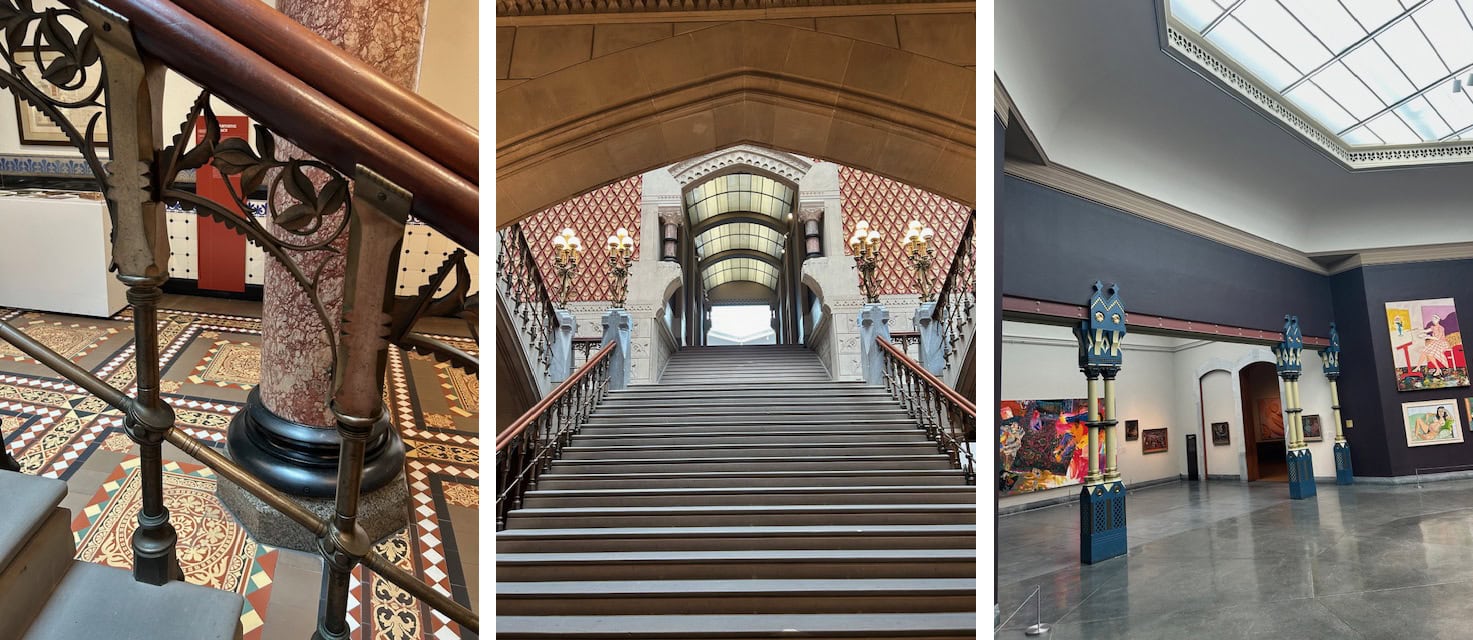
Left: Close-up picture showing the detail on the interior stair railing. Center: The iconic grand staircase, illustrating the massive interior space. Right: Gallery space showing the cast iron pillars and beams, as well as one of the skylights. Credit: Becky Stewart
Because of the Academy’s reputation as the home of great artists (including Charles Willson Peale, Mary Cassatt, and Thomas Eakins) as well as Philadelphia’s identity as the Workshop of the World, the Building Committee spared no expense in furnishing the interior. Among the many unique interior design elements, I was particularly interested in the ornamental and durable Minton encaustic tile floors.
Encaustic tiles are made by stamping a design into the surface of a wet clay tile, letting it dry until it is as hard as leather, and then filling the stamped design with slip. It is a labor-intensive process, but it produces a much more durable tile because instead of being fired on, the decorative design is embedded in the tile.
Minton was a prolific and celebrated ceramic manufacturer based in Stoke-on-Trent, England. This company created the encaustic tiles used in the PAFA building, but by the time the building was being refurbished for the U.S.’s Bicentennial in 1976, the company no longer existed. So, an alternative solution was needed to refurbish the floors.
The preservation saga: Reviving the lost art of Minton tiles (1976–1984)
At the time of the 1976 PAFA refurbishment, a successor company to Minton called H&R Johnson Tiles had the original hand tools and forms in their museum. However, they had been historically unwilling to revive the process because of the painstaking hand work required. Fortunately, two other refurbishment projects generated enough demand to encourage H&R Johnson Tiles to restart production of the encaustic tiles.
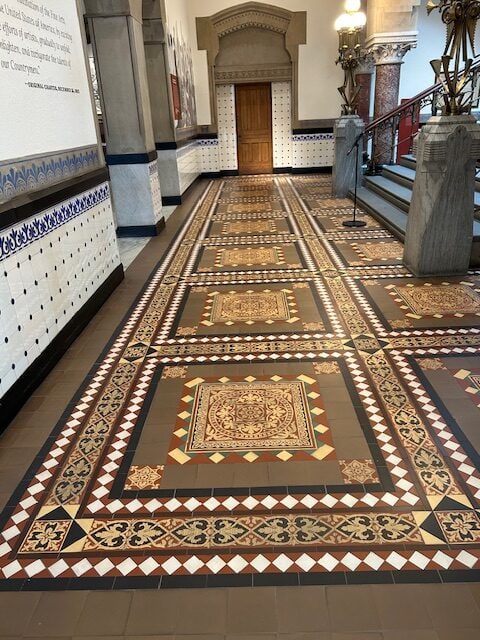
Encaustic tile floors in the main lobby of the PAFA building. Credit: Becky Stewart
First, the extensions and office buildings of the U.S. Capitol Building (built from 1851 to 1865) were also being refurbished, and there were Minton tile floors in these areas that needed repair.
Concurrently, James Ellis, directing architect of ancient monuments and historic buildings for the Crown in the United Kingdom, had been trying to replace worn Minton tiles at the Houses of Parliament. He had almost given up on this project because of H&R Johnson Tiles’ refusal to revive the process, until this confluence of demand changed the company’s stance
A few years later, after the Center City Commuter Connection tunnel was built (opened in 1984), the museum needed to replace some additional Minton tiles that cracked due to construction-related vibrations. They again sourced these tiles from H&R Johnson Tiles.
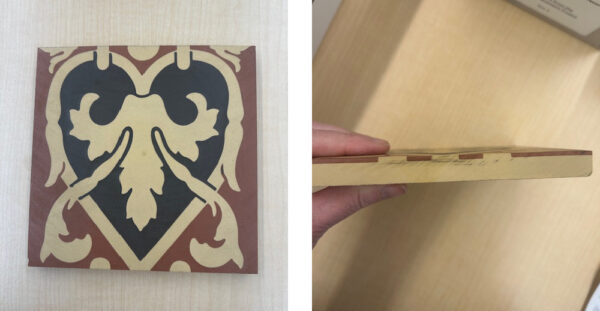
Close-up of one of the replacement tiles from the 1980s repairs. Credit: Becky Stewart
A manifesto in clay and longevity
Today, on the eve of the U.S. Semiquincentennial, the 1876 PAFA building still stands, unchanged in its dual mission as a school and a museum. The material resilience of the Minton encaustic tiles is a fitting tribute to the enduring legacy of U.S. independence—both have their roots in England, and both have survived centuries of friction while retaining (for the most part) their brilliant original design.
Further reading
G.E. Thomas, First Modern: Pennsylvania Academy of the Fine Arts. University of Pennsylvania Press, 2017.