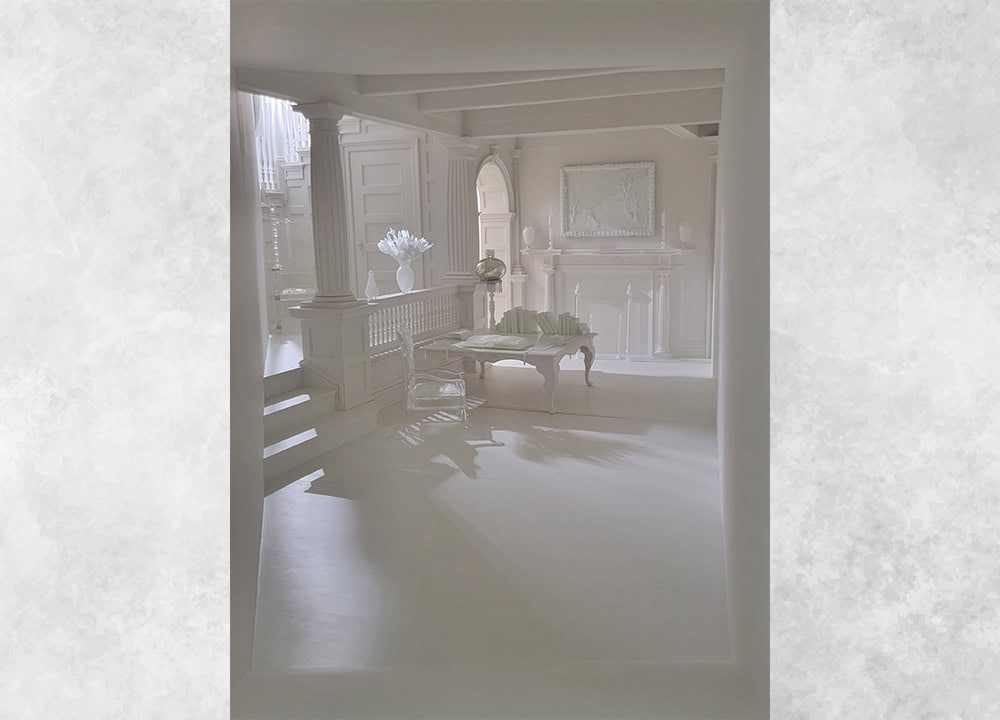
[Image above] The ReGift exhibition by Beth Lipman at the Toledo Museum of Art Glass Pavilion recreates the parlor in the home of the museum’s founders, Edward Drummond Libbey and Florence Scott Libbey. Credit: (Photo) Laurel Sheppard; (Background) Pixel Nest HM / Shutterstock
Learn more about the CTT special series on the Ohio Creativity Trail and find links to all the ceramic and glass sites highlighted in this post.
For Ohioans, getting married in January is not a good idea if you want to celebrate your anniversary without cold temperatures and snow. But for my husband and I, those conditions fortunately did not hamper our celebration plans when we headed to Toledo, aka the Glass City, on Jan. 15, 2026, to visit the Glass Pavilion at the Toledo Museum of Art. (I was a bit happier with the weather than my husband because I had brought my cross-country skis.)
On our way to Toledo, we stopped in Findlay for lunch at a local winery and then at the Rossford Public Library to learn some about the long glass history of Toledo’s cousin industrial town.
Rossford is a company town, meaning it was originally founded as a result of a company setting up operations there. In this case, the town was founded by Edward Ford, who left Pittsburgh Plate Glass Co. in 1897 to open a new plate glass factory near Toledo. Construction of the factory began in 1898, and by 1899, plate glass production had begun; the Edward Ford Plate Glass Company was incorporated on November 11.
By the time Ford died, the company was producing roughly one fifth of all the plate glass in the United States. A decade after his death, Ford’s company merged with Libbey-Owen’s sheet-glass operation in Toledo to become the Libbey-Owens-Ford Co., which was acquired in 1985 by Pilkington Ltd.
At the library, I perused several histories and photos about the Edward Ford Plate Glass Company. The next morning, after visiting the National Museum of the Great Lakes (where several pieces of ships’ ceramic dinnerware were displayed) and a drive by the adjacent Glass City Metropark (too cold to explore on foot or to ice skate on the Ribbon), we finally arrived at the Glass Pavilion. We rushed inside, where some wonderful glass art and glassware awaited to warm our spirits.
Toledo: The Glass City
The roots of the Toledo glass industry go all the way back to 1818, when the New England Glass Company was founded in East Cambridge, Mass. When William L. Libbey took over the company in 1878, his son, Edward Drummond, joined the business. A decade later, Edward decided to move the company to Toledo. The company was renamed Libbey Glass Company in 1892. Three years later, Edward partnered with Michael Owens to found the Toledo Glass Company.
The next few decades saw several major innovations come to fruition, as well as name changes, acquisitions (e.g., Libbey Glass Co., Brockway Glass, Kimble Glass), and joint ventures. Innovations included the first successful automatic bottle-blowing machine, resulting in the establishment of the Owens Bottle Machine Co. Later, that company acquired the Illinois Glass Co. to become the Owens-Illinois Glass Co., the largest glass company in the world at the time.
Other developments included improvements in the plate glass drawing process and the introduction of glass fibers and glass blocks. In 1938, Owens-Illinois Glass Co. (which later was renamed Owens-Illinois Inc. or O-I) and Corning Glass Works established the Owens-Corning Fiberglas Corp. These acquisitions and joint ventures helped O-I surpass $1 billion in sales in 1968.
Owens-Illinois celebrated its 100th anniversary with 34,000 employees and $5.6 billion in annual sales in September 2003. Three years later, the company moved its headquarters from downtown Toledo to a new building in Perrysburg, part of the Toledo metropolitan area.
Honoring Toledo’s glass legacy
It will be no surprise that the Toledo Museum of Art (TMA) has strong ties to the glass industry: Edward Drummond Libbey and his wife, Florence Scott Libbey, provided funding in 1901 to establish the museum. Some 100 Toledoans also pledged $10 each to be founding members.
Later, in 1913, Edward purchased the first of several significant glass collections: 53 pieces of European Renaissance and Baroque glass. By the early 1920s, TMA’s glass collection was ranked with that of the Metropolitan Museum of Art, according to the museum website. Edward also made sure the museum documented the history of American glass from the 17th century onwards.
Now, more than 30,000 artworks, including paintings by Claude Monet and Vincent van Gogh, are found in more than 40 galleries housed in several architecturally significant buildings on the 37-acre TMA campus. One of these iconic buildings is the Glass Pavilion, a $30 million, 74,000-square-foot facility that opened in 2006.
However, long before the Glass Pavilion came into existence, TMA constructed the Glass-Crafts Building in 1969. This facility made the museum the first in the nation to build a studio specifically designed for teaching glass working techniques. In fact, TMA lays claim to the founding of the Studio Glass Movement, which started seven years earlier when Harvey Littleton, a pottery instructor, received permission to conduct a workshop in a museum garage for artists to learn how to create works from molten glass.
The Glass Pavilion was designed by the Tokyo architecture firm SANAA. The firm’s founders, Kazuyo Sejima and Ryue Nishizawa, are known as experts at using architectural glass. Their design won Travel + Leisure’s 2007 Design Award for Best Museum. In 2010, the Sejima and Nishizawa won architecture’s highest honor, the Pritzker Price.
The Glass Pavilion structure uses all-glass exterior and interior walls, including curved panels, resulting in a blurring of boundaries between the outside and inside. There are more than 360 panels that make up the glass walls, each measuring approximately 8 feet wide by 13 ½ feet high and weighing 1,300 to 1,500 pounds each.
Today, the Glass Pavilion houses more than 5,000 works of glass spanning from ancient Egypt to the present day. During our visit, my husband and I saw some exquisite modern pieces, as well as some beautiful ones from past centuries. We were also fortunate to see part of the glass-blowing demonstration at the Glass Studio, which was quite popular based on the crowd in attendance. Although we had to watch from outside the studio because we arrived after it started, it was still a unique experience.
We were also treated to several special exhibits, including ReGift by Beth Lipman. This unique installation created an almost life-sized version of the parlor in Edward and Florence’s home using glass, wood, and metal. Lipman based her design on their bookplate from 1917. According to the museum description, the exhibit is a “reminder that our perspective on history informs our view of the present.”
If you like bling (and who doesn’t!), the Glass Pavilion also was exhibiting Radiance and Reverie, featuring more than 150 extraordinary jewels from the private collection of famed jewelry designer Neil Lane. I was fortunate to see this impressive exhibit because it was the exhibit’s concluding days. However, my husband did not join me (perhaps because he did not want his wife begging him for more jewelry!).
The exhibit traced the evolution of jewelry from the 19th-century revival styles displayed in Paris at the World Fairs to the glamour of Hollywood’s red carpet worn by legends such as Mae West and Joan Crawford. These pieces included ones from Suzanne Belperron, Cartier, Boucheron, and Castellani. Radiance and Reverie also focused on the legacy of Tiffany & Co., Louis C. Tiffany (and Clara Driscoll), and the rise of American design.
Our busy day was concluded with a wonderful anniversary dinner at Coopers’ Hawk Winery, where we toasted our marriage and the marvelous glass art we had seen earlier. And yes, in case you are wondering, I was able to cross-country ski at a nearby nature preserve the next morning!
Watch the following video to see some of the Glass Pavilion’s collections.

Credit: The American Ceramic Society, YouTube
Further information
Learn about TMA’s major renovations and what galleries are closed.
In this documentary, The House that Glass Built, learn more about Toledo’s glass manufacturing industry and the studio glass movement.
This video celebrates the 2022 International Year of Glass by paying a visit to the Toledo Museum of Art Glass Pavilion. The same year, the Glass City Center, home to the Glass City Rollers, underwent a major renovation.
Explore more architectural details in this article about the Glass Pavilion.
Watch a short video about Florence Scott Libbey.