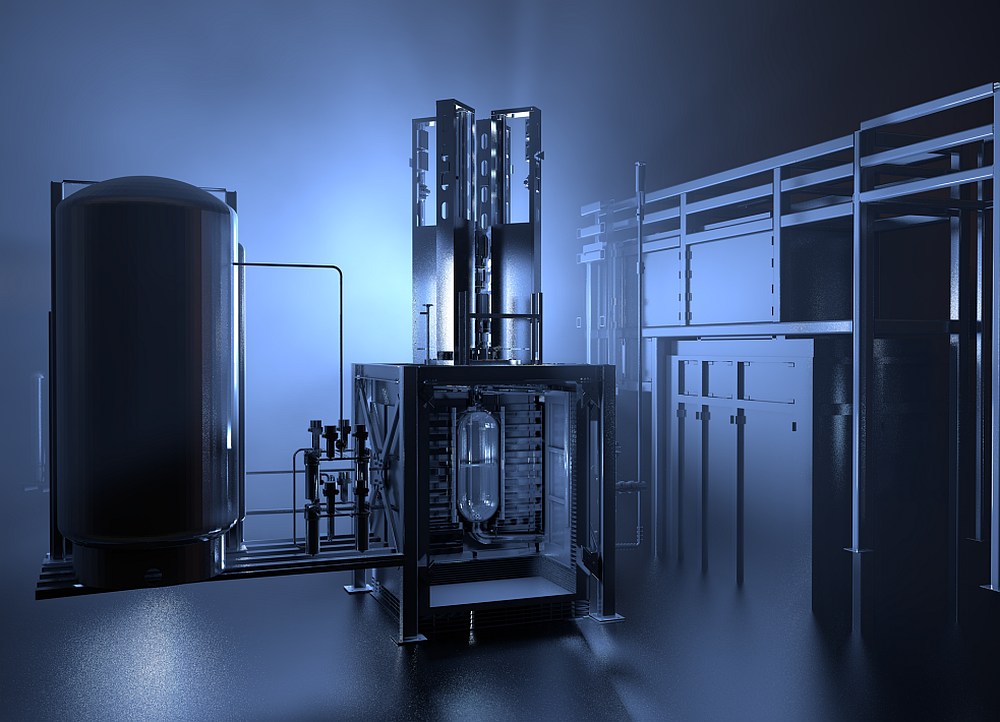
[Image above] Rendering of the Molten Chloride Fast Reactor, a public–private collaboration involving scientists at Idaho National Laboratory. As research advances on molten salt reactors, we will need ways to safely dispose of the halide-containing nuclear wastes generated during operation. Credit: Idaho National Laboratory(opens in new tab)
From Sweden(opens in new tab) to Brazil(opens in new tab), many countries around the world are reversing their phase-outs and bans on nuclear energy in response to geopolitical conflicts(opens in new tab) that put the stability of traditional power sources at risk. However, the decades of public and political resistance to nuclear energy means the technology remains largely the same as it was in the 1970s, albeit with vastly improved safety systems(opens in new tab).
Almost all existing and new commercial nuclear builds are light water reactors (LWRs), which means they use normal water as both a coolant and neutron moderator to generate electricity. Military priorities and the commercial availability of enriched uranium boosted the popularity of LWRs(opens in new tab) during the late 1950s and 1960s, and they remain the mainstream reactor design to this day.
Despite being the standard for nuclear power, LWRs come with a host of operational challenges. For example, normal water acts as a “neutron poison,” meaning it naturally absorbs the neutrons needed for the fission reaction. So, natural uranium must be enriched(opens in new tab) to contain enough of the fissile isotope uranium-235 so that the reaction can be sustained despite the neutrons lost to the water.
Furthermore, LWRs operate under extreme pressure to keep the water in a liquid state at the high temperatures found inside nuclear reactors. This extreme pressure increases the potential severity of a loss-of-coolant accident(opens in new tab). Finally, LWRs use solid pellet-filled metal rods as the fuel, which cannot be efficiently consumed(opens in new tab) and so leave behind a lot of toxic transuranic waste.
Molten salt reactors(opens in new tab) (MSRs) are an alternative nuclear reactor design that overcome many of these operational challenges. In these reactors, the nuclear fuel is typically dissolved directly into a molten salt, creating a solution that acts as both the fuel and primary coolant. This solution operates near atmospheric pressure, thereby eliminating the risk of high-pressure steam explosions or vessel ruptures. It also allows the fuel to be consumed much more efficiently, leaving behind a smaller (and less toxic) amount of transuranic waste.
Oak Ridge National Laboratory heavily tested MSR designs in the 1960s(opens in new tab), but the design was shelved in favor of the military advantageous LWRs. However, interest in MSRs is growing once again(opens in new tab), and many governments are funding research to understand the exceptionally complex and dynamic chemistry inside this reactor design.
In the United States, Idaho National Laboratory(opens in new tab) serves as the lead U.S. Department of Energy center for nuclear energy research and development. The ACerS Bulletin editorial team was fortunate to have several INL chemical scientists and engineers contribute an article(opens in new tab) for the September 2026 issue exploring the radiation effects on rare earth chemistry in MSRs.
Pacific Northwest National Laboratory(opens in new tab) is also involved in nuclear energy research mainly from the waste side. Scientists at PNNL help develop methods to turn the radioactive waste at the Hanford Site(opens in new tab) into stable waste forms.
Last week, three researchers from PNNL published a new open-access paper(opens in new tab) in ACerS’ International Journal of Ceramic Engineering & Science. The paper reviews recent advances in the safe disposal of halide-containing nuclear wastes, which are mainly generated through the electrochemical processing of used nuclear fuel and from the operation of MSRs.
The researchers explain that solidifying salt-based nuclear wastes into a stable waste form poses several challenges. Specifically, “salt mixtures usually have a relatively lower melting temperature compared to the fabrication or processing temperature of the intended hosting materials,” they write. As a result, “The molten salt could be considerably volatilized during the thermal processing to create a waste form, which leads to the low retention of halides in the final waste form.”
Furthermore, “the molten salt has lower viscosity than the glass melt, and, due to limited solubility within the glass, this results in a salt layer on top of the melt,” the researchers continue. “Excess amounts of salt could result in the liquid–liquid phase separation or crystallization that often deteriorate the overall chemical durability of the final glass waste form.”
The rest of the paper describes different strategies for designing and processing the halide-containing materials to overcome these challenges. They spend a significant portion of the paper describing glass-ceramic composite waste forms because this approach “is considered the baseline technology for full-salt waste forms.” Compositions based on sodalite, phosphate, tellurite, and borosilicate receive robust attention, and the radar graph below provides a qualitative comparison of the key properties of these various waste forms.
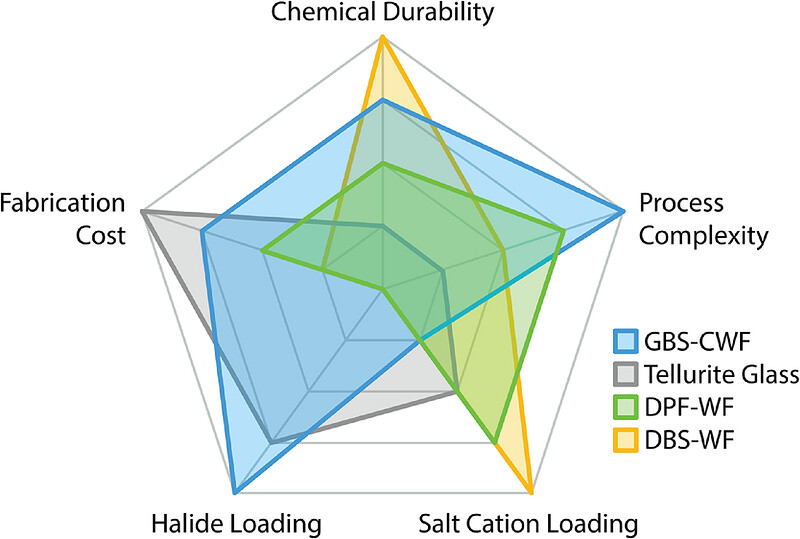
Radar graph providing a qualitative comparison of the key properties of various waste forms. DBS-WF: dehalogenated borosilicate waste form. DPF-WF: dehalogenated phosphate with Fe2O3 waste form. GBS-CWF: glass-bonded sodalite ceramic waste form. Credit: Bai et al.(opens in new tab), International Journal of Ceramic Engineering & Science (CC BY 4.0)
The researchers conclude by stating that future studies should focus on improving the chemical durability of the tellurite glass waste forms, as well as decreasing the manufacturing cost by reducing the TeO2 content through dilution with other glass-forming additives. Additional basic science studies on the halide-containing nuclear wastes themselves are needed as well, as “the vast variance in the chemistry of halide salt wastes requires extensive research on the scientific bases and engineering techniques for effective immobilization.”
The open-access paper, published in International Journal of Ceramic Engineering & Science, is “Immobilization of high-halide nuclear waste: A review of recent advances of relevant material design and processing(opens in new tab)” (DOI: 10.1002/ces2.70066).