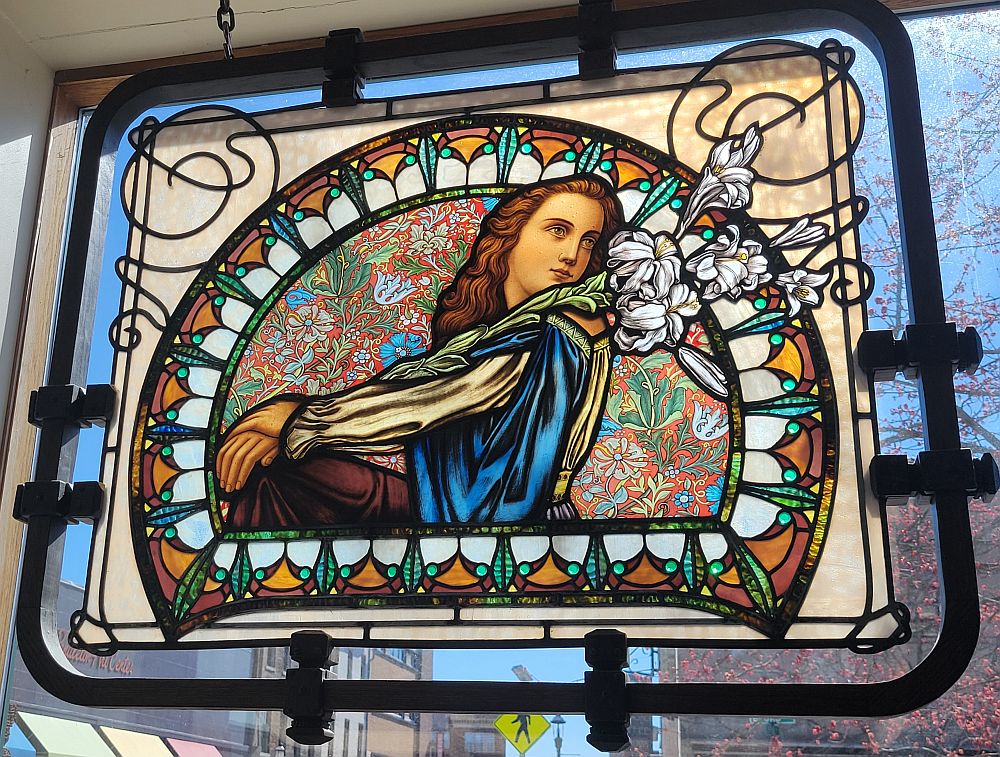
[Image above] Example of a stained-glass window on display at BeauVerre Riordan Studios. Credit: Laurel Sheppard
Learn more about the CTT special series on the Ohio Creativity Trail and find links to all the ceramic and glass sites highlighted in this post(opens in new tab).
This month, we visit a stained-glass studio and pottery that both got their start in the Queen City of Cincinnati(opens in new tab) during the 19th century. Both companies exchanged hands several times, with Rookwood Pottery leaving Ohio for several decades, only to return to its native state more than 100 years after its founding.
BeauVerre Riordan Studios: Continuing a tradition in stained glass
In 1838, this establishment(opens in new tab) opened under the name Coulter and Finagin’s, in reference to the original owners, William Coulter and Joseph Finagin. Finagin soon left the company, however, and Coulter’s son John joined the studio, changing the name to William Coulter & Son.
The company originally advertised itself as a producer of cut and plain glassware, but by 1875, the company was listed as a glass stainer, offering stained, beveled, and cut glass products. By the 1880s, John was leading the company and manufactured a wide range of products, including stained glass, embossed glass, cut glass, and opalescent glass.
Gerald Collins Riordan, originally from Ireland, managed the company during this time. . He originally joined the company in 1872 as an artist and craftsman after studying design and art in New York City and Cincinnati. In 1892, he purchased William Coulter & Son and changed the name to the G.C. Riordan Co., whereupon he continued the company’s tradition of excellence in glass.
The company soon became a major leader in stained glass and was touted as Cincinnati’s first establishment producing decorative glass. The G.C. Riordan Co. had commissions from around the country, with glowing testimonials. During the next few decades, several other designers joined the company, and Gerald’s son John took over when his father died in 1936.
In 1955, John hired Walter Bambach, a master craftsman in stained glass from Austria. Now called Riordan Stained Glass Studio, the company continued to provide stained glass for churches and chapels for the next few decades. The studio adopted a new method called dalle de verre(opens in new tab) or faceted glass in the late 1930s, which was used to produce windows with a more modern design during the 1960s and 1970s.
Later, the Riordan Glass Co. offered a more diversified range of stained-glass techniques to the global market, which spread throughout the United States and Europe. Today, thousands of churches, businesses, and private residences still have beautiful works by the original Riordan artisans. In Ohio alone, there are more than 30 Roman Catholic churches with Riordan stained glass, the majority in Cincinnati.
In 1983, BeauVerre Studio was founded by Jay and Linda Moorman in Middletown, Ohio, about 38 miles northeast of Cincinnati. Self-taught in making stained glass windows, the couple bought Riordan Studios’ machinery, inventory, and archives from its current owner, the master craftsman Walter Bambach, in 2003. Two years later, the BeauVerre/Riordan Studio finished its renovations of a former department store in downtown Middletown and held a grand opening. The business now claims to be the oldest continuously operated stained-glass studio in the United States.
BeauVerre has completed hundreds of commissions for businesses, residences, and places of worship. One of the largest commissions was for the Greater Cincinnati Islamic Center(opens in new tab) in West Chester, which contains 510 windows, doors, and skylights for the mosque and community center’s three building. The studio also does expert restoration work and teaches stained-glass classes.
On my visit to BeauVerre Riordan Studios with a friend in March 2026, we entered the building to find a beautiful display room with hardwood floors and original woodwork. We were greeted by Linda Moorman, who was our gracious host for the tour. The production level was one level down and included several kilns and worktables. One of the staff gave us a demonstration of repairing glass.
Back on the first level, we took our time viewing the magnificent stained-glass works on display. We were impressed with the craftsmanship, and I was glad to see such works up close and in person, after writing a three-part series on the history of stained glass for CTT in 2024 (read Part 1(opens in new tab), Part 2(opens in new tab), and Part 3(opens in new tab)). It gave me a much better appreciation of the time and effort that goes into each piece.
See some of BeauVerre’s works in the video below.

Credit: The American Ceramic Society(opens in new tab), YouTube
Rookwood Pottery: Woman owned then and now
If it wasn’t for Maria Longworth Nichols(opens in new tab), Rookwood Pottery(opens in new tab) would not exist. Born into a prominent landowning family in Cincinnati, Nichols (later Storer) was trained in the fine arts and became a china painter, primarily decorating porcelain with overglaze decoration.
In 1876, Nichols attended the Centennial Exposition(opens in new tab) held in Philadelphia, Pa.; it was the first World’s fair held in the United States. From that visit, where she also displayed some of her work, Nichols gained an appreciation for Japanese art and began incorporating some of those elements into her own work.
After the fair, Nichols spent several years working and experimenting out of the kilns at Frederick Dallas Hamilton Road Pottery in Cincinnati, where she met Mary Louise McLaughlin(opens in new tab), another studio potter. McLaughlin had developed a new technique to mimic the underglaze slip decoration used by Haviland & Co. and Limoges. This technique was adopted by Nichols and other local ceramicists. Fired at a lower temperature, McLaughlin’s method allowed for a wider variety of decorative effects and colorful glazes to be achieved than in traditional overglaze decoration.
In 1880, Nichols founded Rookwood Pottery in Cincinnati, named after her family estate at the historic hilltop of Mt. Adams. Rookwood was one of the first female-owned manufacturing companies in the United States. Her staff included Clara Chipman Newton(opens in new tab), her general assistant and a china decorator. Two years later, Nichols won a gold medal at the Tenth Cincinnati Industrial Exposition(opens in new tab) for some of her works.
Nichols’ tenure as company president lasted until 1889, when she handed the company over to her second husband, William W. Taylor (her first husband had died several years before). Rookwood’s accomplishments while Nichols was at the helm include
- Hiring Karl Langenbeck, the first “ceramic chemist(opens in new tab)” in the American pottery industry.
- Developing an “airbrush” glaze to introduce new floral patterns and styles.
- Adopting the famous RP mark to identify Rookwood’s ware.
- Hiring a well-known Japanese artist, Kataro Shirayamadani(opens in new tab), giving the studio an international reputation.
- Winning the Gold Medal at the 1889 Exposition Universelle(opens in new tab) in Paris.
The “airbrush” glazing technique mentioned above was developed by Laura Ann Fry, a skilled ceramicist and wood carver, who joined the company as a decorator in 1881. According to Terry and Kim Kovel, authors of the column Antiques and Collecting, Fry developed this technique using an atomizer, allowing for color gradients and blending. This method became critical to Rookwood’s standard glaze and was awarded a patent in 1889.
After Nichols left, Rookwood continued to win awards(opens in new tab), including the Highest Award in ceramics at the 1893 Chicago World’s Fair(opens in new tab). In 1900, Rookwood received the Grand Prix for ceramics at the Paris Expo(opens in new tab), and a year later earned another gold medal at the Pan-American Exposition(opens in new tab) in Buffalo, N.Y. The winning streak continued with an additional two Grand Prizes at the 1904 Louisiana Purchase Exposition(opens in new tab) in St. Louis, including one for the newly introduced Vellum glaze(opens in new tab).
In 1902, Rookwood added an architectural tile line, which became so popular it was installed in several major facilities across the country. These facilities included New York City subway stations(opens in new tab), the Louisville’s Seelbach Hotel(opens in new tab), Pittsburgh’s Fort Pitt Hotel(opens in new tab), and New York’s Vanderbilt Hotel bar(opens in new tab).
In 1934, John D. Wareham(opens in new tab), who began working at Rookwood in 1893 as a decorator and artist, became president. More ownership changes occurred over the next few decades, until Michigan entrepreneur Arthur Townley purchased the company’s assets in 1982, operating in that state for two decades.
Rookwood finally returned to Cincinnati in 2006, when Townley sold the company to local investors. Several years later, Rookwood opened its current facility at 1920 Race Street, in the historic Over-The-Rhine neighborhood. Rookwood is once again female owned by Marilyn Scripps, the great-granddaughter of media founder E.W. Scripps. As of 2020, Rookwood’s employees are 70% women(opens in new tab).
My friend and I visited Rookwood Pottery in May 2026. As we approached the building, we were greeted by a beautiful floral mural painted on the outside of the building. Once inside the gallery, we checked in for the tour of the production facility, which produces 40,000 to one million pieces per year. The production process involves numerous steps.
- Densite plaster is used to produce molds and dies for making tile and bowls in three hydraulic ram presses (30, 60, and 90 tons).
- A master of the mold is made from rubber and archived. One mold is used 10 to 50 times.
- Porcelain slip is made in house in a 300-gallon vat.
- Slip casting, which is used for more complex shapes such as vases, takes six to 10 minutes for small forms such as ornaments but up to 40 minutes or more for larger forms.
- Drying slipware takes anywhere between 24 hours or up to a week at 120°F.
- Clay scrap is reused and processed in pug mills.
- Two Blaauw kilns are used for firing: one for converting greenware to stoneware and one for firing the glaze.
- Glazes are sprayed onto the ware. There are 5,000 glaze recipes; hundreds of tests have been conducted over the years to get the correct glaze composition based on spray weights and number of pieces.
After our tour, we perused the gallery to take a closer look at the tile and pottery. We then had time to visit the Cincinnati Union Terminal(opens in new tab), where we also saw some Rookwood tiles at the ice cream parlor(opens in new tab). If my three bathrooms did not already have tile floors, I would definitely decorate them all with Rookwood tile!
View some of Rookwood’s pottery and tile in the video below.

Credit: The American Ceramic Society(opens in new tab), YouTube
Further information
See an 1897 vase by Nichols at the Metropolitan Museum of Art at this link(opens in new tab).
Another work of pottery by Nichols can be viewed at this link(opens in new tab).
Learn more about Rookwood’s glazes at this link(opens in new tab).
Read about Maria Longworth Nichol’s involvement with the National Society of the Colonial Dames of American in the State of Ohio at this link(opens in new tab).
Find out more about Rookwood, Nichols, McLaughlin, and the Cincinnati Pottery Club (the first women’s ceramic club in the United States) at this link(opens in new tab).
Books about Rookwood Pottery can be found here(opens in new tab) and here(opens in new tab).
Watch this 1925 film, Uncommon Clay(opens in new tab), which provides a brief intro to American ceramics and describes the inner workings of the Rookwood complex.