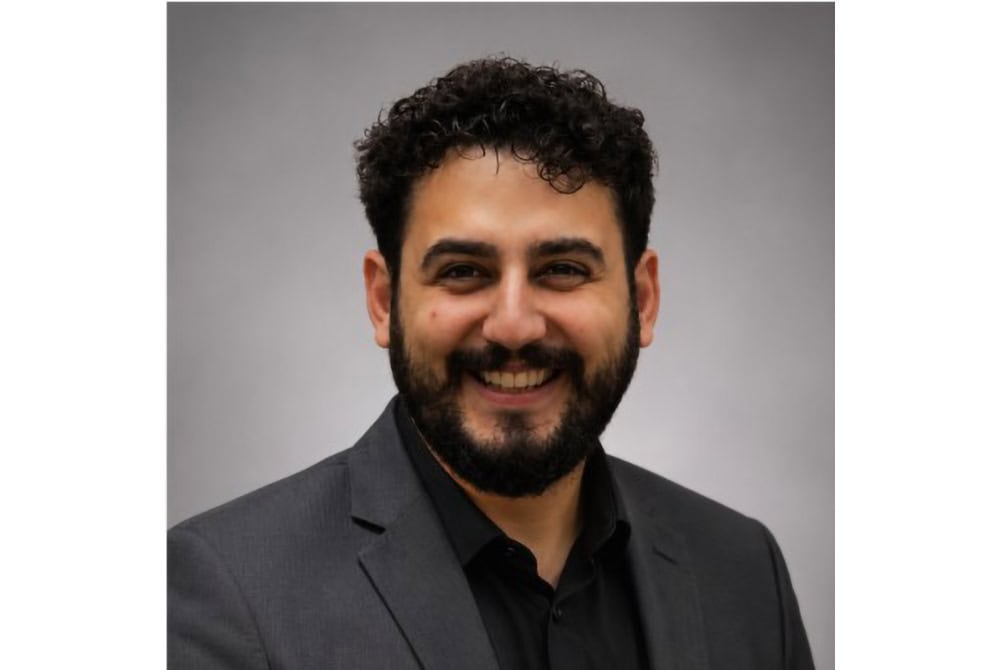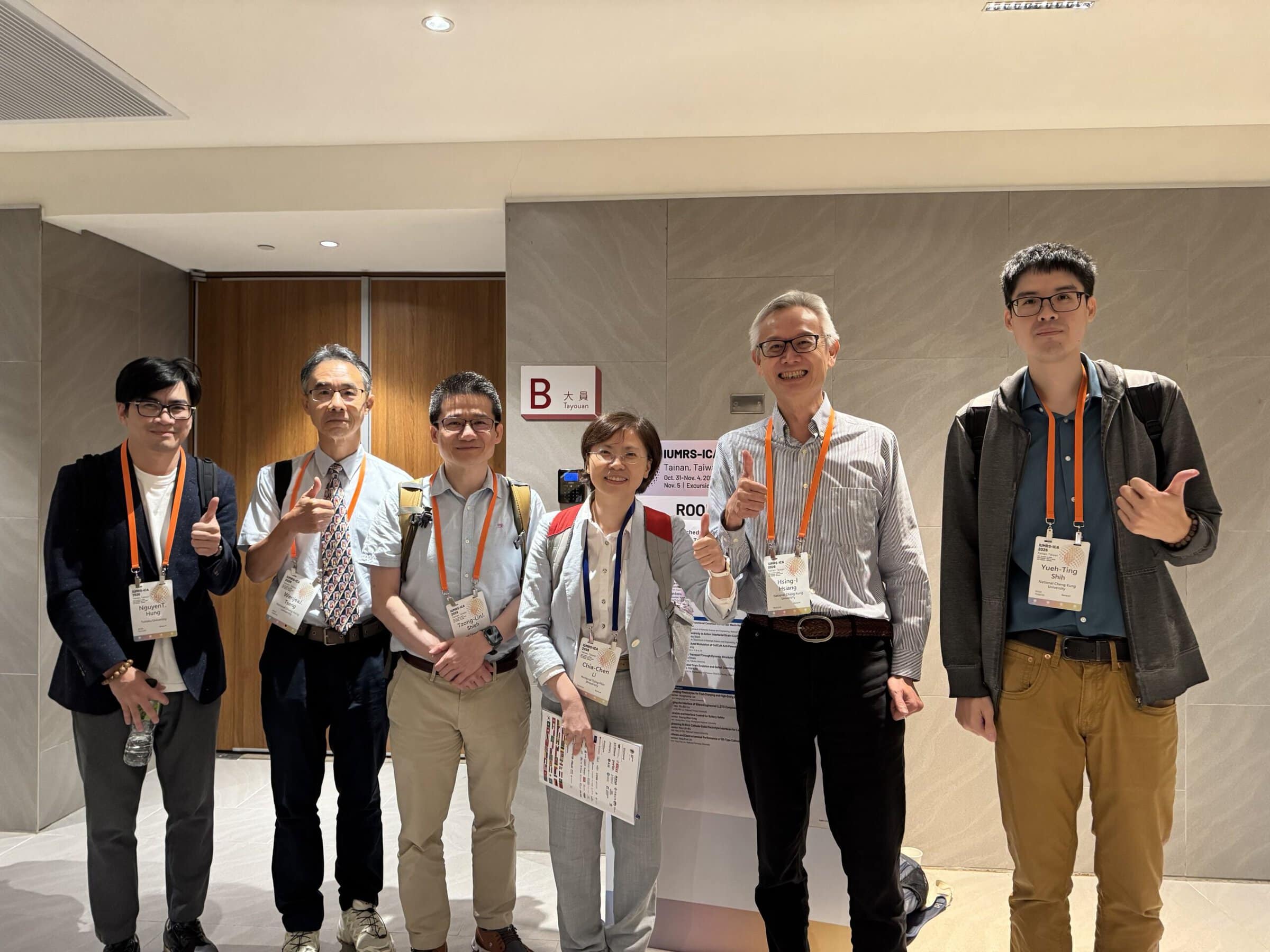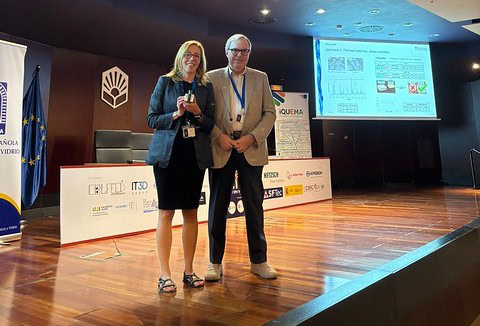
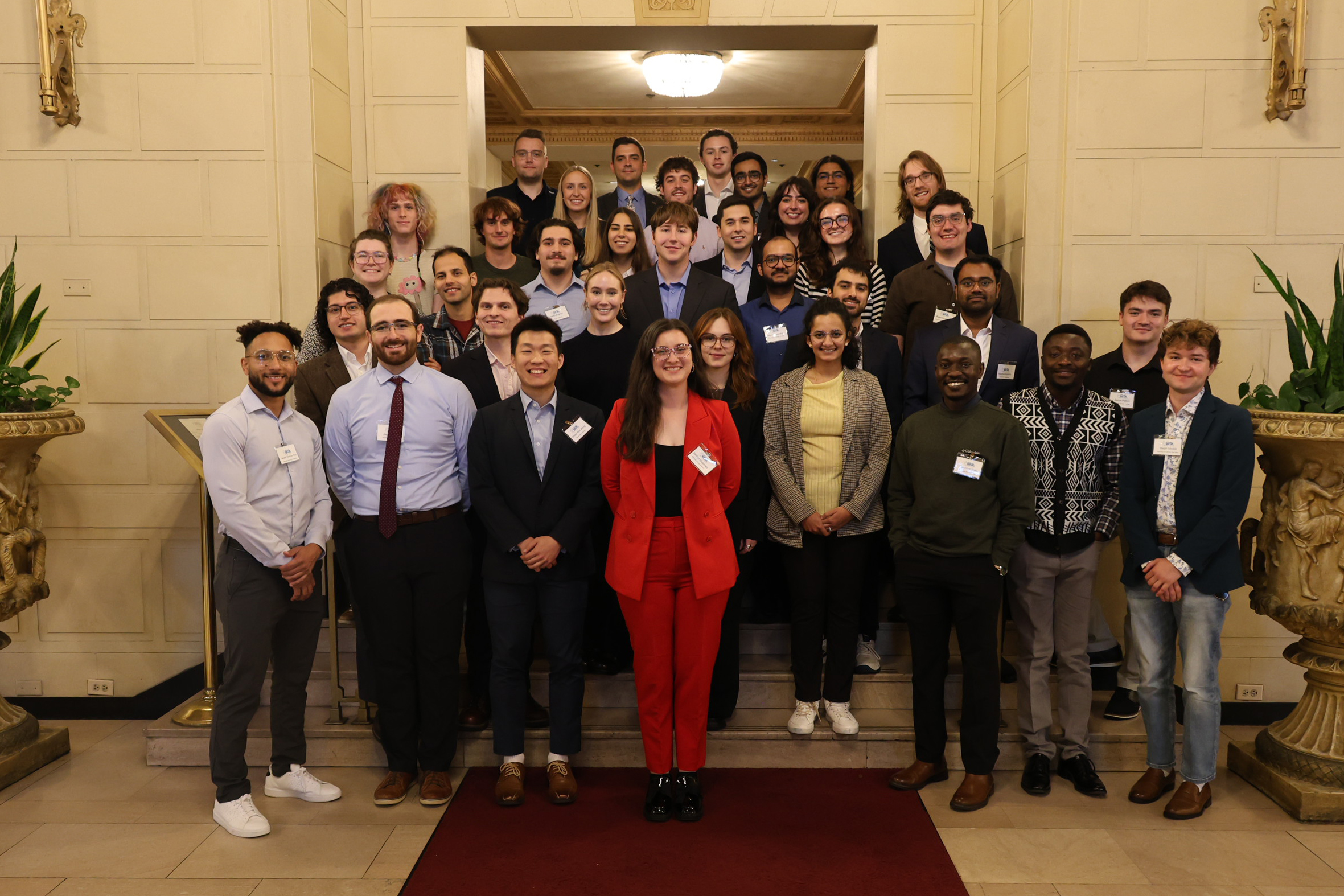
[Image above] ACerS President’s Council of Student Advisors held their annual business meeting on the Friday and Saturday before ACerS Annual Meeting at MS&T26. This year’s delegates consist of 40 students from 25 universities, representing eight countries. Credit: ACerS
From decarbonized energy systems to personalized medicine, the world is starting to bear witness to the technologies only dreamed about at the turn of the century. We are still far from realizing the ideal future depicted in the United Nations’ Agenda for Sustainable Development, but steady progress toward these goals was evident during ACerS 128th Annual Meeting at the Materials Science & Technology technical meeting and exhibition.
MS&T is an annual event cohosted by The American Ceramic Society; The Minerals, Metals & Materials Society (TMS); and the Association for Iron & Steel Technology (AIST). This year, more than 2,400 attendees from 33 countries attended the conference and exhibit, which took place Oct. 4–7, 2026, in Pittsburgh, Pa.
“I want to thank the volunteer organizers who put so much work into the technical program of another successful MS&T. Our ACerS Divisions organized an impressive 32 symposia this year,” says Andrea Ross, ACerS executive director. “I’d also like to publicly recognize our staff for their effort in running the ACerS Annual Meeting. It’s a heavy lift each year, and I’m proud of the work they do for our members. We look forward to returning to Pittsburgh in 2027 as a part of our great partnership with AIST, TMS, and Event Partners.”
Below are highlights from ACerS 128th Annual Meeting at MS&T26.
Supporting domestic and international needs at ACerS
The American Ceramic Society accomplished several key initiatives to support the needs of members both domestically and abroad over the past year, as reported by outgoing ACerS President Mario Affatigato during the Annual Business Meeting on Monday, Oct. 5.
Regarding scientific conferences, members of the Engineering Ceramics Division celebrated 50 years of advanced ceramic development down in Florida at the Golden Jubilee Celebration of ICACC in January. Then in April, six Divisions co-hosted the first-ever Spring Meeting over in Washington state, representing a new chapter of collaboration for the Divisions.
The Society will also soon fund the first project through its new Innovation Fund, which was a key initiative for Affatigato. This fund was created to support new revenue-generating products and services that benefit the ceramics, glass, and materials community.
Finally, two task forces established to address industrial needs and Society awards wrapped up operations, while two more task forces on artificial intelligence and young professionals continue to develop solutions.
Incoming ACerS President Shibin Jiang said he plans to focus on enhancing the services as well as professional development and engagement opportunities that ACerS provides while still ensuring the Society’s long-term fiscal stability.
“I feel very, very grateful for your trust and support,” he told ACerS members and staff who attended the Annual Business Meeting.
Notably, this year’s meeting was the last presided over by former ACerS Executive Director Mark Mecklenborg, who is retiring after 31 years with the Society. Attendees gave Mecklenborg a round of applause for his dedicated years of service.
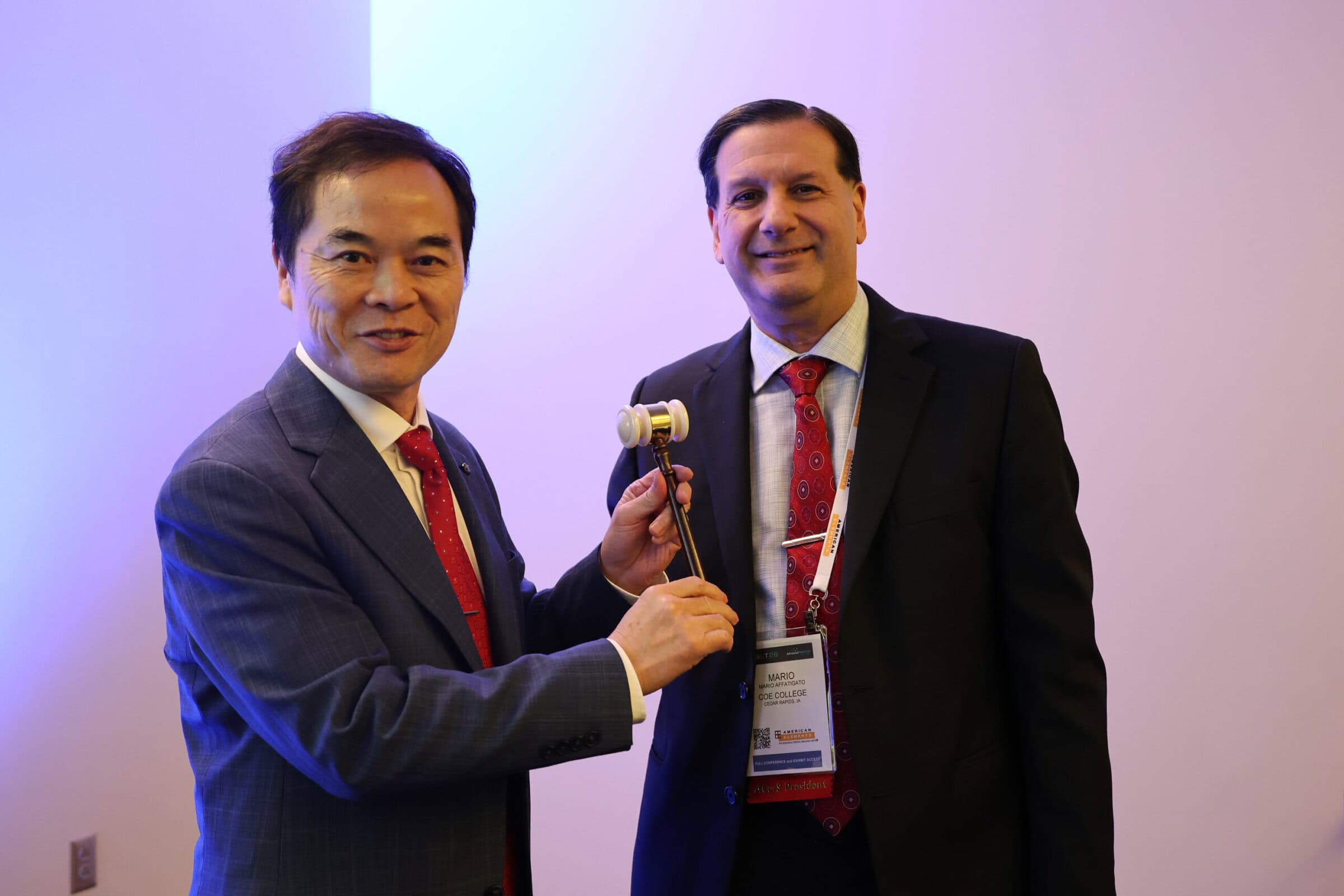
Outgoing ACerS president Mario Affatigato, right, passes the ceremonial ceramic gavel to incoming ACerS President Shibin Jiang during the Annual Board Meeting. Credit: ACerS
Award lectures describe advances in next-generation technologies
The award talks at this year’s Annual Meeting demonstrated the progress being made in certain areas toward a cleaner, healthier, and economically viable future.
The award talks started on Monday morning with the George W. Morey Award Lecture, which was rescheduled from ACerS Spring Meeting 2026. Sabyasachi Sen of the University of California, Davis talked about using an oxygen-centric view to understand the network former versus modifier role of high-field-strength cations in oxide glasses. This topic “sounds like a simple question, but it’s a confusing answer,” Sen prefaced his talk.
Several overlapping award talks immediately followed, starting with the D.T. Rankin Award delivered by Yang Bai of the University of Oulu. He talked about the advances and bottlenecks in developing and implementing different types of energy harvesting technologies, noting that kinetic energy harvesting “has not yet found its potential.”
Frank DelRio of Sandia National Laboratories gave this year’s Arthur L. Friedberg Ceramic Engineering Tutorial and Lecture. He provided a solid overview of high-throughput and in-situ approaches to understanding material fracture.
A session sponsored by the Bioceramics Division included three lectures by Bioceramics awardees:
- Ngoc Huu Nguyen of Flinders University delivered the Bioceramics Young Scholar Award. He talked about developing multifunctional bioceramic interfaces for infection prevention and regeneration of bone implants.
- Robert Hill of the Dental Institute at Queen Mary University of London delivered the Larry L. Hench Lifetime Achievement Award. He expressed delight at being able to present on the design of bioactive glasses based on an understanding of their chemical structure.
- Maziar Montazerian of The Pennsylvania State University delivered the Tadashi Kokubo Award. He overviewed the commercial evolution of bioactive glasses and glass-ceramics and hinted at the expected future developments in this field.
The last award session on Monday was the Edward Orton Jr. Memorial Lecture, delivered by Alexander Michaelis of Fraunhofer Institute for Ceramic Technologies and Systems IKTS. As president of IKTS, he was able to succinctly describe all the ways that the Institute’s researchers have helped develop advanced ceramics for the energy transition and industrial decarbonization. He also touched briefly on the evolving role of artificial intelligence in materials development.
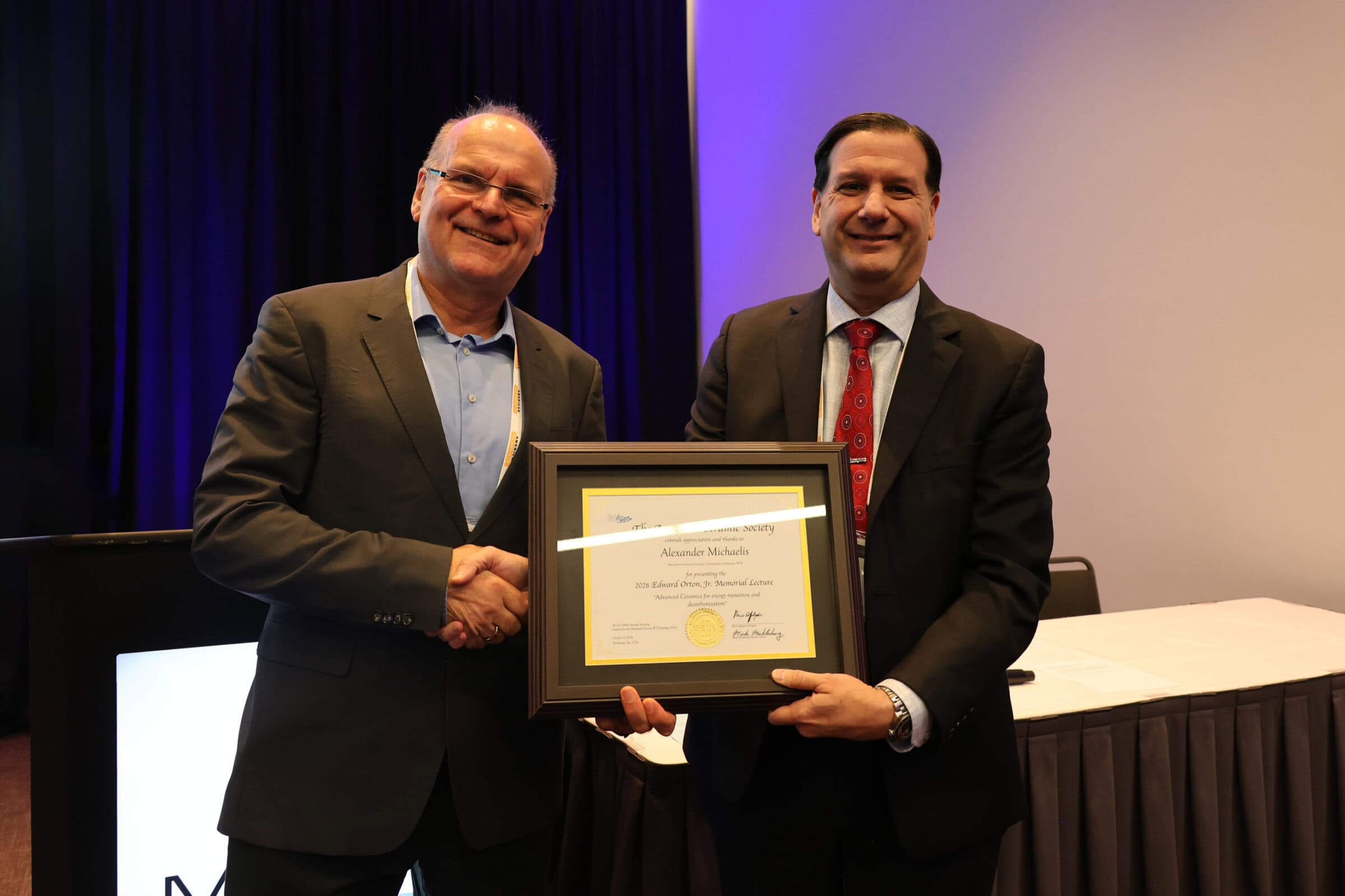
Alexander Michaelis, left, accepts the Edward Orton Jr. Memorial Lecture certificate from outgoing ACerS President Mario Affatigato. Credit: ACerS
On Tuesday morning, Vincenzo M. Sglavo of the University of Trento delivered the Cooper Session Distinguished Lecture on the chemical strengthening of silicate glass. He noted what an honor it was to be recognized “so highly” by the Society before discussing methods to make chemical strengthening a reliable and quick process. He was followed by this year’s Cooper Scholar recipient, student Rafael Baságlia Rosante of the Federal University of São Carlos, who talked about using machine learning to predict the glass-forming ability of novel glasses.
Following the Cooper Award talks, Cosmin-Constantin Popescu of 2Pi Inc. presented the Norbert J. Kreidl Lecture, also rescheduled from ACerS Spring Meeting 2026. He talked about the design of durable and programmable metasurfaces informed by a materials-centric lens for understanding device degradation.
The last award lecture took place on Tuesday afternoon. Makio Naito, one of this year’s Distinguished Life Members and Emeritus Professor at Osaka University, delivered the Rustum Roy Lecture on powder processing technology for high-quality advanced materials. He concluded by reminding attendees to mark their calendars for the 9th International Conference on the Characterization and Control of Interfaces, which will take place from July 4–7, 2028, in Japan.
Emerging professionals make the most of targeted competitions and events
ACerS Annual Meeting always features several targeted events for students and young professionals to help them grow their networks and knowledge. This year, the nearly 770 students in attendance made the most of these opportunities.
On Sunday, students competed in the annual Undergraduate Student Speaking Contest, which provides students the opportunity to practice communicating their research to a broader audience. This year, Kaylin Lamaute of The Pennsylvania State University took home first place, Kaia Thompson of the University of Michigan placed second, Aileen Cornwall-Brady of Worcester Polytechnic Institute placed third, and Daniel Johnson of the University of Michigan placed fourth.
On Monday, the Ceramic and Glass Industry Foundation hosted the IGNITE MSE symposium and luncheon. This program, which runs in conjunction with selected conferences affiliated with The American Ceramic Society, provides an opportunity for undergraduate and graduate students to explore professional development and career opportunities.
On Tuesday, the poster session provided students another opportunity to practice their presenting skills by explaining their scientific research to the judges and other attendees. The winners from this year’s poster session include
Undergraduate posters
- Allison Jones, Colorado School of Mines
- Kyle Mizenko, The Pennsylvania State University
- Sophia Ayer, University of Wisconsin–Madison
Graduate posters
- Nathan Gillespie, University of Tennessee, Knoxville
- Stephen Price, Worcester Polytechnic Institute
- Sarah Loucks, Alfred University
The famous mug drop and disc golf competitions also took place on Tuesday. These annual events, hosted by Keramos, challenge students to fabricate ceramics that can withstand heavy impacts, and each year conference attendees flock to witness the students’ successes and failures.
This year, a record number of mugs were submitted and dropped during the mug drop competition. Joseph Casper of Alfred University took home first place in the drop portion of the competition, while Lily Phillips of the University of Florida was announced as having the most aesthetic mug.
In the disc golf competition, there was a four-way tie for longest successful throw: Monte Jenkins, Kate Tickle, and Noi Larrick of Virginia Tech, and Tully Downer of Purdue University. Meanwhile, Katelynn Bone of Missouri S&T was announced as having the most aesthetic disc.
The final event aimed at students and young professionals was a new session hosted by the ACerS Bulletin team. Called “The Science of Saying It Clearly,” this workshop explained the importance of developing your science communication skills, provided tips and examples of how to frame your science for different audiences, and gave participants the chance to practice these skills through a three-sentence pitch card activity.
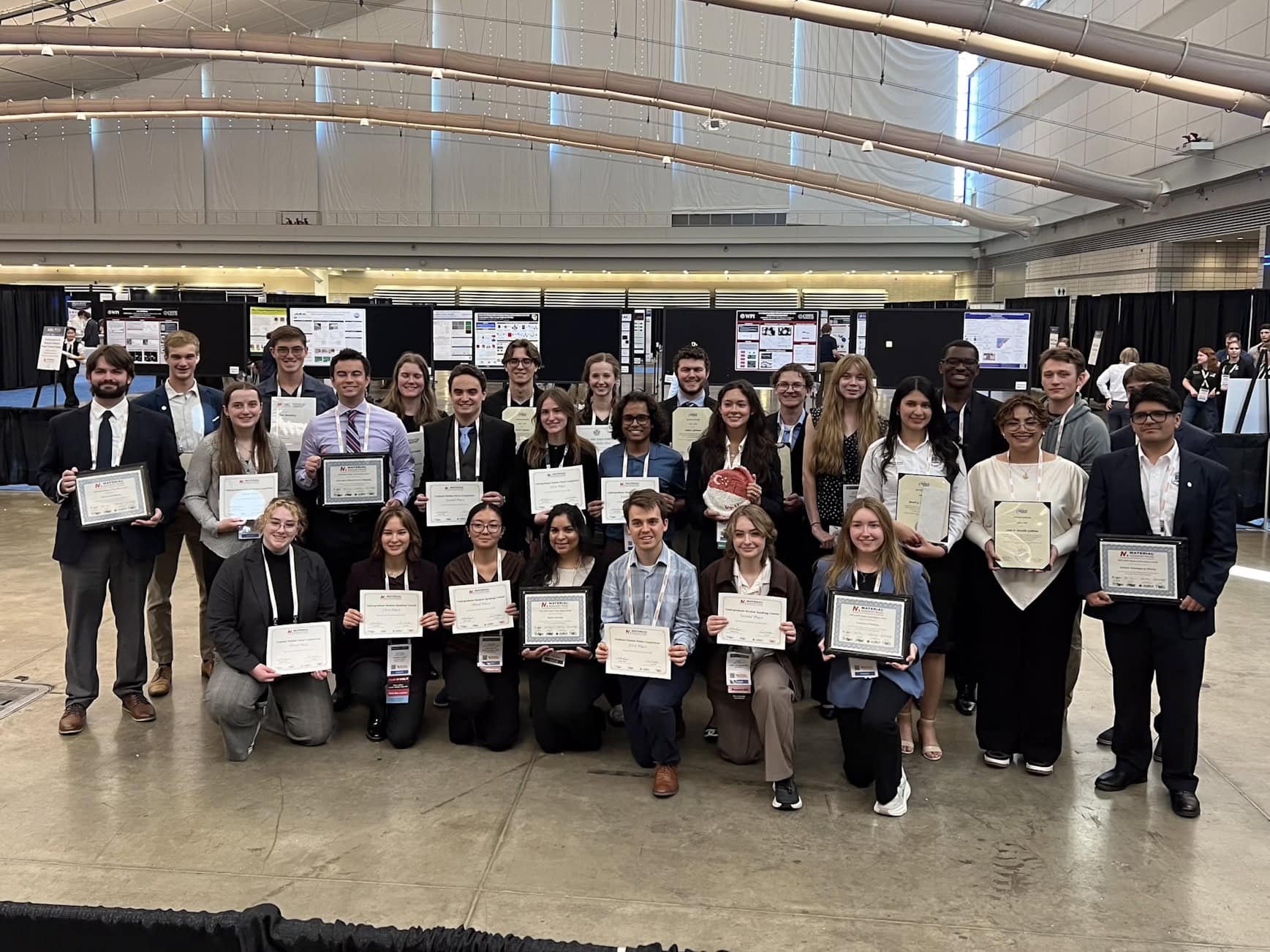
Group picture of this year’s winners during the Student Award Ceremony on Tuesday. Credit: ACerS
Visit the ACerS Flickr page for more photos from ACerS Annual Meeting at MS&T26. Pictures from the Awards Banquet can be found there as well. Next year, ACerS 129th Annual Meeting at MS&T27 will take place in Pittsburgh, Pa., from October 24–27. We look forward to seeing you then!