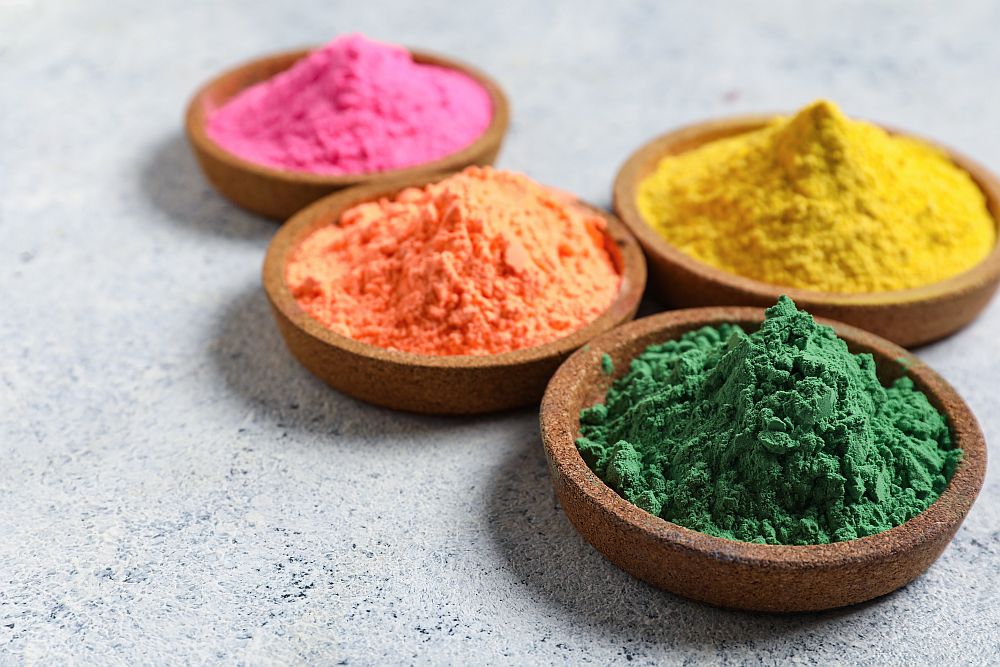
[Image above] There is a lot more engineering than people may realize that goes into creating the vivid and varied colors surrounding us in everyday life. Credit: Pixel-Shot / Shutterstock
June stands as a beacon of diversity in both the floral and social calendars. Gardens and city streets alike overflow with summer blooms and pride flags, bringing an array of colors to spaces that previously were weighed down by the barren grays of winter.
While the health benefits of being surrounded by color are well known, many people likely do not realize the amount of engineering that has gone into imbuing objects with color. For example, blue consistently ranks as the top favorite color in surveys, yet it is widely considered the most difficult color to produce. As evidence of this difficulty, three scientists won the 2014 Nobel Prize in Physics for their work on blue light-emitting diodes.
Throughout the years, CTT has highlighted some of the groundbreaking colorant research and development efforts that enable our modern vivid world. Today we have rounded up and linked some of these stories, which hopefully will spark a curiosity and appreciation for all the colors you will see this coming month.
Uncovering the secrets of past pigments
Just like Roman concrete, there are historical pigments and other colorants that we have lost the knowledge of how to make. The CTTs linked below demonstrate how researchers are using advanced techniques to uncover some of these lost formulations.
- Asking big questions of a microscopic particle: Scientists probe secrets of ancient mummy painting
- Revealing secrets of the past—nanoscale engineering gave historic glaze its iridescence
- Uncovering the mysteries of ancient Egypt: World’s first synthetic pigment recreated
Engineering novel hues and coloring approaches
Using modern knowledge of atomic structure and advanced synthesis techniques, various research groups have created colors that do not exist in nature, as shown in the CTTs linked below.
- Back in (blacker) black: World’s blackest material Vantablack goes extra goth with new version that absorbs even more light
- Vivid new magenta pigment created using the same elements found in lunar soil
Even though we typically rely on pigments to give an object color, you can also design highly structured surfaces that interact with visible light to achieve coloration. The CTTs linked below provide some examples of structural color.
- Video: Make shimmery chocolate at home using nanostructured film
- Direct ink writing opens the door to complex-shaped objects with isotropic structural color
Eco-friendly pigment production
Before the development of advanced synthesis techniques, people often created pigments by extracting them from the environment. In recent years, some groups have focused on extracting pigments from waste materials to serve the dual purpose of cleaning up our land and water while making a marketable product, as the CTTs linked below demonstrate.
- Video: From waste to watercolors—Colorado artist turns food scraps into paint
- Video: From pollution to pigments—Appalachian community turns mine waste into marketable product
Stained glass through the ages
Stained glass is one of the most eye-catching uses of color in the built environment. The history of this artform spans several centuries, and the techniques used to create it have evolved during that time.
In April 2024, CTT contributor Laurel Sheppard published a special three-part series on stained glass, which looks at traditional and new fabrication methods as well as famous examples of stained glass around the world.
Among the famous stained-glass examples, Tiffany lamps are some of the most highly sought after collector items due to their colorful, intricate, nature-inspired designs. While the science behind the glass’s rainbow hues is fascinating, so is the history of master design Clara Driscoll, who oversaw the Women’s Glass Cutting Department at Tiffany Studios. Learn more about Driscoll’s work and legacy in this CTT: https://ceramics.org/ceramic-tech-today/clara-driscoll-and-the-tiffany-girls.