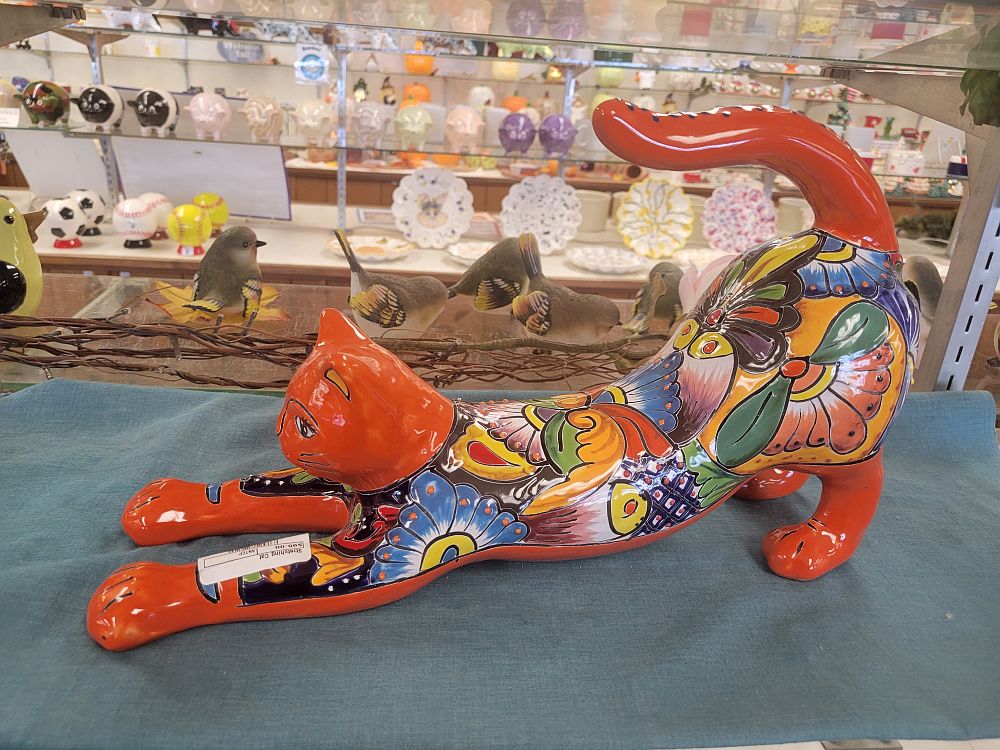
[Image above] Example of a ceramic cat for sale at Zanesville Pottery. The retail store was originally established to serve as an outlet for local factories, but it now offers collections of pottery from around the world. Credit: Laurel Sheppard
Learn more about the CTT special series on the Ohio Creativity Trail and find links to all the ceramic and glass sites highlighted in this post.
For this month’s stops on the Ohio Creativity Trail, we will focus on the city of Zanesville, the former “Pottery Capital of the World.”
Located 55 miles due east of Columbus off I70, Zanesville was known during the 19th century for having easy access to abundant raw materials, water, and rail transportation. These factors, in addition to the availability of several types of fuel for firing the kilns, allowed potteries to quickly sprout in Zanesville and across the surrounding region as early as 1808.
By the turn of the 20th century, there were roughly 50 potteries in and around Zanesville, with the largest ones employing 100 or more employees. The pottery industry played such an important role that there was even a baseball team named the Zanesville Potters!
Although there are only a few potteries left today in Zanesville, for example, Ohio Stoneware, the city still offers plenty to satisfy any pottery cravings you may have. These offerings include several retail stores and museums, including those that I visited with a friend during our visit in January 2026 (discussed below).
Zanesville Pottery: A retail store for local and global artists
Our first stop was the retail store Zanesville Pottery (not to be confused with the manufacturer Zanesville Art Pottery, 1900–1920). Zanesville Pottery was established in 1945 to serve as a small outlet store representing local factories in the area. In 1953, the business was sold to a local family, and descendants of the same family—Kim and Carolyn Castor—still own the store to this day.
In 1967, Zanesville Pottery relocated eight miles east of the city off the newly built Interstate 70, which bypassed the original Route 40 location.. By this time, many of the larger art pottery giants in the area had folded, and in the coming decades, cheap overseas imports and new lead regulations caused many of the remaining factories to close as well.
In the 1990s and early 2000s, Zanesville Pottery started to diversify to overcome these market challenges. The store now offers exciting collections of pottery from across the United States and around the world, including dinnerware by West Virginia-based Fiesta Tableware (I bought a set of blue dinner plates during my visit).
After perusing the colorful displays of indoor pottery and glass sets (including those made by another Ohio Creativity Trail manufacturer, Mosser Glass), we explored the outdoor ware in the next building. There you can find birdbaths, statuary, flowerpots, and more. To satisfy my obsession with owls, I bought a life-like owl statue for my yard (the next best thing to the real thing!).
Zanesville Pottery also offers wholesale services for resellers and helps supply landscapers, restaurants, and floral shops. A viewable in-house production studio occasionally offers classes in turning, glazing, and firing to large groups as needed; otherwise, it is used to make the store’s own products.
Watch the video below to see a sampling of what the store offers.

Credit: The American Ceramic Society, YouTube
Further information
Take another online tour of Zanesville Pottery.
Students can take a virtual field trip to Ohio Stoneware in Zanesville, Ohio.
Learn more about the history of Fiesta Tableware, an Ohio original before its move to West Virginia.
Zanesville Museum of Art: Free exhibits for all
After we finished satisfying our pottery craving at Zanesville Pottery, we headed into the city for lunch and then visited the Zanesville Museum of Art (ZMA). ZMA was not originally on the Ohio Creativity Trail during our visit in January 2026, but it is on the list now. In hindsight, I am glad we stopped to avoid an extra trip!
Local philanthropist couple Edward and Klara Ayers formally established ZMA in 1936 as the Zanesville Art Institute . The couple donated their collection of regional glass and ceramics; U.S. and European paintings, sculpture, and works on paper; and a Renaissance Revival residence to house these collections. They also included an endowment to sustain the institute, which successfully welcomed up to 22,000 visitors annually over the next 40 years.
The institute moved to a new facility in 1977 and became the Zanesville Art Center. Two major expansions occurred over the next few years: a 7,000-square-foot addition in 1985, and more gallery and storage space in 2003. In 2008, the Zanesville Art Center was renamed the Zanesville Museum of Art. ZMA now welcomes on average 12,000 visitors per year and hosts more than 170 free and low-fee public educational programs for learners of all ages, according to the museum website.
ZMA consists of three floors of galleries. On the first floor is the American Art Pottery Gallery, where you can view items from the permanent collection and temporary exhibitions. We visited that first and found wonderful examples of pottery made by the “Big Three”: Roseville Pottery, J.B. Owens Pottery, and Weller Pottery. These three companies were inspired by consumer demand after the Philadelphia Centennial Exposition of 1876 sparked an interest among middle-class Americans for hand-crafted ceramics.
Intense competition among the three companies resulted in popular glazes of one company being recreated by others, as well as the development of new glazes and designs. With the introduction of mass production methods by 1900, prices of wares were reduced, expanding the market to the middle class. By the 1950s, Zanesville’s potteries had created more than 400 lines of art pottery.
Several other examples of this pottery are found in at least one other gallery on the first floor, in addition to early paintings and other decorative arts. The first floor also houses a research library, museum store, and classrooms.
On the second floor are seven galleries exhibiting early landscape paintings, decorative arts, and contemporary glass. One gallery displays Asian, African, Persian, and Indonesian art from the permanent collection. On the third floor, six more galleries covering art from the late 19th century to today are found, as well as sculpture from the permanent collection. Both these floors have several examples of pottery and other ceramics, including items from Cowan Pottery, another Ohio Creativity Trail manufacturer.
Temporary exhibits are a major feature of ZMA. During our visit, we were fortunate to view Howard Chandler Christy; A Golden Age Master. Christy (1872–1952) was born in Morgan County, Ohio, and became famous for his illustrations and paintings, especially that of the “Christy Girl,” who represented the modern woman at the time. Christy later became a master portraitist for the nation’s elite. More than 40 paintings and drawings were displayed in the exhibit, making a nice complement to the art pottery and other works we saw.
We concluded our trip by stopping at a historic inn and winery (ca. 1833) on our way back to Columbus. A terrific way to finish a day filled with pottery and art, both old and new!
Watch the video below for a tour of the museum’s art pottery and more.

Credit: The American Ceramic Society, YouTube
Further information
See more of the museum’s art pottery collection at this link.
The Clay Center of Ohio (formerly The National Ceramic Museum) exhibits include pottery made in southeastern Ohio.
Read this digitized book to learn more about Zanesville art pottery.
Dive deep into Roseville Pottery history, marks, and more.
Attend the Pottery Lovers Show and Sale in July 2026 to find and bring a treasure home.