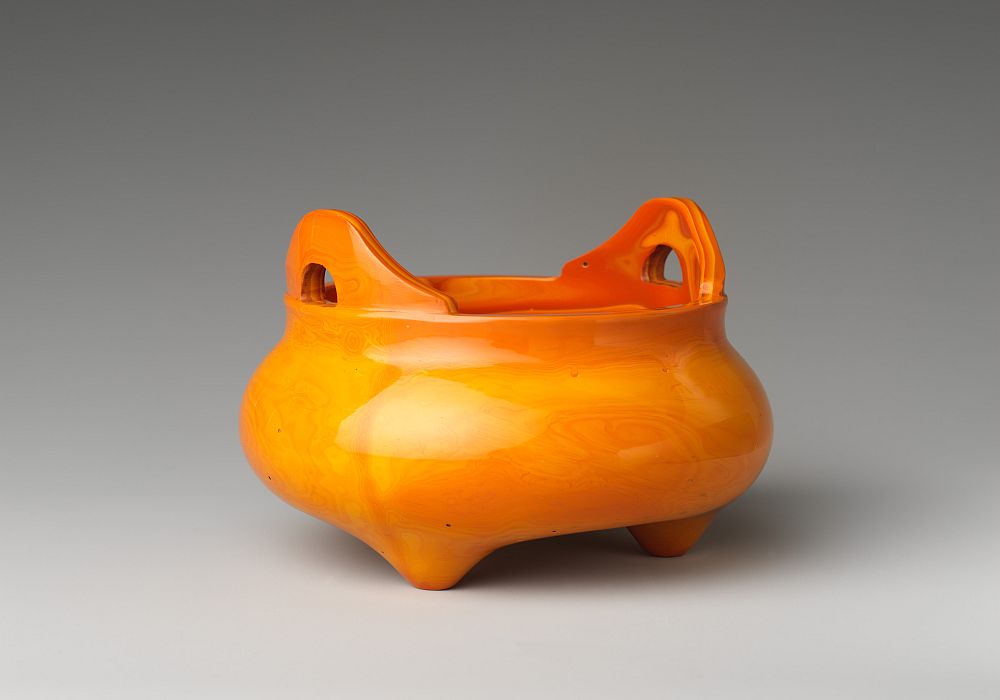
[Image above] Example of a realgar glass incense burner. Credit: The Metropolitan Museum of Art (public domain)
Porcelain is among the most well-known materials developed in China, inspiring envy and innovations globally in the fine ceramics field. Yet there are many other materials that demonstrate China’s contributions to craftsmanship, including the vibrantly colored glassware of the Qing Dynasty (1644–1912).
Although glassmaking has a long history in China, it truly flourished in the 18th century with the establishment of the Imperial Glassworks in Beijing. The Kangxi Emperor established the Imperial Glassworks in Beijing because of his interest in Western science and arts, and he appointed the German Jesuit Bernard-Kilian Stumpf to oversee its technical setup. The following Yongzheng and Qianlong Emperors also supported the growing glass sector and other art forms.
Unlike their European counterparts, who favored transparent glass, Chinese glass artisans liked their glass to mimic natural stones such as jade, quartz, and agate, which inherently feature variations in transparency and color saturation. They accomplished this preference by casting solid glass objects and carving them using traditional lapidary (stone working) techniques.
The traditional view of glass innovation in this period suggests that European missionaries provided the technical knowledge of glass compositions while Chinese artisans contributed the lapidary-inspired forming skills. This collaboration produced some of the most intriguing glasses of the 18th century, but it does not account for all the glasses designed during the Qing Dynasty, such as realgar glass.
Realgar glass: A nomenclature red herring
Realgar glass is a vibrant persimmon-colored glass that captivated the Chinese Imperial court with its wild swirls of semi-opaque orange and deep red. It was actually called persimmon glass during the Qing Dynasty; the term realgar was popularized by Western connoisseurs and art collectors in the early 20th century.
In chemistry, the term realgar refers to an arsenic sulfide ore (As4S4) that has a vibrant red–orange hue. On exposure to light, it can degrade to yellow pararealgar.
Despite its toxicity, realgar has been used in various artworks throughout history. For example, microanalysis of 17th-century European painting masterpieces (including works by Rembrandt) confirms the use of realgar and pararealgar mineral pigments. There is also evidence of a closely related arsenic sulfide mineral called orpiment (As₂S₃) being used to create glass beads.
However, realgar glass was named by poetic license; it does not contain the mineral realgar, as confirmed by chemical analysis, even though it looks very similar. Unfortunately, the exact recipe and thermal processing conditions for Qing Dynasty realgar glass are unknown because official palace records only include details about the commissions and quantities for glass objects but omit the technical recipes (artisans passed furnace techniques down orally through apprenticeships).
The ability to recreate realgar glass was thus lost to time, but that has now changed thanks to a project at the Corning Museum of Glass.
The surprising science behind realgar glass
Since 2019, a team of art historians, conservators, and glass scientists at the Corning Museum of Glass and Corning Incorporated have been attempting to decode the process of realgar glass formation through a combination of archival research, microanalytical testing, and experimental hot-shop recreations.
(When curator Julie Bellemare joined the staff, she leveraged that research to inform her preparation for the Museum’s Sensorium exhibit, which included numerous snuff bottles, a popular application of realgar glass.)
Quantitative analysis of the museum’s realgar glass samples revealed its unexpected composition: approximately 20% boron oxide (B2O3) with smaller quantities of sodium, arsenic, calcium, and copper.
This finding of significant quantities of boron oxide in 18th-century Chinese glass could completely reframe the history of glass chemistry. Traditional glass scholarship holds that late 19th-century European chemists were the first to develop boron oxide-based glass formulations in an intentional and systematic manner. In particular, most mentions of borosilicate glass contend that it originated in 1887 with Otto Schott. The realization that realgar glass has a high boron oxide content presents a new puzzle piece that could upend this traditional narrative.
Although some may argue that the presence of boron oxide in realgar glass was a happy accident, the scarcity of boron oxide in China meant this inclusion was very intentional—this material was only sourced from Tibet and Persia during the Qing Dynasty.
It is important to note that Schott and the Chinese artisans included boron oxide in their formulations for quite different reasons. Schott used boron oxide to develop a glass with low thermal expansion, i.e., it does not significantly expand or contract under extreme thermal changes. However, the Chinese artisans used boron oxide to improve the workability of the molten glass by lowering the melting temperature and decreasing viscosity. Boron oxide also helped prevent premature crystallization of the realgar glass, which could affect its optical clarity, surface texture, and perceived color.
The question now turns to how this borosilicate glass mimicked the color of realgar without including the actual mineral. Although color is a physical property, it is intrinsically the result of a material’s chemistry. The Corning team found that the orange–red coloration of realgar glass is not caused by added colorants but by copper oxide crystal growth. The small amount of arsenic in the formulation acts as a reducing agent in the melt (at approximately 4–5 wt.%), ensuring copper remains in the Cu+ state rather than oxidizing into blue–green Cu2+.
Nanoscale cuprite crystals allow light transmission (appearing transparent ruby red) while microscale and larger crystals scatter light, inducing opacity and shifting the hue toward opaque orange (yielding the persimmon color the glass is famous for). The interplay of transparency and opacity produces the glass’s similarity to natural realgar.
Experimental archaeology: Recreating realgar glass in the furnace
After the chemical characterization, the Corning team attempted to reproduce a batch of realgar glass. They synthesized the batch in an electric furnace at Corning Incorporated and observed the natural color separation of the melt when poured onto a steel quench plate. This separation confirmed that their formulation was correct, but optimizing the processing parameters now became the obstacle to recreating realgar glass in its entirety.
As any glass scientist can tell you, how a glass is heated and cooled can affect its color just as much as the raw composition. To further understand how Qing Dynasty glassmakers controlled the color when making glass objects such as vases and snuff bottles, the Corning team turned to the Museum’s recreation of a 4th-century wood-burning furnace. They wanted to know if the glass could be melted and molded at the lower temperatures produced in such furnaces. They found that the lower melting temperatures enabled by the boron oxide addition were critical to the color variation because the cuprite crystals could grow larger under those conditions.
To further understand the effects of thermal variations, they went back to a modern glass furnace for better control. This environment allowed them to discover that reheating a quickly cooled glass sample to between 600–700°C (1,112–1,292°F) changed its color from translucent ruby red (indicating small cuprite crystals) to opaque persimmon orange (indicating larger crystals). This finding underscores the Qing artisans’ skill for creating these conditions with a much more variable fuel source.
The Corning team also found that coldworking (polishing and cutting) was important for revealing the patterns of color within the glass. The lapidary techniques applied by the Qing Dynasty glass artisans (carving, faceting, or polishing molded surfaces) exposed the opaque orange layer beneath the red coat, producing striking relief patterns and variegated marbling.
Letting the past inform the future
This exercise in reverse engineering 18th-century realgar glass goes beyond correcting the historical timeline for borosilicate glass chemistry. It demonstrates that Qing Dynasty artisans possessed a sophisticated command of phase separation, redox buffering, and thermal nucleation long before modern analytical chemistry existed.
It also once again affirms the tendency of non-Western discoveries to become lost to history (or reworked into Western narratives), even when these discoveries could inform modern innovations. This tendency is not just limited to materials science but also affects linguistics, forestry, medicine, meteorology, and seismology, among other fields.
Fortunately, appreciation and attention to traditional knowledge is becoming more mainstream, thus allowing solutions of the past to inform solutions of the future. For example, the pursuit of ancient pigment formulations is a popular research topic for ceramic historians. Such research reveals that ancient artisans possessed sophisticated empirical knowledge of local and imported minerals and their behavior long before modern inorganic chemistry characterization.
As we continue to reverse engineer historical ceramics and glasses, we are sure to witness even more breakthroughs in nanomaterials, coating methods, and other advanced applications.