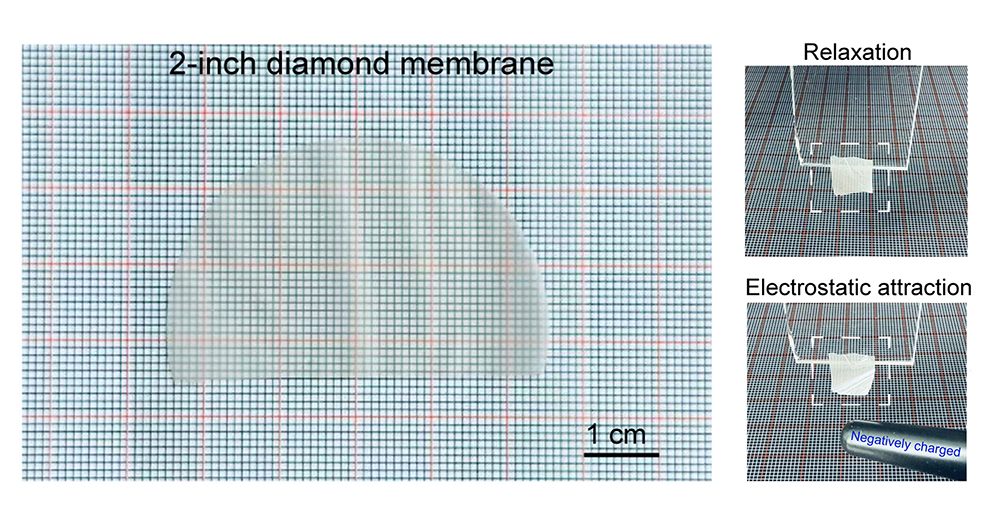
 [Image above] Photograph of the 1-μm-thick diamond membrane (left) and how it bends in response to a negatively charged rubber rod (right). Credit: Jing et al.(opens in new tab), Science Advances (CC BY-NC 4.0)
Over the past century, piezoelectricity(opens in new tab) has evolved from an eccentric natural behavior to a highly engineered phenomenon.
Piezoelectricity refers to the ability of certain materials to convert mechanical strain into an electric charge, and vice versa. Similar to nuclear science(opens in new tab), the first practical and commercial applications of piezoelectricity were for military purposes(opens in new tab), but advanced energy systems(opens in new tab) are now the fastest growing application of this technology.
Although piezoelectricity is a well-established field in many respects, researchers continue to discover new aspects of the phenomenon, even ones that overturn previously held conceptions. The studies summarized below contribute to our improved understanding of piezoelectricity.
Diamond membranes exhibit piezoelectric effect
Traditionally, materials must have an asymmetric crystal structure in order to exhibit the piezoelectric effect. That is because in a symmetric crystal, internal charges balance out perfectly when you squeeze or stretch the material, producing no net voltage.
Bulk diamonds have a perfectly symmetrical crystal structure, and researchers have known since the early 1900s(opens in new tab) that they do not show a piezoelectric response. However, in a novel open-access paper(opens in new tab) published in March 2026, researchers from the University of Hong Kong showed that ultrathin and ultraflexible polycrystalline diamond membranes can exhibit a significant piezoelectric effect.
The impetus for this study was the observation of “unusual electrostatic effects while storing diamond membranes in a plastic petri dish,” the researchers explain in the paper. Specifically, they noticed that the membrane deformed reversibly as the plastic lid approached (i.e., it moved away from the petri dish).
They had created the membranes using microwave plasma chemical vapor deposition on silicon substrates, and they had separated the membranes using sticky tape through edge-exposed exfoliation. Although it is possible that surface friction from the exfoliation process caused charge to accumulate on the membranes, “these observations are unexpected given that diamond membranes are insulators with very high electrical resistance (1010 Ω),” the researchers write. So, they decided to examine the membranes more closely to determine what caused the unusual behavior.
They cut a freestanding 1-μm-thick diamond membrane into small pieces and suspended each piece vertically by adhering one end onto a polydimethylsiloxane substrate. They then used a negatively charged rubber rod (charged by friction with fur) and a positively charged glass rod (charged by friction with silk) as electrostatic test materials.
The researchers found that the membrane exhibited pronounced attraction (moving toward) and repulsion (moving away) to the rubber rod and glass rod, respectively. They attempted to neutralize the suspected surface charge by touching the membrane with a grounding metal rod, but the electrostatic response persisted.
“This unexpected observation suggested that the charges are likely located within the bulk of the membrane rather than on the surface, and the effect observed is not driven purely by surface charge or electrostatics,” they write.
The researchers then coated the diamond membrane squares with a 100-nm-thick gold layer and attached them to a durable and flexible polyethylene terephthalate substrate. This vertical pressure loading setup allowed them to “precisely control the deformation of the diamond membrane and measure any resulting electrical outputs,” they explain.
They measured a nonzero intrinsic piezoelectric coefficient for the membranes, which indicates the presence of piezoelectricity. They validated this result by performing piezoresponse force microscopy measurements, and the coefficient remained stable even at elevated temperatures up to 600 K.
Now that the presence of piezoelectricity in the diamond membranes was experimentally confirmed, the researchers sought to understand the origins of this behavior using first-principles calculations. They determined that because the membranes consist of polycrystalline rather than single-crystal diamonds, the multiple grain boundaries break the local symmetry of the diamond and induce a piezoelectric response. Additionally, local defects in the membrane may contribute to the piezoelectric response as well.
“This finding lays the groundwork for the development of diamond-based piezoelectric devices for applications in energy harvesting, sensing, and numerous others,” the researchers conclude.
The open-access paper, published in Science Advances, is “Uncovering piezoelectric effect in polycrystalline diamond membranes(opens in new tab)” (DOI: 10.1126/sciadv.aea8318).
Elaborating on the occurrence of piezoelectricity in liquids
Piezoelectricity is conventionally considered a solid-state material property, as researchers did not believe that liquids and gases had enough structural organization to enable the behavior. However, in 2023, Gary Blanchard(opens in new tab)’s group at Michigan State University made the groundbreaking discovery(opens in new tab) that room-temperature ionic liquids can exhibit piezoelectricity.
In 2024, Blanchard received a grant(opens in new tab) from the National Science Foundation to continue the cutting-edge exploration of piezoelectricity in liquids. Now, his group and colleagues at Deakin University in Australia have published an open-access paper(opens in new tab) overviewing what is known about piezoelectricity in liquids.
Most of the paper focuses on room-temperature ionic liquids and their integration into energy-harvesting components. But there is also preliminary coverage on deep eutectic solvents, which are fluid mixtures with a melting point significantly lower than that of any individual ingredient.
“Future studies that integrate multiscale modeling, reversible phase control, and robust composite design have the potential to translate liquid-phase piezoelectricity into practical devices for sensing, actuation, and self-powered electronics,” the researchers conclude.
The open-access paper, published in Matter, is “Piezoelectric response in ionic liquids and electrolytes through dynamic phase transitions(opens in new tab)” (DOI: 10.1016/j.matt.2026.102917).
AI accelerates piezoelectric discovery
The use of artificial intelligence to accelerate materials discovery has become a huge research trend(opens in new tab) over the past two decades. Many ACerS members have harnessed AI for ceramic(opens in new tab) and glass(opens in new tab) development, and recently some members and their colleagues at The Pennsylvania State University used a large language model to streamline their search for piezoelectric ceramics.
As succinctly explained in a press release(opens in new tab), the researchers prompted the large language model to analyze patterns from decades of previously published research and use that data to yield a list of new material compositions. Based on this list, they decided to focus on a potassium sodium niobate-based composition, abbreviated KNN-BNKZT-SCZ, and they used crystallographic texturing to improve the material’s theorized performance.
After testing the new piezoceramic by itself, the researchers incorporated it into a magneto-mechano-electric energy harvester to demonstrate its practical potential. The device achieved a power density of about 705 microwatts per cubic centimeter, outperforming comparable systems and the material’s nontextured counterpart.
“This work demonstrates that AI is most powerful when it collaborates with scientists rather than replacing them,” says co-author Michael Lanagan(opens in new tab), professor of engineering science and mechanics at Penn State, in the press release.
The open-access paper, published in Nature Communications, is “Design and realization of high performance textured lead-free piezoelectric ceramics through human–AI collaboration(opens in new tab)” (DOI: 10.1038/s41467-026-74568-x).