
Posts by Lisa McDonald
Modeling teaches old dogs new tricks: Viscosity predictions from dilatometry and DSC

Determining viscosity of a glass through experiment is a slow and expensive process. In two recent papers published in JACerS, Penn State professor John Mauro and his colleagues show how it can be predicted much easier by using dilatometry and DSC to calculate parameters for a glass viscosity model that was proposed in 2009.
Read MoreVideo: Next-gen Gorilla Glass improves both scratch and drop resistance

Historically, Corning focused on improving drop resistance rather than scratch resistance when developing new Gorilla Glass. But Gorilla Glass Victus—the latest version announced last week—improves both resistances, with significant results.
Read MoreOther materials stories that may be of interest
Graphene can act as a surfactant, laser inversion enables multi-materials 3D printing, and other materials stories that may be of interest for July 29, 2020.
Read MoreStoring charge in sodium-ion batteries: Study supports “three-stage” model for hard carbon anodes
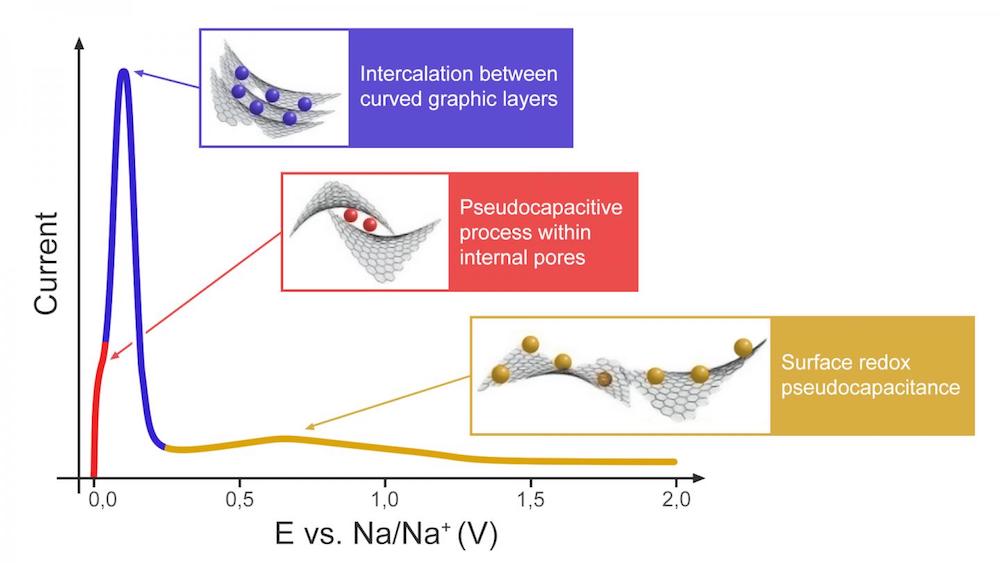
In developing sodium-ion batteries, hard carbon is the material most often used for the anode, but unknowns concerning the charge storage mechanism in this material hinder further development. Researchers have proposed several models to explain the charge storage mechanism, and a recent study lends support for the three-stage “adsorption-intercalation-adsorption” process.
Read MoreCeramic and glass business news of the week for July 27, 2020

Online technology platform to support UK energy transition, New York announces one of world’s largest procurements for renewable energy projects, and more ceramic and glass business news of the week for July 27, 2020.
Read MoreIdentify molecular ‘fingerprints’: Proposed graphene-based nanofocused sensor may improve molecular analysis

Mid-infrared spectroscopy is an important tool for nondestructive analysis of molecules, but it cannot analyze nanometric volumes very well. One way to improve nanometric analysis is through a technique called nanofocusing, and researchers in Spain and Russia proposed an improved nanofocusing technique using graphene.
Read MoreVideo: Vitrification of human tissue

Vitrification is the process through which a material turns into a glass or glasslike substance by undergoing rapid cooling. Though the discovery this year that a man’s brain vitrified during the Mount Vesuvius eruption surprised some people, vitrification of human tissue is actually a well-established practice in fertility treatment.
Read MoreOther materials stories that may be of interest
Changing the composition of brick, first manufactured noncuttable material, and other materials stories that may be of interest for July 22, 2020.
Read MoreHow effective is that mask? Depends on what materials it is made of

There is no shortage of options available when shopping for nonmedical face masks, yet most provide little information about their filter efficiency and breathability—important considerations for a mask that is both efficient and comfortable. But a recent study offers more complete data on the performance of an array of common materials.
Read MoreCeramic and glass business news of the week for July 20, 2020
Europe’s largest floating PV park gets local owners, sole U.S. rare earth miner goes public, and more ceramic and glass business news of the week for July 20, 2020.
Read More